Whether you want to build, regain, or maintain biceps strength, isometric biceps exercises can be a useful addition to your training routine.
Isometric exercises involve producing muscle tension while maintaining a relatively fixed joint position, rather than repeatedly moving the joint.
They can be a convenient, low-movement training option. People recovering from an injury can also use them with guidance from a qualified healthcare professional.
Below, you’ll find the best biceps isometric exercises, how to perform them, how long to hold each position, and how to incorporate them into your workout.
What are Isometric Biceps Exercises?
Any exercise where you contract your biceps without moving your elbow joint will be called an isometric biceps exercise.
During isometric exercises, your biceps produce force while you hold a position instead of lifting or lowering a weight.
Hold times can range from a few seconds to much longer durations depending on the exercise and goal.
Shorter, harder holds are generally more appropriate for strength, while longer holds can be useful for muscular endurance and lower-load training.
Biceps isometric holds help build and maintain biceps strength, improve strength at specific joint angles, and add variety to your arm workouts.
Some low-impact biceps static exercises (such as a self-resisted biceps curl hold) can also be used in a rehabilitation program (under a qualified healthcare professional’s guidance) because they can help you regain strength.
Isometric Bicep Exercises Overview
| Exercises | Primary Goal | Difficulty | Equipment | Best For |
|---|---|---|---|---|
| Dumbbell Isometric Curl | Strength & Muscle Gain | Easy | Dumbbells | Overall biceps training |
| Barbell Isometric Curl | Strength & Muscle Gain | Easy | Barbell | Heavy loading |
| Cable Isometric Curl | Strength & Muscle Gain | Easy | Cable Machine | Controlled resistance |
| Chin-up Hold | Strength | Medium | Pull-up Bar | Biceps & pulling strength |
| Supinated Inverted Row Hold | Strength | Medium | Low Bar/TRX | Beginners & bodyweight training |
| Resistance Band Iso Curl | Strength & Rehab | Easy | Resistance Band | Home & rehab |
| Self-Resisted Biceps Isometric Curl | Rehab & Beginner | Very Easy | None | Gentle training |
| Towel Bicep Curl Hold | Strength & Rehab | Very Easy | Towel | Home/no-equipment training |
| Fixed-Object Biceps Isometric | Strength & Rehab | Very Easy | Fixed object | Gentle training |
9 Best Isometric Exercises for Stronger Biceps
Let’s see how to perform each biceps isometric exercise step-by-step, what their benefits are, and who should use them.
1. Dumbbell Isometric Biceps Curl

The dumbbell isometric curl is a simple and effective exercise for increasing biceps strength and endurance.
You can perform dumbbell isometric curls during any variation, such as incline dumbbell curls, preacher curls, hammer curls, or concentration curls.
The dumbbell static curl helps increase muscular strength, grow muscle size, and improve muscle coordination.
Dumbbell biceps static curls involve the following steps:
- Grab one dumbbell in each hand with an underhand grip (palms-up).
- Stand upright or sit on the bench and keep your elbows close to your sides.
- Curl the dumbbells to a comfortable elbow angle, such as around 90°, depending on your goal and ability.
- Stop and hold for 5-20 seconds in this position without moving your elbows.
- Squeeze your biceps and keep your wrists straight.
- After the hold, lower the dumbbells with control.
You can also do a single-arm static curl to work on each arm individually and improve muscle imbalance.
Recommended sets and holds:
- 2-4 sets × 5 to 30-second holds
- Rest: 60 to 90 seconds
- For muscle gain: Try adding the hold after regular dumbbell curls or holding the final challenging position after your last repetition.
2. Isometric Barbell Biceps Curl
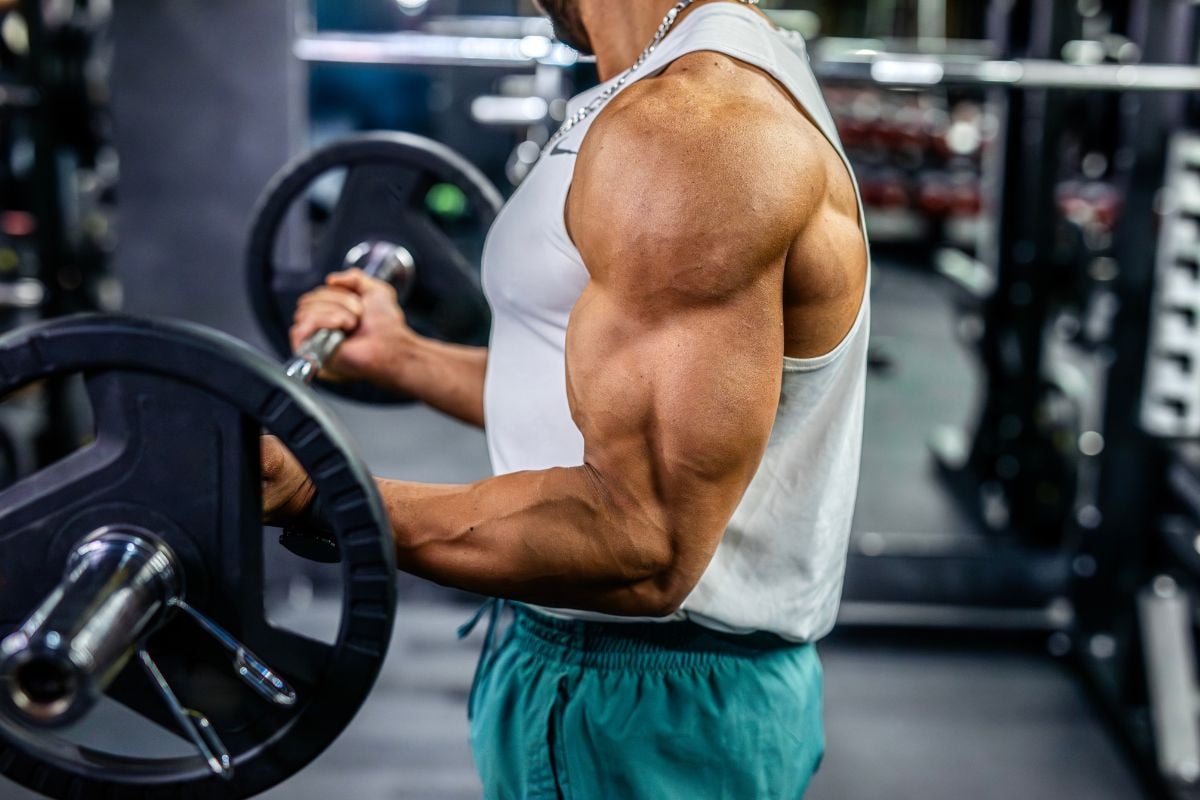
You can also try an isometric bicep hold with a barbell. The barbell allows you to handle a substantial load in a fixed position and progressively increase the load as your static strength improves.
You can perform static curls standing (using an EZ or straight bar) or on a preacher bench.
Steps to perform a barbell biceps static curl:
- Grab an empty or loaded barbell with an underhand grip, hands about shoulder-width apart.
- Stand upright with your chest up, back straight, and core tight.
- Curl the bar until your forearms are roughly parallel to the floor.
- Pause and hold the barbell in this position, keeping your upper arms still.
- Contract your biceps continuously while keeping your wrists firm.
- Lower the bar slowly after a 5- to 20-second hold.
If you are doing it for the first time, start lighter and increase the load gradually as you get comfortable maintaining the hold.
Recommended sets and holds:
- 3-4 sets × 5-20 seconds
- Rest: 90-120 seconds
3. Cable Biceps Static Curl
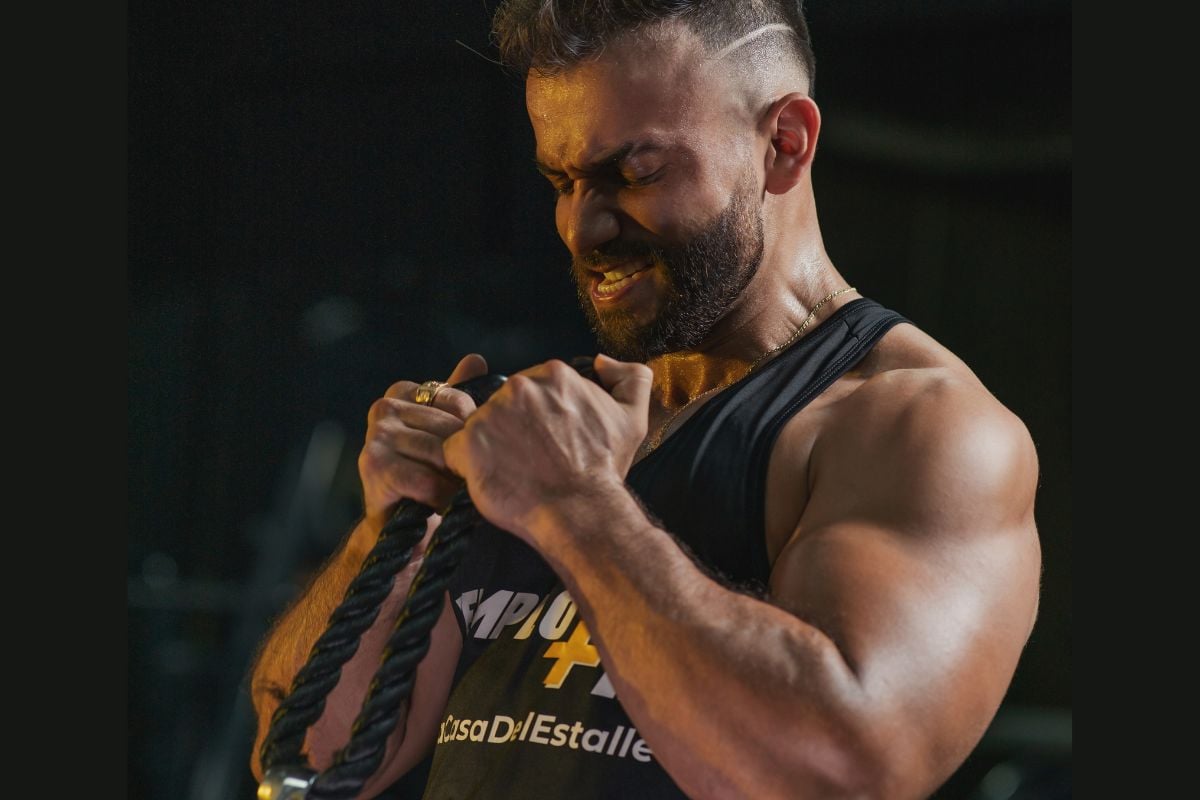
Doing isometric bicep curls on a cable machine is very efficient and convenient. It allows you to adjust the load, so you can train your biceps with different intensity. For example, you can use heavier, shorter holds for strength or lighter, longer holds for muscular endurance.
You can perform various isometric biceps exercises on a cable machine, such as hammer curl, standard curl, Bayesian curls, etc.
The cable isometric bicep curls involve the following steps:
- Attach a straight bar or single handle to a low cable.
- Stand upright with your elbows close to your sides.
- Curl the handle to about 90° elbow flexion.
- Keep your wrists straight and neutral.
- Hold the position while squeezing your biceps.
- Keep your body still and avoid shrugging or leaning backward.
Recommended Sets & Hold:
- 2-4 sets × 10-30 seconds hold
- Rest 60–90 seconds between sets
- Use a weight that makes the final few seconds challenging while allowing you to maintain good form.
4. Static Chin-up Hold

The chin-up hold is a bodyweight compound exercise that simultaneously strengthens the biceps, forearms, back, and abs.
It also improves your ability to control the top portion of a chin-up and take your pulling ability to the next level.
You can perform static chin-up using two grips: underhand and neutral. Both help make your arms stronger.
An isometric chin-up involves the following steps:
- Grab a pull-up bar with a shoulder-width, underhand grip.
- Pull yourself up until your chin is above the bar.
- Keep your chest close to the bar and elbows bent.
- Hold this position while keeping your body controlled.
- Squeeze your biceps and upper back throughout the hold.
If you can’t hold the top position for 10 seconds, use a resistance band or step to the top position and gradually build your hold time.
To make it more advanced, lift your legs in front of you, making an L shape.
Recommended sets and holds:
- 3-4 sets × 5-20 seconds
- Rest: 90-120 seconds
5. Supinated Inverted Row Hold
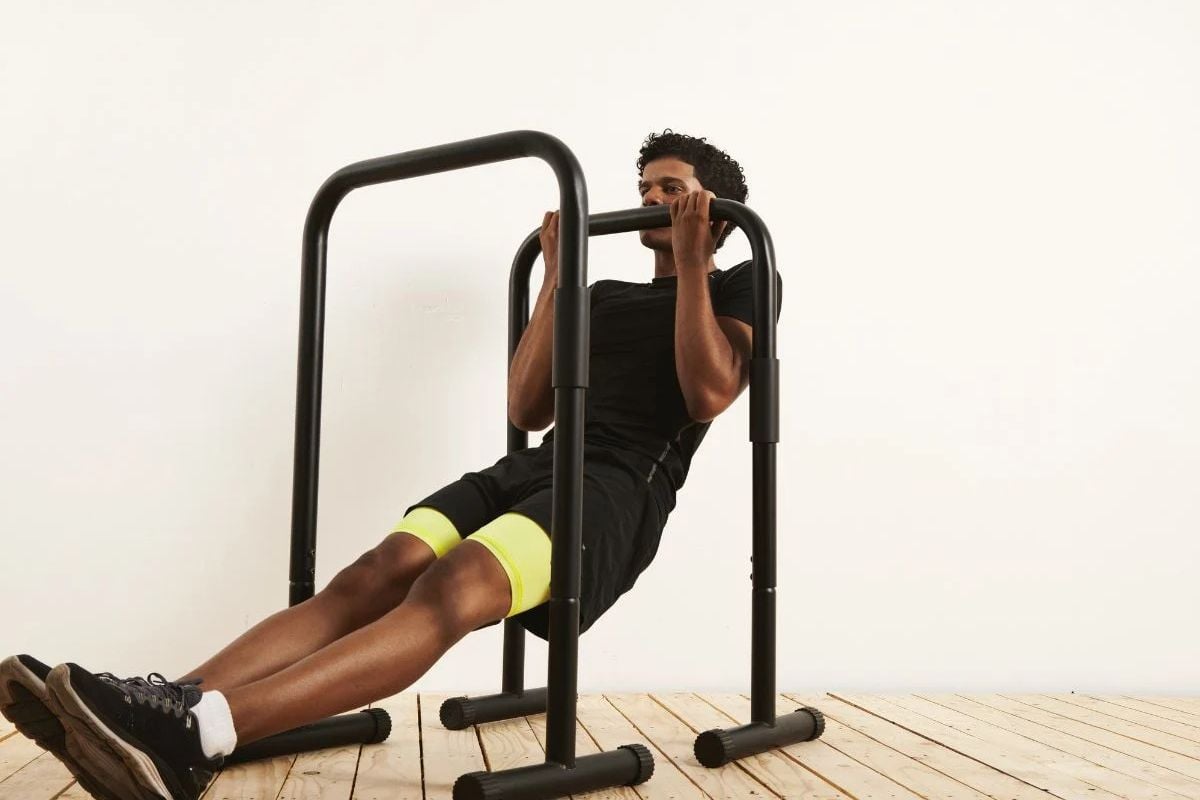
Supinated inverted row elbow flex hold is a compound isometric exercise. It engages multiple muscles simultaneously, such as the upper back, biceps, posterior deltoids, and abs.
It contracts your biceps when you pull your upper body toward the bar, with your elbows flexed at the top. It also strengthens your forearms and builds foundational strength for chin-up and pull-ups.
The supinated inverted row hold involves the following steps:
- Set a bar around waist height and grip it with your palms facing up.
- Walk your feet forward and lean back with your body straight.
- Pull your chest toward the bar.
- At the top, hold the position with your elbows bent and squeeze your biceps and upper back.
- Keep your abs tight, body straight, and avoid letting your hips sag.
Recommended sets and hold:
- 2-4 sets × 10-30-second holds
- Rest: 60-90 seconds between sets
6. Resistance Band Bicep Static Curl

Resistance bands are excellent for doing the static bicep exercises. They are easy to grip and allow you to adjust the tension level easily.
The resistance band isometric curl can replace dumbbell or barbell biceps static curls, especially if you train at home.
Steps to perform a banded biceps curl hold:
- Place your feet on the middle of the resistance band and stand straight.
- Grab the band in each hand with your palms up.
- Keep your elbows close to your sides and curl your hands until your biceps are contracted.
- Stop and hold this position for 10 to 30 seconds without moving your elbows.
- After completing the hold, lower your hands and rest before doing the second set.
To make the hold harder, use a stronger band or stand farther apart to increase tension.
Recommended sets and hold:
- 2-4 sets × 10-30-second holds
- Rest: 60-90 seconds between sets
7. Self-Resisted Biceps Isometric Curl
The self-resisted biceps curl (also known as palms up & down curls) is a no-equipment isometric exercise. It involves curling with one arm and controlling the resistance with your opposite hand.
The self-resisted biceps curl is mostly used for rehabilitation purposes when needed because it helps improve mobility and rebuild strength in your biceps and forearms.
Step-by-step guide:
- Sit on the chair and bend your right elbow to 90 degrees.
- Close the palm of your right hand and place your left hand on it.
- Try to curl the right hand toward your shoulder while using your other hand to resist the movement.
- Keep the working elbow stationary and don’t allow the arm to move.
- Gradually increase the resistance while maintaining a strong biceps contraction.
- Hold for the desired time, then relax and repeat with the other arm.
Recommended sets and hold:
- For rehabilitation: Suggested by your doctor
- For general purpose: 2–3 sets of 10-30 seconds per arm with 20-30 seconds between sets.
8. Isometric Bicep Hold with Towel
Sometimes, only a towel can be good workout equipment. You can do plenty of workouts using a towel, including the biceps isometric hold.
The towel provides good resistance and allows you to put the needed stress on your two-headed arm muscles.
The towel isometric biceps curl can also be a part of a rehabilitation program, but the appropriate loading and hold time should be determined by your doctor.
Instructions to perform it:
- Sit or stand with the towel looped securely around one or both feet.
- Hold the opposite ends of the towel and attempt to curl your hands toward your shoulders while using your feet to provide resistance.
- Make sure you feel the contraction in your biceps during the hold.
You can also perform this movement unilaterally, using one arm at a time. It allows you to work more on your underdeveloped arm and correct strength imbalance.
Recommended sets and hold:
- For dual-arm: 4-5 sets, hold for 10 to 30 seconds
- For single-arm: 3-4 sets, hold for 10 to 30 seconds per arm
- Rest: 30-60 seconds between sets
9. Fixed-Object Biceps Isometric
The fixed-object isometric biceps curl is a bodyweight exercise that requires no special equipment.
You can do it using a sturdy desk, table, or another immovable, stable surface (sturdy enough to withstand the force you apply).
It can also be used at the starting stages of rehabilitation when appropriately prescribed.
Steps to perform a biceps static curl using a fixed object:
- Stand or sit next to a sturdy, immovable object.
- Bend your elbow to about 90° and position your hand under or against the object.
- Try to curl your hand upward against the object without actually moving it.
- Contract your biceps as hard as appropriate while keeping your elbow in position.
- Hold the contraction, then relax slowly.
Recommended sets and holds:
- For strength: 3-5 sets × 5-15 seconds
- For rehabilitation: 2-3 sets × 10-30 seconds, using an intensity appropriate for your condition
- Rest: 60–90 seconds
Benefits of Biceps Static Hold Exercises
1. Build Strength & Support Muscle Growth
Isometric training can contribute to muscle growth, and research suggests that the muscle length at which isometric contractions are performed can influence the adaptations you get.
For example, some research has shown that isometric training at longer muscle lengths may be particularly effective for muscle growth.1 Oranchuk, Dustin & Nelson, Andre & Storey, Adam & Cronin, John. (2019). Scientific Basis for Eccentric Quasi-Isometric Resistance Training: A Narrative Review. The Journal of Strength and Conditioning Research. 33. 2846-2859. 10.1519/JSC.0000000000003291, 2Oranchuk DJ, Storey AG, Nelson AR, Cronin JB. Isometric training and long-term adaptations: Effects of muscle length, intensity, and intent: A systematic review. Scand J Med Sci Sports. 2019 Apr;29(4):484-503. doi: 10.1111/sms.13375. Epub 2019 Jan 13. PMID: 30580468.
However, simply holding your arms in a stretched position does not guarantee greater biceps growth. The overall training intensity, effort, joint angle, and volume also matter.
More importantly, combining static biceps exercises with regular biceps curls can help you gain more mass than isometric training alone.3 Zou, Z., Morimoto, N., Nakatani, M., Morinaga, H., & Takai, Y. (2023). Effects of Different Isometric Training Programs on Muscle Size and Function in the Elbow Flexors. International journal of environmental research and public health, 20(5), 3837. https://doi.org/10.3390/ijerph20053837
2. Train Biceps at Specific Joint Angles
Static holds allow you to train your biceps while keeping your elbow at a fixed angle. This can help improve strength at that particular position and may be useful when you want to target a specific part of your range of motion.4 Coratella, G., Tornatore, G., Longo, S., Toninelli, N., Padovan, R., Esposito, F., & Cè, E. (2023). Biceps Brachii and Brachioradialis Excitation in Biceps Curl Exercise: Different Handgrips, Different Synergy. Sports (Basel, Switzerland), 11(3), 64. https://doi.org/10.3390/sports11030064
3. Can Be Included in Some Rehabilitation Programs
Isometric exercises can sometimes be incorporated into rehabilitation programs because they allow muscles to be trained without repeated joint movement.
However, the appropriate exercise, joint position, intensity, and duration should be determined according to the individual’s condition and rehabilitation goals.
Isometric vs. Regular Biceps Curls
Let’s see how isometric biceps curls are different from regular biceps curls through this simple comparison.
| Points | Isometric Curls | Regular Curls |
|---|---|---|
| Joint movement | None | Full range of motion |
| Strength | More angle-specific | Broader range of motion |
| Progressive overload | More difficult | Easier |
| Convenience | Excellent | Good |
| Muscle growth | Can contribute | Strong foundation |
| Best use | Supplement | Primary biceps training |
Can Isometric Holds Build Muscle?
Yes. Isometric exercises can help you build muscle when you do them with a heavier load and hold for a longer duration (that must feel challenging).5 Lum D, Barbosa TM. Brief Review: Effects of Isometric Strength Training on Strength and Dynamic Performance. Int J Sports Med. 2019 May;40(6):363-375. doi: 10.1055/a-0863-4539. Epub 2019 Apr 3. PMID: 30943568.
Although isometric training can build muscle, dynamic resistance exercises generally provide a more complete stimulus because they train the muscle through a range of motion with eccentric and concentric movements.6 Schoenfeld BJ, Ogborn DI, Vigotsky AD, Franchi MV, Krieger JW. Hypertrophic Effects of Concentric vs. Eccentric Muscle Actions: A Systematic Review and Meta-analysis. J Strength Cond Res. 2017 Sep;31(9):2599-2608. doi: 10.1519/JSC.0000000000001983. PMID: 28486337
That’s why it’s better to perform isometric biceps exercises alongside regular curls rather than as a complete replacement for dynamic resistance training.
For getting better results:
- Holds must be challenging.
- Progressively increase resistance, hold duration, or sets.
- Consider training more than one elbow angle.
- Combine isometric holds with regular biceps curls for more complete training.
How Often Should You Do Biceps Isometric Exercises?
The frequency of isometric training depends on your fitness goals. For example:
For rehabilitation, use the frequency your healthcare professional recommends.
For strength or muscle growth, 2-3 sessions per week can work well when isometric holds are appropriately balanced with your other biceps training.
If you’re already doing several sets of curls each week, you may need less direct isometric work.
How to Progress Isometric Biceps Exercises?
Progressive overload is important for getting stronger and building muscle with isometric exercises.
Instead of simply holding the same position for longer and longer, gradually make the exercise more challenging.
You can progress your isometric static holds by:
- Increase resistance: Use a heavier dumbbell, barbell, cable weight, or stronger resistance band.
- Increase hold time: Once you can comfortably complete your target hold, gradually add a few seconds.
- Add more sets: Increase your training volume when you’re consistently handling your current workload.
- Increase effort: For strength-focused training, gradually work toward harder, higher-effort holds while maintaining good form.
- Change the joint angle: Train the biceps at different elbow positions to develop strength across a broader range.
- Use a harder variation: For example, progress from an Australian row hold to a more challenging chin-up hold.
References
- 1Oranchuk, Dustin & Nelson, Andre & Storey, Adam & Cronin, John. (2019). Scientific Basis for Eccentric Quasi-Isometric Resistance Training: A Narrative Review. The Journal of Strength and Conditioning Research. 33. 2846-2859. 10.1519/JSC.0000000000003291 ↩︎
- 2Oranchuk DJ, Storey AG, Nelson AR, Cronin JB. Isometric training and long-term adaptations: Effects of muscle length, intensity, and intent: A systematic review. Scand J Med Sci Sports. 2019 Apr;29(4):484-503. doi: 10.1111/sms.13375. Epub 2019 Jan 13. PMID: 30580468. ↩︎
- 3Zou, Z., Morimoto, N., Nakatani, M., Morinaga, H., & Takai, Y. (2023). Effects of Different Isometric Training Programs on Muscle Size and Function in the Elbow Flexors. International journal of environmental research and public health, 20(5), 3837. https://doi.org/10.3390/ijerph20053837 ↩︎
- 4Coratella, G., Tornatore, G., Longo, S., Toninelli, N., Padovan, R., Esposito, F., & Cè, E. (2023). Biceps Brachii and Brachioradialis Excitation in Biceps Curl Exercise: Different Handgrips, Different Synergy. Sports (Basel, Switzerland), 11(3), 64. https://doi.org/10.3390/sports11030064 ↩︎
- 5Lum D, Barbosa TM. Brief Review: Effects of Isometric Strength Training on Strength and Dynamic Performance. Int J Sports Med. 2019 May;40(6):363-375. doi: 10.1055/a-0863-4539. Epub 2019 Apr 3. PMID: 30943568. ↩︎
- 6Schoenfeld BJ, Ogborn DI, Vigotsky AD, Franchi MV, Krieger JW. Hypertrophic Effects of Concentric vs. Eccentric Muscle Actions: A Systematic Review and Meta-analysis. J Strength Cond Res. 2017 Sep;31(9):2599-2608. doi: 10.1519/JSC.0000000000001983. PMID: 28486337 ↩︎