In a series of dumbbell workouts, I’m going to include the best exercises for a small but important muscle of the upper body, the trapezius.
The traps are divided into three parts (upper, middle, and lower traps) that start at the base of your neck, go across your shoulders, and extend to the middle of your back.1 What is the trapezius muscle? – my.clevelandclinic.org
They help move your head, neck, arms, shoulders, and torso. They also stabilize your spine and help with posture.
Strengthening the traps helps keep your neck and shoulders strong, improves posture, reduces neck pain, and supports heavy lifts like rows and deadlifts.2 Park SH, Lee MM. Effects of Lower Trapezius Strengthening Exercises on Pain, Dysfunction, Posture Alignment, Muscle Thickness and Contraction Rate in Patients with Neck Pain; Randomized Controlled Trial. Med Sci Monit. 2020 Mar 23;26:e920208. doi: 10.12659/MSM.920208. PMID: 32202262; PMCID: PMC7115121.
Strong traps also protect your shoulders from injury and enhance your upper body appearance.
You can strengthen your traps using multiple pieces of equipment, including barbells, machines, and resistance bands. But this article focuses on dumbbell exercises only.
Here’s a list of the best dumbbell trap exercises you’ll see here:
- Incline Dumbbell IYT Raises
- Dumbbell Reverse Fly
- Bent-Over Dumbbell Row
- Dumbbell Facepull
- Dumbbell One-arm Row
- Dumbbell Seal Row
- Dumbbell Shrugs
- Dumbbell Upright Row
- Dumbbell Prone Row
- Overhead Shrug
Some of these exercises are similar to each other, such as seal row and face pull. So, include them in your training plan strategically.
For example, you can do shrugs and upright rows on day 1, IYT raises and reverse fly on day 2, and prone row and prone horizontal extension on day three.
You can use these trap exercises at home as well as in the gym. These exercises are suitable for every fitness level, unless you have any injuries.
Related: Free 12-Week Dumbbell Workout Plan PDF
10 Best Dumbbell Trapezius Exercises to Sculpt Your Traps
1. Incline Dumbbell IYT Raises
The IYT raise is a compound movement that strengthens upper body muscles, particularly the back and shoulders.
It highly activates the middle and lower traps and helps build a strong and sculpted back.3ACE RESEARCH: What Is the Best Back Exercise? by Holly Edelburg, B.S., John P. Porcari, Ph.D., Clayton Camic, Ph.D., Attila Kovacs, Ph.D., and Carl Foster, Ph.D., with Daniel J. Green
It involves three different movements: front raise, lateral raise, and reverse fly.
Let’s explore how to perform IYT raises:
Set the bench at a 30-degree incline height and lie prone, holding one dumbbell in each hand with a neutral grip. Keep your arms straight down with your palms facing each other. That’s the starting position. Now, let’s do each movement in the following ways:
- I raise: Raise the dumbbells in front of you until your arms are parallel to the floor. Pause and lower the dumbbells to the start.
- Y raise: Raise the dumbbells slightly out, so your arms make a 45-degree angle until you feel the work in your trap muscles. Pause and lower the weight in the beginning.
- T raise: Raise your arms out to your sides until they are horizontal to the floor. Squeeze your trapezius at the top and then return the dumbbells to the start. That’s one rep.
Perform three sets of 6 to 8 reps at the start of your training session.
Explore different variations of I-Y-T raises.
2. Dumbbell Reverse Fly

The reverse dumbbell fly strengthens the rear delt and upper traps simultaneously, and improves balance, coordination, and posture. You can do it in a seated or bent-over position without a bench.
Follow the steps to perform the rear dumbbell fly:
- Hold one dumbbell in each hand, sit on the edge of a bench, and bend forward until your chest is parallel to the floor. Brace your core, maintain a neutral spine position, and keep your arms straight down the floor. That is your starting position.
- Raise your arms out until your upper trap and posterior delt are fully engaged. Pause and return to the start.
Perform three sets of 8 to 12 reps with one to two minutes of rest between sets.
3. Bent-Over Dumbbell Row
The bent-over dumbbell row is an excellent upper-body exercise and a good alternative to the barbell row. It hits the entire back muscles, including upper, middle, and lower traps.4 Comparison of different rowing exercises: trunk muscle activation and lumbar spine motion, load, and stiffness – Journal of Strength and Conditioning Research.
The bent-over involves the following steps:
- Hold one dumbbell in each hand and stand upright with your feet hip-width apart.
- Brace your core and slightly lean your torso forward.
- Keep your arms straight with your palms facing your body. That’s the start.
- Pull your elbows to your sides until your back muscles are fully engaged.
- Extend your arms to the start and repeat for the desired number of times.
Do three to four sets of 8 to 12 reps each.
Start with light dumbbells and maintain proper form during the movement.
4. Dumbbell Face Pull
The dumbbell face pull is not as effective as the cable face pull, but it helps develop trap muscles. It also strengthens the posterior deltoid and biceps and improves upper body appearance.5 Yoo WG. Effects of pulling direction on upper trapezius and rhomboid muscle activity. J Phys Ther Sci. 2017 Jun;29(6):1043-1044. doi: 10.1589/jpts.29.1043. Epub 2017 Jun 7. PMID: 28626320; PMCID: PMC5468195.
Steps to perform face pulls with dumbbells:
- Grab one dumbbell in each hand and stand upright with your feet hip-width apart.
- Hinge forward at your hips until your torso is parallel to the floor.
- Keep your arms straight down with your palms facing in. That’s the start.
- Pull the weight toward your face until your elbows are aligned with your delts.
- Pause for a second and return to the start.
Shoot for three sets of 8-10 reps with one to two minutes of rest between sets.
5. Dumbbell One-arm Row

The single-arm row is a unilateral exercise, involving rowing the weight on one side at a time. It decently stretches the latissimus dorsi and trapezius muscles and helps build a strong and wider back.
If you feel one side of your back is more developed than the other, use this exercise to fix the muscle imbalance and enhance definition.
Steps to perform one-arm dumbbell row:
- Grab a dumbbell in your right hand and place your left knee and hand on the bench.
- Tighten your abs, keep your back straight, and your arm straight and down.
- Drive your elbows at your side as you pull the dumbbell up.
- Pause at the top, hold for a moment to feel the contraction, then return to the start.
Aim for three sets of eight to ten reps.
6. Dumbbell Seal Row
The seal row is unpopular but an excellent exercise for building stronger traps. It works on the upper and middle traps and helps strengthen the back muscles without putting stress on the lower back.
So, if you feel back pain while doing standing rows, the seal row can be a great alternative to other rowing exercises.
How to perform seal row with dumbbells:
- Place the foot of the bench on elevated objects and lie on it.
- Grab one dumbbell in each hand with your arms straight toward the floor and your palms facing each other.
- Drag your elbows at your sides until your hands reach your chest level.
- Pause for a second at the top, feel the moment, then return to the start.
Aim for three sets of eight to 10 reps.
7. Dumbbell Shrugs
The dumbbell shrug is an excellent exercise to build your upper trap and shoulder muscles. Studies have demonstrated that upward rotation shrugs enhance the upper and lower trapezius and improve shoulder abnormalities.6 Jia X, Ji JH, Petersen SA, Keefer J, McFarland EG. Clinical evaluation of the shoulder shrug sign. Clin Orthop Relat Res. 2008;466(11):2813-2819. doi:10.1007/s11999-008-0331-3, 7Modifying a shrug exercise can facilitate the upward rotator muscles of the scapula – National Institute of Health Database.
So, you can perform standard as well as modified upward rotational shrugs interchangeably to develop your trap muscles.
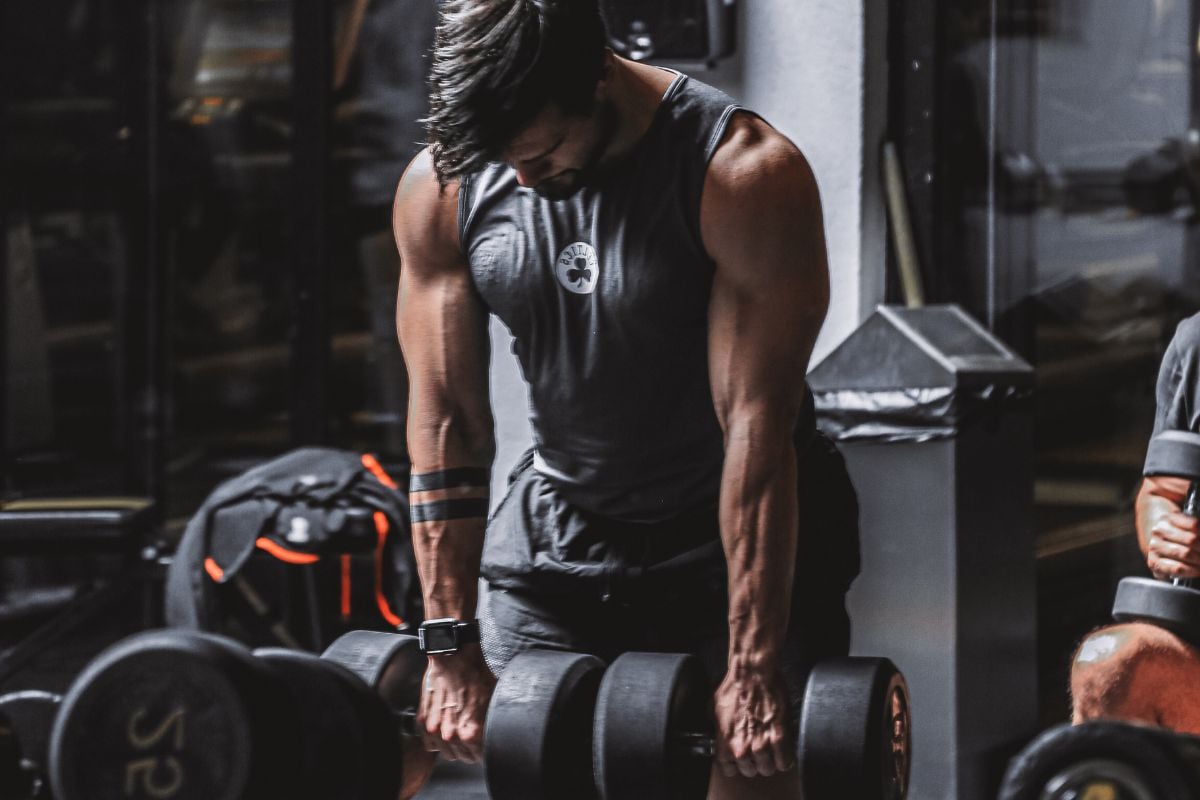
Standard Shrug: Holding a pair of dumbbells, stand upright with your feet hip-width apart. Keep your arms straight at your sides with your palms facing in. Now, pull your shoulder blades toward your ears as high as possible. Pause and then relax your shoulder. That’s one rep.
Upward Rotation Shrug: To perform the modified shrug, extend your arms slightly out until they form a 30-degree angle. Raise your shoulder blades as high as possible; you’ll feel the contraction in your traps. Squeeze your trapezius muscles, pause for a moment, and then return to the start.
Suggested Reps: Do three sets of 10 to 12 reps each.
8. Dumbbell Upright Row
The dumbbell upright row is a free-weight exercise, involving pulling your elbows out to the sides. It strengthens the deltoids, upper traps, and rhomboids simultaneously and improves posture and appearance.8 Effect of grip width on electromyographic activity during the upright row – Journal of Strength and Conditioning Research
How to perform the wide grip upright row with dumbbells:
- Grab one dumbbell in each hand with an overhand grip and stand upright.
- Keep your arms straight at your sides with your palms facing in.
- Pull the dumbbells up until your elbows are in line with your shoulders.
- Pause for one second at the top, then slowly return to the start. That’s one rep.
Do three sets of 10 to 12 reps each.
9. Dumbbell Prone Row
The prone row is a great rowing exercise for strengthening the lower trapezius muscle. It involves lying on the bench with your face down, which eliminates the stress on the lower back and engages only the upper and middle back.9 Arlotta M, Lovasco G, McLean L. Selective recruitment of the lower fibers of the trapezius muscle. J Electromyogr Kinesiol. 2011 Jun;21(3):403-10. doi: 10.1016/j.jelekin.2010.11.006. Epub 2010 Dec 8. PMID: 21144767.
Steps to perform the prone row with dumbbells:
- Set the bench to 30-45 degrees (inclined).
- Grab one dumbbell in each hand and lie prone with your chest resting on the edge.
- Keep your arms straight with your palms facing each other.
- Drive your elbows toward your waist until your back is fully engaged.
- Hold for a second at the top, then return to the start.
Perform 3 sets of 10-15 reps with moderate weight.
10. Overhead Shrug
The overhead shrug, also known as the trap shrug, is an upper body strength and conditioning exercise.
It involves keeping the arms straight upward with your wrists above the shoulders. Shrugging from this position requires the upper traps to drive elevation while maintaining scapular upward rotation. This highly activates the traps, mainly the upper part, because the traps must work harder to lift the shoulders against gravity in a stretched, overhead position.10 Camargo PR, Neumann DA. Kinesiologic considerations for targeting activation of scapulothoracic muscles – part 2: trapezius. Braz J Phys Ther. 2019 Nov-Dec;23(6):467-475. doi: 10.1016/j.bjpt.2019.01.011. Epub 2019 Feb 3. PMID: 30797676; PMCID: PMC6849087.
Performing the standard shrug with overhead helps you achieve defined traps and improves your overhead pressing.
Steps to perform overhead dumbbell shrug:
- Grab one dumbbell in each hand and stand straight.
- Keep your arms fully extended overhead and lock your elbows.
- Tighten your abs and maintain a neutral head position.
- Shrug your shoulders down. You’ll feel the contraction in your traps.
- Slowly return to the starting position.
Complete 3 sets of 12-15 reps
Takeaway Message
Strengthening trapezius muscles helps improve posture and shoulder mobility and reduces the risk of spinal and shoulder injuries. Despite all this, many people often forget to train these muscles specifically.
However, if you’re one of those who want to forge and sculpt your traps can do the above trap exercises with dumbbells. The dumbbells are an excellent piece of workout equipment that provides a full range of motion and allows you to perform various exercises at home and in the gym.
You don’t need to perform each dumbbell trap workout on the same day. Instead, you can incorporate them on different days of your training. For example, reverse fly and upright row on day 1, IYT raise and shrug on day 2, and overhead shrug and prone row on day three.
If you want to explore dumbbell exercises for other muscle groups, explore this section.
I’ve also designed a simple, easy-to-follow, and effective 72-day dumbbell workout plan for all fitness enthusiasts. You can give it a try.
References
- 1What is the trapezius muscle? – my.clevelandclinic.org ↩︎
- 2Park SH, Lee MM. Effects of Lower Trapezius Strengthening Exercises on Pain, Dysfunction, Posture Alignment, Muscle Thickness and Contraction Rate in Patients with Neck Pain; Randomized Controlled Trial. Med Sci Monit. 2020 Mar 23;26:e920208. doi: 10.12659/MSM.920208. PMID: 32202262; PMCID: PMC7115121. ↩︎
- 3ACE RESEARCH: What Is the Best Back Exercise? by Holly Edelburg, B.S., John P. Porcari, Ph.D., Clayton Camic, Ph.D., Attila Kovacs, Ph.D., and Carl Foster, Ph.D., with Daniel J. Green ↩︎
- 4Comparison of different rowing exercises: trunk muscle activation and lumbar spine motion, load, and stiffness – Journal of Strength and Conditioning Research. ↩︎
- 5Yoo WG. Effects of pulling direction on upper trapezius and rhomboid muscle activity. J Phys Ther Sci. 2017 Jun;29(6):1043-1044. doi: 10.1589/jpts.29.1043. Epub 2017 Jun 7. PMID: 28626320; PMCID: PMC5468195. ↩︎
- 6Jia X, Ji JH, Petersen SA, Keefer J, McFarland EG. Clinical evaluation of the shoulder shrug sign. Clin Orthop Relat Res. 2008;466(11):2813-2819. doi:10.1007/s11999-008-0331-3 ↩︎
- 7Modifying a shrug exercise can facilitate the upward rotator muscles of the scapula – National Institute of Health Database. ↩︎
- 8Effect of grip width on electromyographic activity during the upright row – Journal of Strength and Conditioning Research ↩︎
- 9Arlotta M, Lovasco G, McLean L. Selective recruitment of the lower fibers of the trapezius muscle. J Electromyogr Kinesiol. 2011 Jun;21(3):403-10. doi: 10.1016/j.jelekin.2010.11.006. Epub 2010 Dec 8. PMID: 21144767. ↩︎
- 10Camargo PR, Neumann DA. Kinesiologic considerations for targeting activation of scapulothoracic muscles – part 2: trapezius. Braz J Phys Ther. 2019 Nov-Dec;23(6):467-475. doi: 10.1016/j.bjpt.2019.01.011. Epub 2019 Feb 3. PMID: 30797676; PMCID: PMC6849087. ↩︎