

I’ve got the best bodyweight exercises for people who want to strengthen their hamstrings at home without weights.
This blog includes exercises that actually work and are backed by research, so you can develop your rear thigh and enhance your lower body health.
The hamstrings are a group of three muscles: biceps femoris, semitendinosus, and semimembranosus. These muscles run down the back of the thigh, from the hips to the knees.
They work with other lower-body muscles to perform various activities, from running and sprinting to jumping and deadlifting.
Strong hamstrings are crucial for athletes and sports professionals because they help run faster, jump higher, and lift heavier while reducing the chances of injuries.
Let’s explore how to strengthen your rear thighs without a leg curl machine, dumbbells, or barbells.
8 Muscle-Strengthening Bodyweight Hamstring Exercises
- Slide Leg Curl
- Nordic Hamstring Curl
- Standing Hamstring Leg Curl
- Hamstring Bridges
- Bent Knee GHD Hip Extensions
- Single-leg Deadlift
- Reverse Hyperextension
- Single-Leg Glute Bridge to Knee Kick
I’ve picked these exercises from this research article published in the Open Access Journal of Sports Medicine.1 Tsaklis P, Malliaropoulos N, Mendiguchia J, Korakakis V, Tsapralis K, Pyne D, Malliaras P. Muscle and intensity based hamstring exercise classification in elite female track and field athletes: implications for exercise selection during rehabilitation. Open Access J Sports Med. 2015 Jun 26;6:209-17. doi: 10.2147/OAJSM.S79189. PMID: 26170726; PMCID: PMC4492645.

Let’s see how to perform each exercise with the step-by-step guide.
1. Single-Leg Slide Curl
The single-leg sliding curl is a closed-chain exercise (because your foot stays in contact with the floor throughout the movement).
It is also a unilateral movement, meaning it involves driving through one heel (or one foot at a time) while maintaining a hip bridge. The unilateral exercises help improve muscle imbalance and symmetry.2Taberner, Matt CSCS; O’keefe, Jason BSc; Cohen, Daniel D. PhD, CSCS. The Sliding Leg Curl. Strength and Conditioning Journal 38(3):p 117-121, June 2016. | DOI: 10.1519/SSC.0000000000000214
It targets the muscles in a lengthened position, creating decent contraction and stretch in the hamstrings, effectively stimulating the biceps femoris and semitendinosus.3Otani R, Nishikawa H, Matsunaga S, Hiroshige Y, Nakamura M. The Effect of Single Leg Romanian Deadlift on the Risk of Hamstring Strain Injuries in Track and Field Athletes: A Cohort Study. Int J Sports Phys Ther. 2025 May 2;20(5):657-665. doi: 10.26603/001c.136803. PMID: 40322523; PMCID: PMC12048357.
It also works on the lower back and glutes, making the posterior chain strong and flexible.
The sliding leg curl involves the following steps:
- Start by lying on the floor on your back with your arms at your sides, knees bent, and heels on the slider (that can easily slide over the floor).
- While keeping your right heel on the mat, lift your left leg and your pelvis off the floor until your knee, shoulder, and hip come in a straight line.
- Now, curl your working leg toward you in a slow and controlled fashion.
- Squeezing the hamstring of your left leg, slide forward in a slow and controlled manner until it is straight, and then reverse the move to complete one rep.
For sliding, you can use anything that can slide on the floor, such as a towel or a piece of a rug.
2. Nordic Hamstring Curl
The Nordic curl is a bodyweight exercise that involves kneeling on a soft mat and lowering your upper body toward the floor until your hamstrings are fully engaged.
It helps develop strong, functional hamstrings, enhances athletic performance, and reduces the risk of hamstring injuries.4van Dyk N, Behan FP, Whiteley R. Including the Nordic hamstring exercise in injury prevention programs halves the rate of hamstring injuries: a systematic review and meta-analysis of 8459 athletes. Br J Sports Med. 2019;53(21):1362-1370. doi:10.1136/bjsports-2018-100045, 5Adıgüzel, N.S.; Koç, M.; Öztürk, B.; Engin, H.; Karaçam, A.; Canlı, U.; Orhan, B.E.; Aldhahi, M.I. The Effect of the Nordic Hamstring Curl Training Program on Athletic Performance in Young Football Players. Appl. Sci. 2024, 14, 10249. https://doi.org/10.3390/app142210249, 6Islam, Muhammad & Rahman, Md & Wase, Dessalegn & Kiflu, Alemmebrat & Pramanik, Tarak Nath. (2024). Nordic Hamstring Curls are a Remedy for Hamstring Muscle Injury: A Narrative Review. International Journal of Human Movement and Sports Sciences. 12. 692-698. 10.13189/saj.2024.120411.
It also builds the ability to control the muscle while it stretches, something machine leg curls or Romanian deadlifts do less effectively.
Step-by-step guide:
- Begin by kneeling on the mat, your torso upright and forward, and ask your partner to hold your ankles.
- Keeping your hips extended, slowly lower your body forward (and toward the ground) as far as possible or until you can no longer go down.
- Put your hands out in front of you on the floor when you can’t go down further, pause for a couple of seconds, and then push yourself back to the start. That’s your one rep.
- Maintain a neutral spine during the entire movement.
If you don’t have a partner, no problem. You can still manage to do this by securing your ankles under a firm object. For example, hook your legs under a bench or loaded barbell.
You may find it difficult to perform Nordic curls at first, but remember, if you do only 50 percent of this exercise, you’ll still feel the good contraction in your hamstrings.
Doing the Nordic hamstring curls frequently (such as 2-3 sets of 8-12 repetitions, 2-3 times per week) also improves the shape of the rear thighs.7Cholp J and Zemková E (2025) Effect of high vs. low volume of the Nordic hamstring curl on hamstring muscle architecture and eccentric strength in soccer players: a systematic review and meta-analysis. Front. Physiol. 16:1631205. doi: 10.3389/fphys.2025.1631205
3. Standing Leg Curl
The standing leg curl is a simple yet effective exercise to help maintain strength in hamstring muscles.
It also improves balance as it involves standing on one foot and performing a leg curl with the other.
The standing leg curl is a less-intense exercise and particularly helpful for those who are recovering from a hamstring injury.
Steps to perform a standing leg curl:
- Stand upright in the hip-width stance with your hands on your hips.
- Slightly bend your right knee and bring your left foot heel toward your buttock as close as possible.
- Make sure you squeeze your hamstring muscle when you fully curl and hold for a second or two, and then lower your leg to the start. That’s one rep.
- Continue until you do 12 to 15 reps, and then switch to the other leg.
There’s another way you can train your hamstrings in the standing position. To do that, stand upright, lift one leg off the floor, bend the knee, and extend the leg until it is straight against the body. This exercise is also known as the standing kick.8 van den Tillaar R, Solheim JAB, Bencke J. COMPARISON OF HAMSTRING MUSCLE ACTIVATION DURING HIGH-SPEED RUNNING AND VARIOUS HAMSTRING STRENGTHENING EXERCISES. Int J Sports Phys Ther. 2017 Oct;12(5):718-727. PMID: 29181249; PMCID: PMC5685404
4. Single-Leg Hamstring Bridges
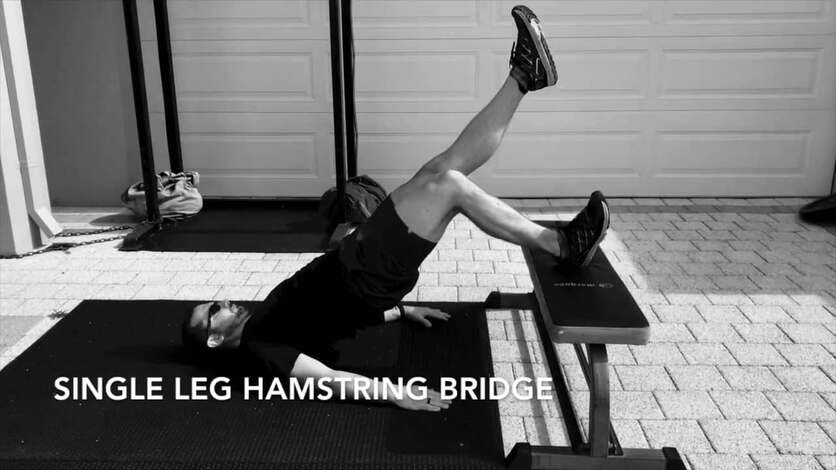
The single-leg hamstring bridge is an easy and effective way to strengthen the back of the thigh and glutes.9 Hirose, Norikazu1; Tsuruike, Masaaki2. Differences in the Electromyographic Activity of the Hamstring, Gluteus Maximus, and Erector Spinae Muscles in a Variety of Kinetic Changes. Journal of Strength and Conditioning Research 32(12):p 3357-3363, December 2018. | DOI: 10.1519/JSC.0000000000002747, 10A practical assessment of hamstring muscle endurance and fatigue using the maximum-speed single-leg bridge test – BMC Sports Science, Medicine and Rehabilitation
It can be an excellent exercise if you feel one side of the hamstring is less strong than the other, as it trains one leg at a time and helps fix a strength imbalance.
Steps to perform a single-leg hamstring bridge:
- Lie flat on your back and place your feet on an elevated object.
- Keep your right foot on the bench with your knee softly bent.
- Straighten the other leg and brace your midsection.
- Lift your hips until your knee, hip, and shoulder form a straight line.
- At the top, hold for a couple of seconds and then return to the start.
Keep your working foot slightly farther from your glutes, unlike a 90-degree bend, so your hamstrings can actively engage.
5. Bent Knee GHD Hip Extensions
The hip extension exercises are excellent for strengthening posterior chain muscles, including the hamstrings.
A study has shown that a 45-degree hip extension exercise activates the biceps femoris and can be useful as part of a hamstring injury prevention program.11Whyte EF, Heneghan B, Feely K, Moran KA, O’Connor S. The Effect of Hip Extension and Nordic Curl Exercise Protocols on Hamstring Strength: A Randomized Controlled Trial. J Strength Cond Res. 2021 Oct 1;35(10):2682-2689. doi: 10.1519/JSC.0000000000003220. PMID: 31356512, 12Keerasomboon T, Mineta S, Hirose N. Influence of Altered Knee Angle and Muscular Contraction Type on Electromyographic Activity of Hamstring Muscles during 45° Hip Extension Exercise. J Sports Sci Med. 2020 Nov 19;19(4):630-636. PMID: 33239935; PMCID: PMC7675620
Combining this one and other exercises will help you build healthy and functional hamstrings over time.
This exercise doesn’t require weight, but it requires a flexible bench or a hip-extension machine. If you don’t have either, you can leave it and do other exercises.
Steps to perform 45-degree hip extension:
- Set the bench to a 45-degree incline height and lie prone with your feet under the pad, hips on edge, and hands crossed on your chest. That’s the start.
- Brace your posterior chain muscles and core, and lift your torso until your hips are extended.
- Pause for a moment and then return to the start.
6. Single-Leg Deadlift
The single-leg Romanian or Stiff-leg deadlift (SLDL) is a strength and mobility exercise for the lower body.
It primarily strengthens the hamstrings (back of your thighs) and glutes, and develops stronger legs.13Diamant W, Geisler S, Havers T, Knicker A. Comparison of EMG Activity between Single-Leg Deadlift and Conventional Bilateral Deadlift in Trained Amateur Athletes – An Empirical Analysis. Int J Exerc Sci. 2021 Apr 1;14(1):187-201. doi: 10.70252/MVFY4610. PMID: 34055137; PMCID: PMC8136577, (3)
The SLDL also engages the glutes and lower back, strengthening the posterior chain.
Whether you perform bridges or curls, the single-leg Deadlift should be a part of your bodyweight hamstrings workout routine.
The SLDL involves the following steps:
- Start upright with your feet width apart and arms straight at your sides.
- Slightly bend your right knee and raise your left leg off the floor behind you as far as possible or until your torso becomes parallel to the ground. Your hands hang straight toward the ground.
- Make sure to squeeze your hamstrings for three to five seconds when your rear leg is fully extended behind you.
- Return to the start. That’s one rep.
7. Reverse Hyperextension
The reverse hyperextension is also a decent exercise for strengthening the hamstring muscles (primarily the semitendinosus) without weights.14ACE-SPONSORED RESEARCH: What Is the Best Exercise for the Hamstrings? by Daniel J. Green, Contributor- American Council of Exercise
It engages the rear thighs as you lift and control your legs in the air.
It also strengthens the glutes and lower back, improves balance, and minimizes the risk of hamstring overload.15Lawrence, Michael A.1; Chin, Andrew2; Swanson, Brian T.3. Biomechanical Comparison of the Reverse Hyperextension Machine and the Hyperextension Exercise. Journal of Strength and Conditioning Research 33(8):p 2053-2056, August 2019. | DOI: 10.1519/JSC.0000000000003146
The reverse hyperextension also has very low spinal loading. Unlike heavy deadlifts or RDLs, it avoids extra pressure on your back, making it safer if you have back issues or are recovering.
Combining it with Nordic curls and slide curls will make your hamstrings more functional.
Steps for performing a reverse hyperextension:
- Lie face down on a bench so your hips are right at the edge. Your legs should hang straight down freely, and your upper body should stay on the bench.
- Hold the sides or underside of the bench firmly for support. Keep your neck neutral (look down). That’s the set-up and your starting position.
- Keep your abs tight, squeeze your backside, and lift both legs (straight) upward until they are in line with your torso (or as high as you can without arching your lower back).
- Pause and squeeze at the top for 1–2 seconds, then return to the start with control. That’s your one rep. 2 sets of 8-10 reps would be a good start.
8. Single-Leg Glute Bridge to Knee Kick
The single-leg glute bridge with knee kick is a functional exercise that involves an isometric bridge and extending your knee toward the ceiling. It targets the glutes and hamstrings and builds a strong athletic posterior chain. (8)
This exercise also keeps your abs engaged throughout the movement and develops core endurance.
Steps to perform the glute bridge with knee drive:
- Lie on your back with knees bent and feet flat on the floor (hip-width apart).
- Keep your arms by your sides and palms down for balance.
- Extend your right leg straight out or lift it slightly off the ground (keep it hovering). The left foot stays firmly on the floor.
- Engage your midsection, squeeze your glutes, and drive through the heel of your planted foot (left one) to lift your hips toward the ceiling. Aim for a straight line from your shoulders to your knee at the top. Keep your hips level (don’t let one side drop) and avoid overarching your lower back. That’s your starting position.
- Slightly drive the right knee toward your chest, then extend until it is straight.
- Perform the desired number of reps, then switch sides and repeat.
You can also add a pause at the top of the bridge or hold a weight on your hips to make it challenging.
How to Plan a Bodyweight Hamstring Workout
You can try this 30-minute bodyweight hamstring workout routine to add strength and definition to your legs at home.
| Exercise | Sets | Reps | Rest |
|---|---|---|---|
| Slide Leg Curls | 3 | 10 per leg | 30 seconds |
| Nordic Hamstring Curl | 3 | 8-10 | 1-minute |
| Hamstring Bridges | 3 | 12-15 | 30 seconds |
| Single-leg Deadlift | 3 | 12 per leg | 1-minute |
| Bent Knee GHD Hip Extensions | 3 | 15 | 60 seconds |
| Reverse Hyperextension | 3 | 15 | 1-minute |
It is just a simple hamstring workout routine, so you can make any changes you want depending on your fitness level.
Frequently Asked Questions (FAQs)
Do Bodyweight Exercises Grow Hamstring Muscles?
Yes, with strategic training, you can increase the size of your hamstrings to some extent using bodyweight exercises. For example, high rep sets to failure, performing exercises with slow tempos, and training twice a week can help grow your hamstrings over time. Still, if your hamstrings don’t grow, I suggest adding weights for extra resistance.
Can Beginners Perform These Hamstring Bodyweight Exercises?
These bodyweight hamstring exercises are less intense and safe to perform, so people of all fitness levels can try some exercises. If you’re a beginner, start with Hamstring Bridges, Slide Leg Curl, Standing Hamstring Leg Curl, and Supported One-leg Deadlift.
Do These Exercises Help Recover Injuries?
Yes, they are often used in rehab. Low-impact exercises like bridges or leg curls help rebuild strength and control without heavy loads. They can be great for hamstring strains when started slowly. However, do not perform any exercise before consulting with a professional if you have an injury.
Final Thoughts
The hamstrings are one of the crucial muscles of the lower body. They help bend and extend your knees and are responsible for various activities, from walking to sprinting.
There are various exercises you can do to develop your hamstrings with and without weights. But if you don’t have access to gym equipment, you can try some of the above exercises at home.
They hit your rear thigh muscles from multiple angles and build strength in the hamstrings while decreasing the risk of injuries.
Strong hamstrings allow you to run faster, jump higher, lift safely, and provide strength to your other lower body muscles.
References
- 1Tsaklis P, Malliaropoulos N, Mendiguchia J, Korakakis V, Tsapralis K, Pyne D, Malliaras P. Muscle and intensity based hamstring exercise classification in elite female track and field athletes: implications for exercise selection during rehabilitation. Open Access J Sports Med. 2015 Jun 26;6:209-17. doi: 10.2147/OAJSM.S79189. PMID: 26170726; PMCID: PMC4492645. ↩︎
- 2Taberner, Matt CSCS; O’keefe, Jason BSc; Cohen, Daniel D. PhD, CSCS. The Sliding Leg Curl. Strength and Conditioning Journal 38(3):p 117-121, June 2016. | DOI: 10.1519/SSC.0000000000000214 ↩︎
- 3Otani R, Nishikawa H, Matsunaga S, Hiroshige Y, Nakamura M. The Effect of Single Leg Romanian Deadlift on the Risk of Hamstring Strain Injuries in Track and Field Athletes: A Cohort Study. Int J Sports Phys Ther. 2025 May 2;20(5):657-665. doi: 10.26603/001c.136803. PMID: 40322523; PMCID: PMC12048357. ↩︎
- 4van Dyk N, Behan FP, Whiteley R. Including the Nordic hamstring exercise in injury prevention programs halves the rate of hamstring injuries: a systematic review and meta-analysis of 8459 athletes. Br J Sports Med. 2019;53(21):1362-1370. doi:10.1136/bjsports-2018-100045 ↩︎
- 5Adıgüzel, N.S.; Koç, M.; Öztürk, B.; Engin, H.; Karaçam, A.; Canlı, U.; Orhan, B.E.; Aldhahi, M.I. The Effect of the Nordic Hamstring Curl Training Program on Athletic Performance in Young Football Players. Appl. Sci. 2024, 14, 10249. https://doi.org/10.3390/app142210249 ↩︎
- 6Islam, Muhammad & Rahman, Md & Wase, Dessalegn & Kiflu, Alemmebrat & Pramanik, Tarak Nath. (2024). Nordic Hamstring Curls are a Remedy for Hamstring Muscle Injury: A Narrative Review. International Journal of Human Movement and Sports Sciences. 12. 692-698. 10.13189/saj.2024.120411. ↩︎
- 7Cholp J and Zemková E (2025) Effect of high vs. low volume of the Nordic hamstring curl on hamstring muscle architecture and eccentric strength in soccer players: a systematic review and meta-analysis. Front. Physiol. 16:1631205. doi: 10.3389/fphys.2025.1631205 ↩︎
- 8van den Tillaar R, Solheim JAB, Bencke J. COMPARISON OF HAMSTRING MUSCLE ACTIVATION DURING HIGH-SPEED RUNNING AND VARIOUS HAMSTRING STRENGTHENING EXERCISES. Int J Sports Phys Ther. 2017 Oct;12(5):718-727. PMID: 29181249; PMCID: PMC5685404 ↩︎
- 9Hirose, Norikazu1; Tsuruike, Masaaki2. Differences in the Electromyographic Activity of the Hamstring, Gluteus Maximus, and Erector Spinae Muscles in a Variety of Kinetic Changes. Journal of Strength and Conditioning Research 32(12):p 3357-3363, December 2018. | DOI: 10.1519/JSC.0000000000002747 ↩︎
- 10A practical assessment of hamstring muscle endurance and fatigue using the maximum-speed single-leg bridge test – BMC Sports Science, Medicine and Rehabilitation ↩︎
- 11Whyte EF, Heneghan B, Feely K, Moran KA, O’Connor S. The Effect of Hip Extension and Nordic Curl Exercise Protocols on Hamstring Strength: A Randomized Controlled Trial. J Strength Cond Res. 2021 Oct 1;35(10):2682-2689. doi: 10.1519/JSC.0000000000003220. PMID: 31356512 ↩︎
- 12Keerasomboon T, Mineta S, Hirose N. Influence of Altered Knee Angle and Muscular Contraction Type on Electromyographic Activity of Hamstring Muscles during 45° Hip Extension Exercise. J Sports Sci Med. 2020 Nov 19;19(4):630-636. PMID: 33239935; PMCID: PMC7675620 ↩︎
- 13Diamant W, Geisler S, Havers T, Knicker A. Comparison of EMG Activity between Single-Leg Deadlift and Conventional Bilateral Deadlift in Trained Amateur Athletes – An Empirical Analysis. Int J Exerc Sci. 2021 Apr 1;14(1):187-201. doi: 10.70252/MVFY4610. PMID: 34055137; PMCID: PMC8136577 ↩︎
- 14ACE-SPONSORED RESEARCH: What Is the Best Exercise for the Hamstrings? by Daniel J. Green, Contributor- American Council of Exercise ↩︎
- 15Lawrence, Michael A.1; Chin, Andrew2; Swanson, Brian T.3. Biomechanical Comparison of the Reverse Hyperextension Machine and the Hyperextension Exercise. Journal of Strength and Conditioning Research 33(8):p 2053-2056, August 2019. | DOI: 10.1519/JSC.0000000000003146 ↩︎




Dear Murshid Akram
I have just started on my road to fitness and have found your information and leadership inspirational and encouraging. I am starting out with your body weight program and hope to add cardio as I go along.
Thank you so much
Catherine Eves