I’ve always enjoyed strength training more than traditional cardio.
But over time, I’ve realized that being strong and muscular doesn’t necessarily mean you’re well-conditioned.
You can lift impressive weights, look athletic, and still find yourself breathing hard after a few minutes of intense running, cycling, rowing, or sport.
That’s one reason I like including VO2 max workouts in a well-rounded training program.
VO₂ max represents the maximum amount of oxygen your body can take in and use during intense exercise.
A higher VO₂ max generally reflects better cardiorespiratory fitness and can help you sustain harder efforts during running, cycling, rowing, sports, and other endurance activities.
Instead of spending a long time doing monotonous cardio, you can use short, structured periods of hard work followed by recovery (also known as High-Intensity Interval Training or simply HIIT).
HIIT is an effective way to improve cardiorespiratory fitness and can also improve several cardiovascular and metabolic health markers.1 Du M, Qiu B, Bai Y, Zeng X, Xu K, Ma E, Xia L, Zhang W, Yin M. Effects of high-intensity interval training on cardiovascular health: An umbrella review of systematic reviews and meta-analyses. J Exerc Sci Fit. 2026 Oct;24(4):200495. doi: 10.1016/j.jesf.2026.200495. Epub 2026 Jun 29. PMID: 42434039; PMCID: PMC13352375. 2 Ko JM, So WY, Park SE. Narrative Review of High-Intensity Interval Training: Positive Impacts on Cardiovascular Health and Disease Prevention. J Cardiovasc Dev Dis. 2025 Apr 17;12(4):158. doi: 10.3390/jcdd12040158. PMID: 40278218; PMCID: PMC12027975, 3Irawati, Dewi & Boenyamin, Hafizh. (2019). The benefits and physiological changes of high intensity interval training. Universa Medicina. 38. 209-216. 10.18051/UnivMed.2019.v38.209-216, 4Atakan MM, Li Y, Koşar ŞN, Turnagöl HH, Yan X. Evidence-Based Effects of High-Intensity Interval Training on Exercise Capacity and Health: A Review with Historical Perspective. Int J Environ Res Public Health. 2021 Jul 5;18(13):7201. doi: 10.3390/ijerph18137201. PMID: 34281138; PMCID: PMC8294064, 5Yin H, Zhang J, Lian M, Zhang Y. A systematic review and meta-analysis of the effectiveness of high-intensity interval training for physical fitness in university students. BMC Public Health. 2025 May 1;25(1):1601. doi: 10.1186/s12889-025-22829-7. PMID: 40312686; PMCID: PMC12044783
A properly designed session can challenge your heart, lungs, and working muscles in 20-40 minutes.
Running is probably the easiest option, but using a stationary bike, rower, SkiErg, hills, or even combining different cardio machines can be effective.
In this guide, I’ve put together 10 VO₂ max workouts that you can choose from according to your fitness level and preferred type of cardio.
I’ll also show you how hard the intervals should feel, how much recovery to take, how often to train, and a simple six-week progression you can follow.
My Approach to VO₂ Max Training
When I design interval workouts, I don’t like prescribing an exact heart-rate number for everyone.
Heart rate varies from person to person, and it also takes time to rise during an interval.
Instead, I prefer a simple rule: Your hard intervals should feel very hard, but they should still be repeatable.
For most of these workouts, aim for around 8-9 out of 10 effort (RPE).
You should feel like you’re working hard enough that having a conversation would be difficult, but not so hard that your pace collapses halfway through the workout.
For example, if you’re doing four 4-minute intervals and the first one feels amazing, but you can barely finish the third, you probably started too aggressively.
I’d rather see you complete 4 strong, consistent intervals than 1 extremely fast interval + 3 progressively worse ones.
That’s an important distinction because VO₂ max training isn’t the same thing as all-out sprint training.
Heart rate can still be useful as a secondary guide. In the classic 4×4 study, participants performed the hard intervals at approximately 90–95% of maximal heart rate. 6Helgerud, J., Høydal, K., Wang, E., Karlsen, T., Berg, P., Bjerkaas, M., Simonsen, T., Helgesen, C., Hjorth, N., Bach, R., & Hoff, J. (2007). Aerobic high-intensity intervals improve VO2max more than moderate training. Medicine and science in sports and exercise, 39(4), 665–671. https://doi.org/10.1249/mss.0b013e3180304570
However, you shouldn’t expect your heart rate to reach that range immediately because it rises gradually during each interval.
Simple Intensity Guide for VO2 Max Training
| Method | Target |
|---|---|
| RPE | About 8-9/10 |
| Talk Test | Speaking more than a few words is difficult |
| Heart Rate | May approach 90%+ of HRmax later in longer intervals |
| Pacing | Very hard, but repeatable across all rounds |
I’d use all four as guides rather than letting one number on your watch control the workout.
10 VO2 Max Workouts I Recommend
There isn’t one best VO₂ max workout for everybody.
I’ve included several options because the workout I’d give to someone new to cardio isn’t necessarily the one I’d use for an experienced runner.
| Workout | Work | Recovery | My Recommendation |
|---|---|---|---|
| 4×4 Intervals | 4 min | 3 min | Classic VO₂ max protocol |
| 3-Minute Intervals | 3 min | 2-3 min | Approachable long intervals |
| 4×5-Minute Intervals | 5 min | 3 min | Experienced trainees |
| 30/30 Intervals | 30 sec | 30 sec | Short, engaging sessions |
| 60/60 Intervals | 1 min | 1 min | Best beginner option |
| 30/15 Intervals | 30 sec | 15 sec | Advanced short intervals |
| 800m Repeats | 3-4 min | 2-3 min | Runners |
| Hill Repeats | 2-3 min | 2-3 min | Runners + leg conditioning |
| Bike Intervals | 3-4 min | 3 min | Lower-impact option |
| Row/SkiErg | 2-4 min | 2-3 min | Full-body conditioning |
If you’re unsure where to begin, I’d start with either 60/60 intervals or 4×3-minute intervals.
Once those feel manageable, the classic 4×4 workout is a natural progression.
1. 4×4 VO₂ Max Workout
If I had to choose one simple VO₂ max workout for someone with reasonable cardiovascular fitness, this would be one of my first choices.
To perform this workout, you’ll do a warm-up for 10-15 minutes, then perform your first hard set, which is for four minutes. Then recover easily for 3 minutes. Repeat four times. This includes a total of 16 minutes of hard work.
Finish with 5-10 minutes of easy movement to gradually lower your breathing and heart rate.
You can perform it on a treadmill, outdoors, stationary bike, rower, or SkiErg.
The 4×4 protocol has also been studied directly. In a well-known eight-week trial involving moderately trained men, 4×4-minute intervals at approximately 90–95% HRmax improved VO₂ max more than work-matched moderate continuous and lactate-threshold training. (6)
2. 3-Minute Intervals
I like 3-minute intervals for people who find the classic 4×4 workout challenging.
This workout involves performing 4-6 rounds of 3 minutes hard with 2-3 minutes easy work.
I suggest starting with four rounds. It gives you only 12 minutes of hard work, which is much more approachable.
Once four repetitions feel manageable, add a fifth and eventually a sixth rather than immediately trying to run much faster.
This is also a useful bridge between short beginner intervals and longer 4-5-minute VO₂ max sessions.
3. 4×5-Minute VO₂ Max Intervals
This is where VO₂ max training starts getting uncomfortable.
Perform four intervals of five minutes of hard work, with three minutes of easy recovery between each round. That gives you 20 minutes of total hard work.
To perform this workout, I suggest building your tolerance with shorter intervals first.
Recent research also suggests that longer work intervals can accumulate substantial time near VO₂ max, although more time near VO₂ max should not automatically be interpreted as greater long-term adaptation.7 Schoenmakers, P., Murray, K., White, J., Matta, G., & Bossi, A. H. (2026). Time spent at or near V̇O₂max during high-intensity interval training – a systematic review and meta-analysis. BMC sports science, medicine & rehabilitation, 18(1), 358. https://doi.org/10.1186/s13102-026-01766-x
If your pace or power drops sharply before the fifth minute, use 3-4-minute repetitions instead.
4. 30/30 Intervals
If you dislike staring at a timer while suffering through four-minute intervals, try this: 30 seconds hard + 30 seconds easy workout for 10-20 rounds.
The frequent recovery periods make the workout mentally easier for some people, even though cardiovascular demand can still become quite high.
I particularly like this format for stationary bikes and SkiErgs because it’s easy to change its intensity.
Short intervals remain useful even though longer intervals tend to accumulate more total time near VO₂ max in acute studies. The important thing is whether you can maintain a sufficiently high and repeatable workload. (7)
5. 60/60 Intervals
This is probably the workout I’d give someone who already has a basic fitness base but is new to structured intervals.
The 60/60 intervals involve 60 seconds of hard work followed by 60 seconds of low-intensity activity or a recovery period.
Start with 8-10 rounds at a manageable pace and keep it consistent during the entire session.
Once you can complete 10 rounds without a major drop in performance, you’re ready to experiment with longer intervals.
Remember that hard does not mean sprinting all-out for the entire minute. You should still be able to reproduce a similar effort during the final few rounds.
6. 30/15 Intervals
30/15 is a more demanding short-interval VO₂ max workout.
Perform 16-20 repetitions of 30 seconds hard and 15 seconds easy, preferably divided into two sets of 8-10 rounds with about 3 minutes of easy recovery between sets.
The shorter recovery prevents oxygen consumption from falling as much between efforts, which can help keep cardiovascular demand elevated.
I wouldn’t use this before someone is comfortable with 30/30 or 60/60 intervals because it is harder than it looks on paper.
7. 800-Meter Running Repeats
If you prefer training by distance rather than time, 800-meter repeats are straightforward.
Perform 4-6 rounds of 800-meter runs with 2-3 minutes of easy walking or jogging in between.
Do not sprint all 800 meters. Run at a pace that you can repeat 4 to 6 times.
The exact pace will differ dramatically between runners, so I wouldn’t prescribe one universal speed.
But try to maintain consistent speed during each round.
For example, if your first 800 meters is dramatically faster than your fourth or fifth, slow your opening repetition instead of treating the first one like a race.
8. High-Intensity Hill Interval Training
Hill intervals are excellent when you want hard running without obsessing over exact pace.
Choose a hill that allows you to run continuously for around two to three minutes.
Workout: Perform 4-6 rounds of 2-3 minutes hard uphill, then walk/jog back down or recover for 2–3 minutes. Begin under control and maintain your effort.
The best thing about hill intervals is that cardiovascular demand can remain high even though your actual running speed is slower than it would be on flat ground.
However, don’t turn a 2-3-minute hill interval into a sprint. Start controlled so you can maintain your effort all the way to the top.
9. Cycling VO2 Max
Cycling is one of my favorite options for lifters and people who want intense cardiovascular training.
I suggest starting with 5 × 3-minute hard intervals, with 3 minutes of easy pedaling between rounds. That gives you 15 minutes of hard work.
As your conditioning improves, you can progress toward 4×4-minute or 5×4-minute intervals.
Running creates more impact and eccentric loading. Cycling still allows you to drive your cardiovascular system very hard without the same landing forces.
If you’re already doing squats, lunges, Romanian deadlifts, and other lower-body resistance exercises, a bike can sometimes be easier to integrate into your weekly program.
That doesn’t automatically make cycling superior. It simply makes it practical.
10. Rowing or SkiErg VO2 Max Intervals
I particularly like this option for people doing functional fitness or HYROX-style training.
You can do them for 5 rounds of 2-3 minutes hard and 2-3 minutes easy work to build your VO2 max.
Choose a pace you can keep reasonably stable during each round.
If you’re preparing for HYROX, rowing and SkiErg intervals also provide specific practice on equipment you’ll use in competition.
A simple progression would be 4×2 minutes for beginners, 5×3 minutes for intermediate trainees, and 5×4 minutes for experienced athletes.
As with running, don’t chase an impressive split during the first repetition and then watch your performance collapse.
Which VO₂ Max Workout Would I Choose?
Here’s the simplest way I would approach it.
If you’re new to cardio: Start with 60/60 intervals.
If you already exercise regularly: Try 4×3-minute intervals.
If you’re reasonably well-conditioned: Use the classic 4×4.
If you’re a runner: Try 800m repeats or hill intervals.
If running bothers your joints: Use a stationary bike.
If you train for HYROX or functional fitness: Use rowing or SkiErg.
You don’t need to search endlessly for the scientifically perfect protocol.
A 2026 network meta-analysis comparing several HIIT structures found no statistically clear winner for accumulated time at or above 90% VO₂ max, with considerable uncertainty between protocols.8 Held, S., Rappelt, L., Micke, F., Wiedenmann, T., & Donath, L. (2026). Comparison of high-intensity interval training protocol designs on accumulated time ≥ 90% V̇O₂max: a network meta-analysis. BMC sports science, medicine & rehabilitation, 18(1), 336. https://doi.org/10.1186/s13102-026-01891-7
A workout you can perform consistently, recover from, and gradually improve is far more useful.
How to Warm Up Before VO2 Max Training
Give yourself around 10-15 minutes before hard intervals.
For running, you can do 7-10 minutes of easy jogging followed by dynamic movements such as leg swings, walking lunges, lateral squats, and a few progressive strides.
For cycling, rowing, or SkiErg training, gradually increase your output during the warm-up and include two or three short harder efforts.
A good warm-up should make the first interval feel familiar rather than shocking.
How Hard Should VO2 Max Intervals Feel?
You shouldn’t finish the first interval feeling completely exhausted.
For most longer VO₂ max workouts, the effort should develop something like this:
- First interval: Hard but controlled
- Second interval: Breathing becomes noticeably harder
- Middle intervals: Maintaining output requires concentration
- Final interval: Very challenging, but your technique and pace are still respectable
If you are completely exhausted halfway through the session, your starting pace was probably too aggressive.
If every interval feels comfortable and you finish with plenty left in reserve, increase the intensity slightly next time.
How to Progress VO2 Max Training: 6 Weeks Plan
One mistake I see in workout programming is assuming progression always means going faster, but it doesn’t.
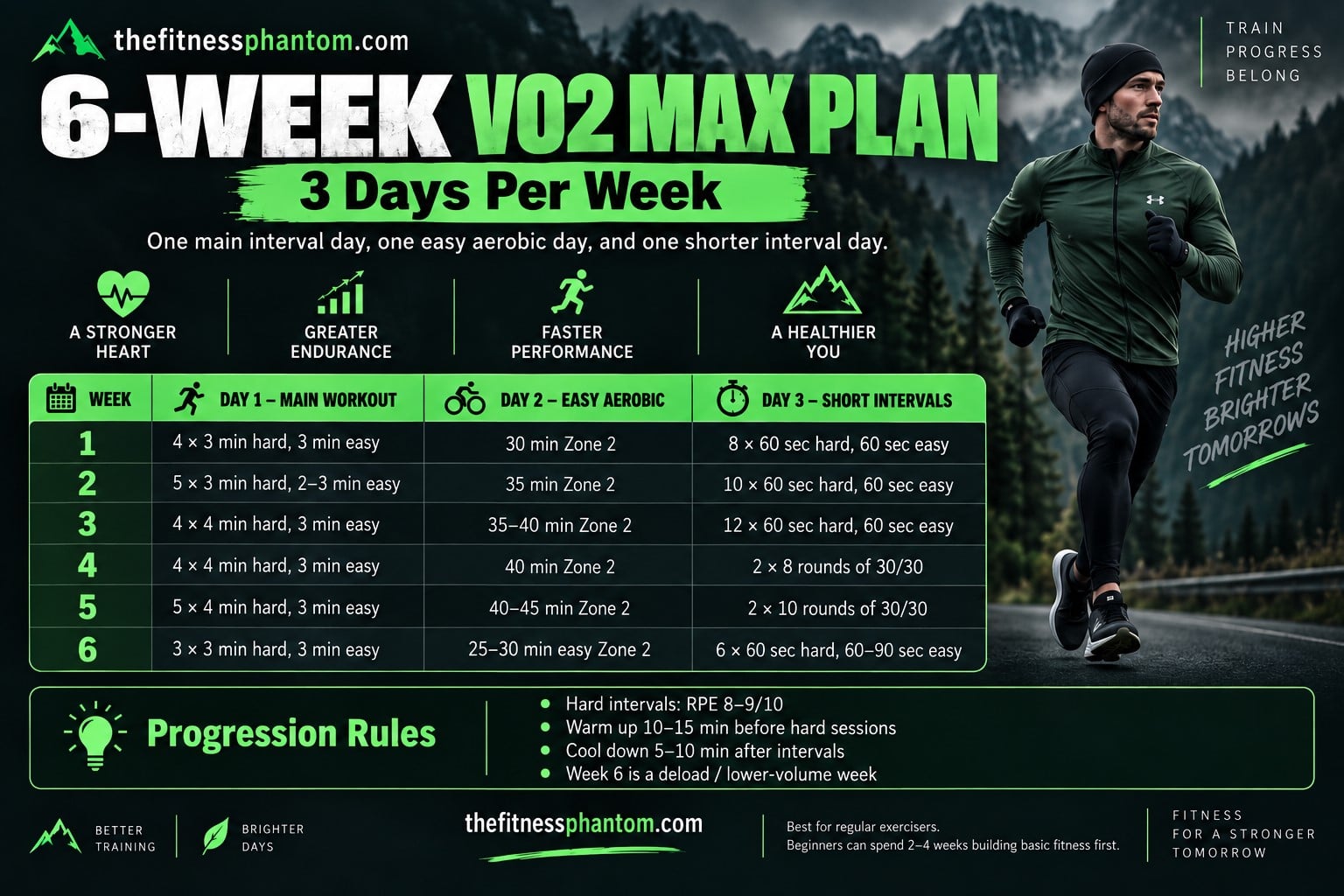
For VO₂ max training, you have several ways to progress. For example, first focus on increasing the number of intervals, then the duration of intervals, then the intensity, and then lowering the recovery time between intervals.
You don’t need to increase all four simultaneously.
If you’re completely new to cardio or structured interval training, spend 2–4 weeks building basic fitness with 60/60 intervals before using this progression.
For someone who already exercises regularly, here’s one way to progress:
| Week | Workout | Hard Work |
|---|---|---|
| 1 | 4 × 3 min | 12 min |
| 2 | 5 × 3 min | 15 min |
| 3 | 4 × 4 min | 16 min |
| 4 | 4 × 4 min | 16 min |
| 5 | 5 × 4 min | 20 min |
| 6 | 3 × 3 min | 9 min |
During Week 4, instead of adding more volume, try to make the same workout feel more controlled.
During Week 6, deliberately reduce the workload before beginning another progression.
I prefer this approach because progression doesn’t have to mean exhausting yourself more every week.
VO2 Max Training vs Regular HIIT
These terms are often used interchangeably, but they aren’t exactly the same.
HIIT is a broad training method involving hard exercises separated by recovery intervals.
A HIIT workout might involve: Burpees, KB swings, Sprints, Cycling, Rowing, or bodyweight circuits.
But simply calling something HIIT doesn’t guarantee that it provides an ideal VO₂ max stimulus.
For example, your shoulders might fail during burpees or your grip might fatigue during kettlebell swings before your cardiovascular system spends meaningful time near maximal oxygen uptake.
That’s why I prefer running, cycling, rowing, SkiErg, hills, and similar repetitive movements when VO₂ max development is the specific goal.
They’re easier to pace, repeat, measure, and progress.
If your goal is general conditioning rather than specifically targeting VO₂ max, traditional circuit-style HIIT is useful.
This doesn’t mean circuit training cannot improve cardiorespiratory fitness. It simply means cyclical cardio exercises are usually easier to control when the specific objective is accumulating repeatable high-aerobic-intensity work.
How to Combine VO2 Max & Strength Training
If muscle and strength are major goals, I wouldn’t randomly insert hard running intervals between heavy leg sessions.
A simple setup might look like this:
| Day | Training |
|---|---|
| Monday | Lower Body Strength |
| Tuesday | Upper Body |
| Wednesday | VO₂ Max |
| Thursday | Rest/Easy Cardio |
| Friday | Lower Body |
| Saturday | Upper Body |
| Sunday | Rest or Easy Zone 2 |
You can also perform your VO₂ max workout after upper-body training, provided you have energy to complete a good session of 15-20 minutes VO2 training.
I wouldn’t intentionally schedule your hardest VO₂ max running session immediately before heavy squats, deadlifts, or high-volume leg training because most VO₂ max exercises also place considerable demand on your lower body.
If cardiovascular development matters more than strength on a particular day, perform cardio first.
If strength is the priority, perform your important strength work while fresh.
Common VO2 Max Training Mistakes
1. Sprinting Every Interval
VO₂ max intervals and all-out sprint training aren’t identical. If the workout calls for four minutes of hard work, sprinting the first 30 seconds is usually a poor strategy.
2. Turning Every Cardio Workout Into HIIT
High-intensity training works precisely because it’s intense. If every training day is hard, eventually none of them will be high quality. Keep plenty of easier work in your program.
3. Chasing Your Watch
Smartwatches can provide useful data, but they’re estimates. Don’t destroy a good workout because your watch says your VO₂ max dropped by one point.
Pay more attention to trends over time and combine the estimate with your actual running pace, cycling power, interval consistency, and recovery.
4. Progressing Too Quickly
Going from occasional jogging directly into two weekly 5×5-minute interval sessions is unnecessary. I advise increasing the intensity or the number of rounds progressively.
5. Assuming More Pain Means More Adaptation
The goal isn’t to create the most miserable workout possible. The purpose should be to create enough high-quality cardiovascular stress that your body can adapt and recover.
How Long Does It Take to Improve VO2 Max?
There isn’t one timeframe that applies to everybody.
How quickly your VO₂ max improves depends on several factors, including:
- Your starting fitness level
- Training experience
- Age and genetics
- How often you train
- The amount and quality of aerobic work you perform
- Recovery and consistency
Research interventions often detect measurable improvements within several weeks, but highly trained athletes usually have less room for rapid improvement than beginners or recreational exercisers.9 Yang, Q., Wang, J., & Guan, D. (2025). Comparison of different interval training methods on athletes’ oxygen uptake: a systematic review with pairwise and network meta-analysis. BMC sports science, medicine & rehabilitation, 17(1), 156. https://doi.org/10.1186/s13102-025-01191-6
Instead of focusing only on a percentage increase, look for practical signs of progress:
- You can maintain a faster pace at the same effort.
- Your power stays more consistent across intervals.
- You can perform more quality work.
- You recover more quickly between repetitions.
- The same workout feels more controlled.
Those improvements matter even if your smartwatch VO₂ max estimate barely changes.
How to Measure Your VO2 Max
The most accurate measurement requires a graded exercise test while respiratory gases are measured in a laboratory. But most people won’t need that.
Fitness watches estimate VO₂ max using combinations of data such as heart rate, speed, power, age, and training history.
Those estimates can be useful for tracking trends, but treat them as estimates rather than perfect physiological measurements.
For most recreational exercisers, improving actual performance matters more than chasing a particular VO₂ max score.
Who Should Be Careful With VO2 Max Training?
VO2 Max workouts are high-intensity. So, if you’ve been inactive for a long time, start by developing basic cardiovascular fitness before jumping into maximal or near-maximal intervals.
People with known cardiovascular, respiratory, metabolic, or other medical conditions should follow guidance from an appropriate healthcare professional before beginning vigorous exercise.
Stop exercising and seek appropriate medical care if you experience warning symptoms such as chest pain, fainting, or unusual severe shortness of breath.
Training hard is part of the workout. Ignoring abnormal symptoms isn’t.
Frequently Asked Questions (FAQs)
What is the best VO2 max workout?
There isn’t one universally best protocol. The classic 4×4, 3-5-minute intervals, and well-designed shorter interval sessions can all be effective.
Recent research comparing HIIT structures hasn’t established one format as clearly superior across athletes and conditions.
If you’re unsure, start with 4 × 3 minutes hard with 2-3 minutes easy recovery.
How Often Should I Perform VO2 Max Workouts?
For most recreational exercisers, I’d start with one dedicated VO₂ max session per week. More experienced trainees may use two when recovery and the rest of their program allow it. Avoid placing your hardest interval sessions on consecutive days.
Can Beginners Perform VO2 Max Workouts?
Yes, but start conservatively. Try: 6-8 rounds of 1 minute hard & 1 minute easy work before progressing toward longer intervals.
Can I Improve VO2 Max Without Running?
Absolutely. You can use cycling, rowing, SkiErg, elliptical training, swimming, and other cardiovascular exercises. Choose something you can perform hard and consistently.
Can I Lift Weights and Train VO2 max?
Yes. I recommend separating your hardest interval workout from your most demanding lower-body strength session when possible.
Bike or rowing intervals can also be useful when running creates too much additional leg impact.
Should I Walk or Jog During Recovery?
Either can work. Recent analysis of time near VO₂ max found no clear effect of active versus passive recovery across the protocols examined.
So, choose the recovery method that allows you to complete the prescribed work effectively.
One Final Piece of Advice
Don’t turn VO₂ max training into a competition with yourself every session.
It’s tempting to see high intensity and assume every interval should be performed as hard as physically possible, but it is not the goal.
Your objective is to accumulate several minutes of high-quality, repeatable work at a very demanding aerobic intensity.
So, start conservatively, learn what an 8-9/10 effort actually feels like.
Keep your intervals consistent, then gradually increase the workload as your conditioning improves.
That’s the approach I’d use whether you’re trying to become a better runner, improve your general cardiovascular fitness, or simply become a more well-rounded athlete.
References
- 1Du M, Qiu B, Bai Y, Zeng X, Xu K, Ma E, Xia L, Zhang W, Yin M. Effects of high-intensity interval training on cardiovascular health: An umbrella review of systematic reviews and meta-analyses. J Exerc Sci Fit. 2026 Oct;24(4):200495. doi: 10.1016/j.jesf.2026.200495. Epub 2026 Jun 29. PMID: 42434039; PMCID: PMC13352375. ↩︎
- 2Ko JM, So WY, Park SE. Narrative Review of High-Intensity Interval Training: Positive Impacts on Cardiovascular Health and Disease Prevention. J Cardiovasc Dev Dis. 2025 Apr 17;12(4):158. doi: 10.3390/jcdd12040158. PMID: 40278218; PMCID: PMC12027975 ↩︎
- 3Irawati, Dewi & Boenyamin, Hafizh. (2019). The benefits and physiological changes of high intensity interval training. Universa Medicina. 38. 209-216. 10.18051/UnivMed.2019.v38.209-216 ↩︎
- 4Atakan MM, Li Y, Koşar ŞN, Turnagöl HH, Yan X. Evidence-Based Effects of High-Intensity Interval Training on Exercise Capacity and Health: A Review with Historical Perspective. Int J Environ Res Public Health. 2021 Jul 5;18(13):7201. doi: 10.3390/ijerph18137201. PMID: 34281138; PMCID: PMC8294064 ↩︎
- 5Yin H, Zhang J, Lian M, Zhang Y. A systematic review and meta-analysis of the effectiveness of high-intensity interval training for physical fitness in university students. BMC Public Health. 2025 May 1;25(1):1601. doi: 10.1186/s12889-025-22829-7. PMID: 40312686; PMCID: PMC12044783 ↩︎
- 6Helgerud, J., Høydal, K., Wang, E., Karlsen, T., Berg, P., Bjerkaas, M., Simonsen, T., Helgesen, C., Hjorth, N., Bach, R., & Hoff, J. (2007). Aerobic high-intensity intervals improve VO2max more than moderate training. Medicine and science in sports and exercise, 39(4), 665–671. https://doi.org/10.1249/mss.0b013e3180304570 ↩︎
- 7Schoenmakers, P., Murray, K., White, J., Matta, G., & Bossi, A. H. (2026). Time spent at or near V̇O₂max during high-intensity interval training – a systematic review and meta-analysis. BMC sports science, medicine & rehabilitation, 18(1), 358. https://doi.org/10.1186/s13102-026-01766-x ↩︎
- 8Held, S., Rappelt, L., Micke, F., Wiedenmann, T., & Donath, L. (2026). Comparison of high-intensity interval training protocol designs on accumulated time ≥ 90% V̇O₂max: a network meta-analysis. BMC sports science, medicine & rehabilitation, 18(1), 336. https://doi.org/10.1186/s13102-026-01891-7 ↩︎
- 9Yang, Q., Wang, J., & Guan, D. (2025). Comparison of different interval training methods on athletes’ oxygen uptake: a systematic review with pairwise and network meta-analysis. BMC sports science, medicine & rehabilitation, 17(1), 156. https://doi.org/10.1186/s13102-025-01191-6 ↩︎