If you are looking for a leg curl variation that requires no plates, barbells, or machines, you should try the dumbbell leg curl.
The dumbbell leg curl is one of the few free-weight exercises that isolates the hamstrings and helps build stronger, more muscular posterior thighs using only a bench and a dumbbell.
It involves lying prone and curling your legs at the knee joints to engage the hamstring muscles. It’s good for improving hamstring strength and reducing the risk of injuries.1 Maeo, S., Huang, M., Wu, Y., Sakurai, H., Kusagawa, Y., Sugiyama, T., Kanehisa, H., & Isaka, T. (2021). Greater Hamstrings Muscle Hypertrophy but Similar Damage Protection after Training at Long versus Short Muscle Lengths. Medicine and science in sports and exercise, 53(4), 825–837. https://doi.org/10.1249/MSS.0000000000002523, 2Snarr, Ronald & Esco, Michael. (2014). Exercise Technique: Lying Hamstring Curl with a Dumbbell. STRENGTH AND CONDITIONING JOURNAL. 36. 82-84. 10.1519/SSC.0000000000000038.
In this article, I’ve shared everything about the dumbbell hamstring curl, including how to do it, when to do it, the benefits, variations, and alternatives.
Exercise Overview
| Target Muscle | Hamstrings |
| Equipment | Dumbbell and Bench (optional) |
| Level | Beginner–Intermediate |
| Mechanics | Isolation |
| Force | Pull |
| Best For | Muscle Growth |
| Alternative To | Machine Leg Curl |
| Target People | People who train at home |
Muscles Worked During Dumbbell Leg Curls
Primary Muscle Group: Hamstrings
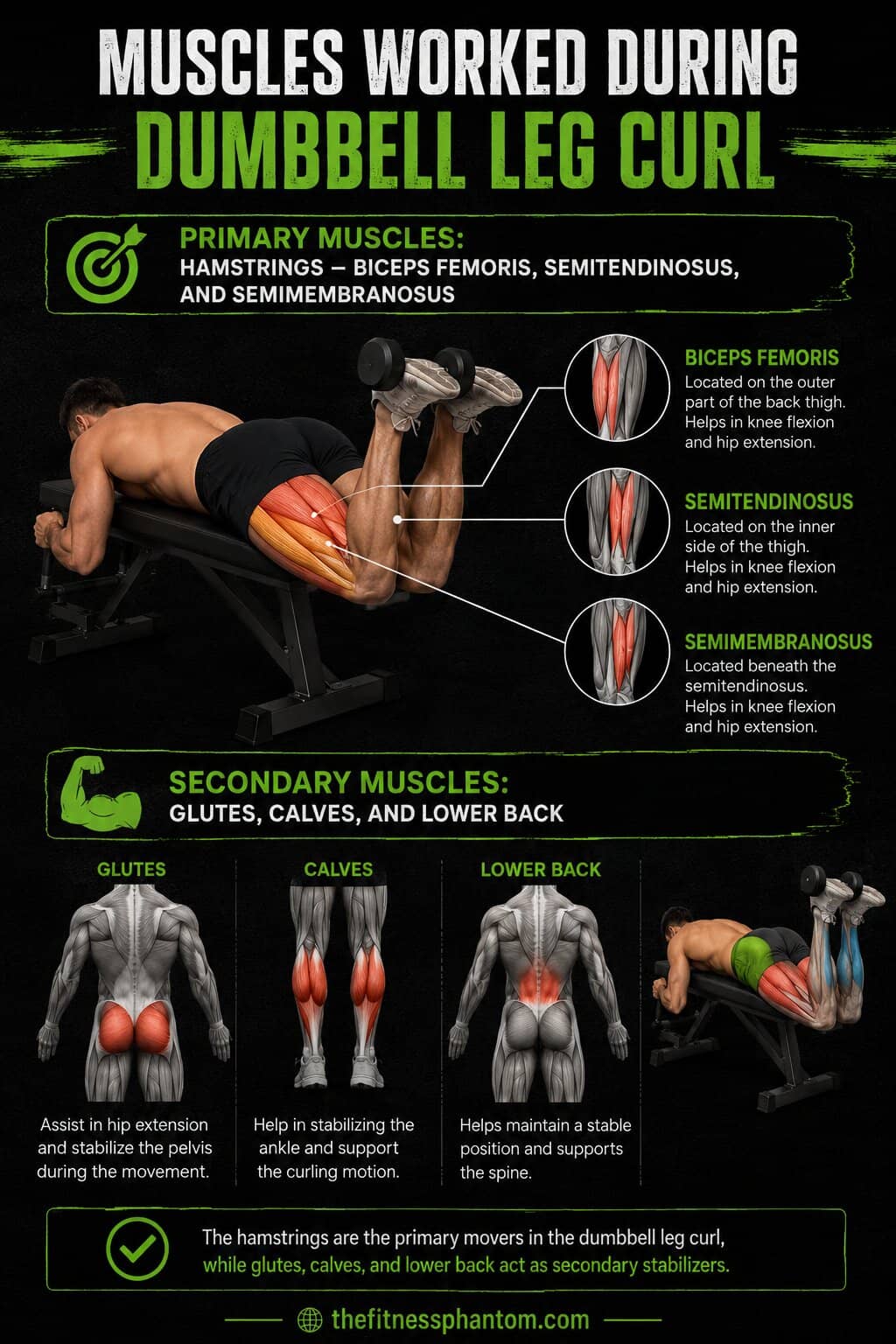
The hamstrings (also known as the posterior thighs) are the primary muscle that works during the DB leg curl.
They are located on the backside of your thigh and work with your lower body muscles to perform various activities, from running and sprinting to jumping and lifting objects.
A hamstring is a group of three muscles: bicep femoris, semitendinosus, and semimembranosus.
These muscles are responsible for flexing and extending the back thigh.
The stronger the hamstrings, the better you can run, jump, and squat.
As the dumbbell leg curl primarily trains the hamstrings, that’s why it is also known as the Hamstring Curl.
Secondary Muscle Groups: Glutes, Calves, & Lower Back
Glutes (Gluteus Maximus): Engage to help stabilize your hips and lower body against the bench or floor during the leg curl.
Calves (Gastrocnemius and Soleus): Assist slightly as your feet flex and hold the dumbbell handle in place.
Lower Back: Act as isometric stabilizers to keep your spine neutral and prevent your hips from lifting off the surface.
Dumbbell Leg Curl Variations for Building Stronger Hamstrings
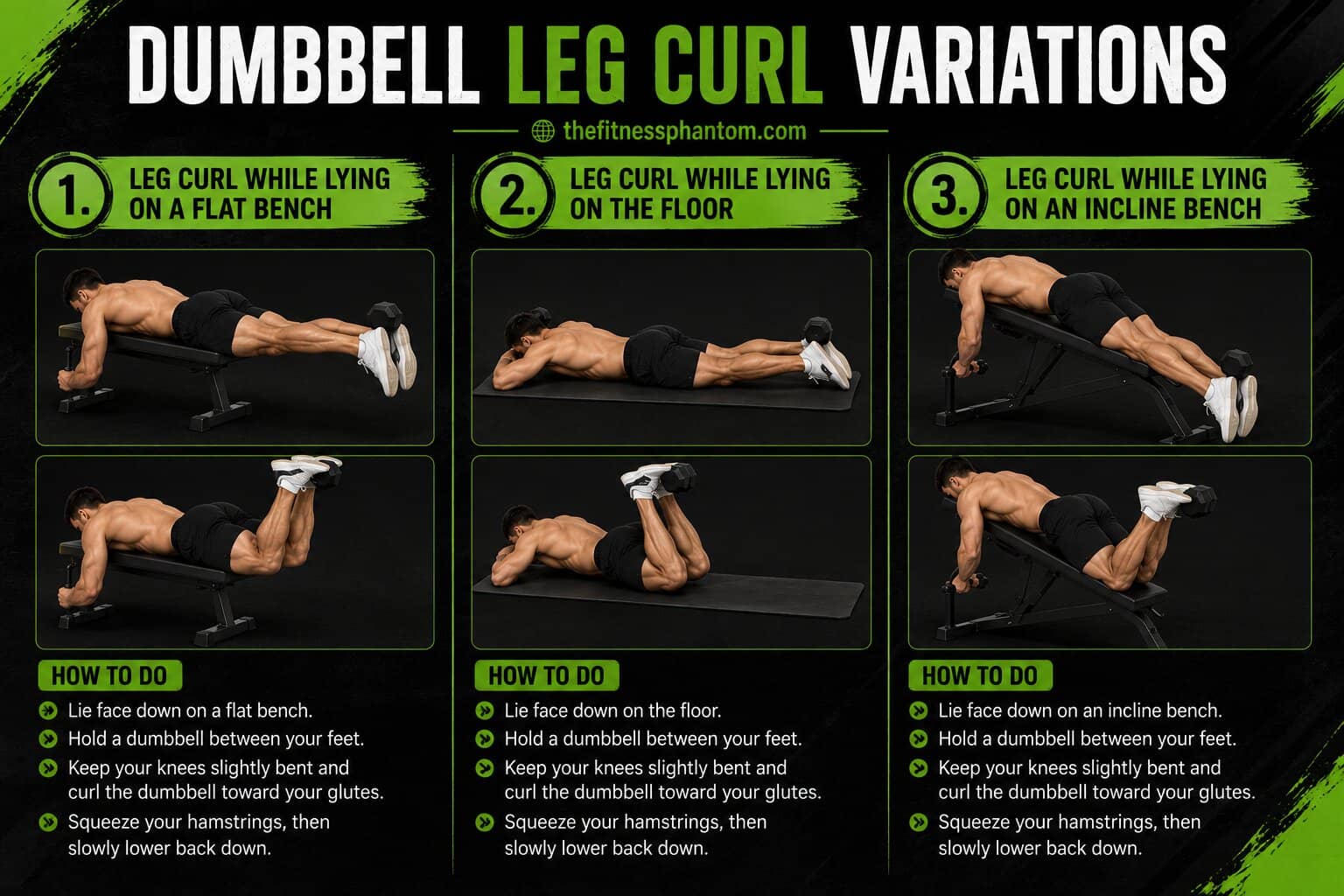
You can do leg curls in multiple ways with dumbbells, for example, lying on the floor or on a bench.
Here are three variations you’ll see:
- Leg Curl while lying on a flat bench
- Leg Curl while lying on the floor
- Leg Curl while lying on an incline bench
All these variations work differently, but their main focus is to make the hamstrings stronger.
1. Dumbbell Hamstring Curl on a Bench
Doing dumbbell leg curls on a workout bench is a great way to engage your hamstring muscles.
The bench provides better body support and helps reduce unwanted hip movement, allowing you to focus on knee flexion and hamstring contraction.
It has a greater range of motion (more space for knee flexion) than the other two variants.
Exercises with a greater range of motion can be beneficial for increasing muscle strength and improving muscle size.3 Schoenfeld, B. J., & Grgic, J. (2020). Effects of range of motion on muscle development during resistance training interventions: A systematic review. SAGE Open Medicine, 8, 2050312120901559. https://doi.org/10.1177/2050312120901559, 4Pallarés JG, Hernández-Belmonte A, Martínez-Cava A, Vetrovsky T, Steffl M, Courel-Ibáñez J. Effects of range of motion on resistance training adaptations: A systematic review and meta-analysis. Scand J Med Sci Sports. 2021; 31: 1866–1881. https://doi.org/10.1111/sms.14006
Flat Bench Dumbbell Leg Curl involves the following steps:
- Place a hexagonal dumbbell on the floor, lie flat on a bench on your chest, face facing the bench. Make sure your knees are at the end of the bench.
- Extend your legs fully behind you and clamp the dumbbell between your feet. Grab the sides of the bench with your hands for support.
- While keeping your hips fixed on the bench, smoothly lift your leg off the floor and curl toward your buttocks until your knees are fully bent.
- Hold for a moment and then reverse the steps to return the dumbbell to the start. That’s your one repetition.
Tips to make it safe and effective:
- If you are not used to working out with free weights, start your training with lighter weights.
- Perform each rep slowly and in a controlled manner so you can contract muscles efficiently.
- Keep your hips in contact with the bench throughout the movement.
- Lift under control and avoid using momentum.
2. Dumbbell Lying Leg Curl on the Floor
The lying dumbbell leg curl is a good option for those who don’t have a workout bench at home.
It involves lying prone on the floor and keeping a dumbbell between your feet and flexing your legs until you feel a good contraction in your hamstrings.
It has a shorter range of motion compared to the bench but is good enough to activate your biceps femoris.
It is more convenient, requires less space, fewer pieces of equipment, and is suitable for most people, including beginners and people over 40.
Steps to perform a lying dumbbell leg curl on the floor:
- Lie on the mat with your face down, with your legs extended.
- Clamp a dumbbell between your feet and lift your feet off the floor.
- Brace your core and keep your hips pressed into the floor.
- Bend your knees to curl the dumbbell toward your glutes as far as possible.
- Pause at the top and feel the work in your hamstrings.
- Slowly lower the dumbbell until your legs are nearly straight. That’s one rep.
Tips to make it safe and effective:
- Put on a pair of shoes so you can hold the dumbbell firmly with your feet.
- Keep your hips glued to the floor during the exercise.
- Ensure your hamstrings are contracted well during each rep.
3. Leg Curl on a Decline Bench
This dumbbell leg curl variation is slightly more challenging than the above ones. It involves lying on a 30-45 degree incline bench and performing hamstring curls.
The decline bench elevates your body, allowing the dumbbell to travel farther without hitting the floor. This position provides a greater range of motion and helps you achieve better results than the floor variation.
Steps to perform prone dumbbell leg curl on an inclined bench:
- Lie prone on a 45-60 degree incline bench with your legs straight behind you.
- Grasp the side of the bench for assistance and keep your chest and hips firmly against the bench.
- Ask someone to help you clamp the dumbbell between your feet.
- Lift your feet off the floor and curl your knees until your hamstrings are fully engaged.
- Pause for a moment, then return to the start. That’s one rep.
Tips to make it safe and effective:
- Grab the bench firmly to stay stable throughout the movement.
- If you can’t keep the dumbbell secure between your feet, lower it safely and reposition it before continuing.
- Fully bend and extend your knees to get decent contraction and stretch during each rep.
Dumbbell Leg Curl Benefits
The leg curl is an isolation exercise. Its primary benefit is to strengthen the hamstrings and make your thighs look defined.5 New Research Determines Which Hamstring Exercises Yield The Best Results, Feb 13, 2018 in ACE Press Releases – American Council of Exercise
Strengthening your hamstrings with leg curls improves your athletic performance and decreases the risk of injuries as well.
Leg curls also activate other muscles, including the glutes and calves, and improve lower body health.
Dumbbell Leg Curl Alternatives
If you train at home and you want alternate curl variations to strengthen your hamstrings, explore these exercises:
1. Resistance Band Seated Leg Curl
The resistance band leg curl is a better exercise for strengthening the hamstrings than the dumbbell leg curl.
The resistance band keeps tension on the hamstrings throughout the movement, helping you grow your hammies.
It can also be done using one leg at a time, allowing you to work on each leg separately and helping you develop balanced hamstrings.
Resistance band leg curl involves the following steps:
- Anchor one end of a band to a sturdy object.
- Sit upright on a bench or chair with your legs extended in front of you.
- Secure the other end around one ankle.
- Hold the sides of the bench or chair for support and keep your core tight.
- Curl your knees until your hamstrings are fully engaged.
- Pause for 1-2 seconds, then extend your leg back to the starting position.
Explore more resistance band hamstring exercises if you train at home.
2. Stability Ball Leg Curl
The stability ball leg curl is an advanced bodyweight exercise to strengthen glutes, hamstrings, and abs simultaneously.6 Rusdiawan, Afif & Kusuma, Donny & Firmansyah, Awang & Wismanadi, Himawan & Cemal, Özman & Wicahyani, Sri & Lani, Ahmad. (2024). A combination of Swiss ball hamstring curl and stiff-leg deadlift training on agility, hamstring asymmetry, and leg power in badminton athletes with hamstring asymmetry conditions. Retos. 59. 666-673. 10.47197/retos.v59.107995.
Doing leg curls on the stability ball also improves balance and develops muscle coordination.
Steps to perform stability ball leg curls:
- Place a stability ball on the floor, lie on your back in front of it, and put your heels and calves on it. Feet hip-width apart.
- Keep your arms at your sides on the floor for assistance. Lift your hips off the floor and hold your legs straight. That’s your starting position.
- Now, bend your knees and bring the stability ball toward your glutes by rolling the ball through your heels. Make sure you feel the contraction in your hamstrings when you pull your heels toward you.
- Pause for a moment and then return to the start. That’s one rep.
3. Nordic Hamstring Curl
The Nordic curl is a bodyweight hamstring exercise. It highly activates hamstring muscles and makes your rear thigh strong, flexible, and less prone to injuries.7 Monajati, A., Larumbe-Zabala, E., Goss-Sampson, M., & Naclerio, F. (2017). Analysis of the Hamstring Muscle Activation During Two Injury Prevention Exercises. Journal of Human Kinetics, 60, 29–37. https://doi.org/10.1515/hukin-2017-0105, 8Nunes, H., Fernandes, L. G., Martins, P. N., & Ferreira, R. M. (2024). The Effects of Nordic Hamstring Exercise on Performance and Injury in the Lower Extremities: An Umbrella Review. Healthcare (Basel, Switzerland), 12(15), 1462. https://doi.org/10.3390/healthcare12151462
The Nordic curl involves the following steps:
- Sit on your knees on the mat with your torso upright.
- Ask your partner to hold your ankles or hook your feet under a loaded barbell.
- Keeping your hips extended, slowly lower your torso forward toward the ground.
- Put your hands out in front of you on the floor when you can’t go down further.
- Push yourself back to the start. That’s your one rep.
- Maintain a neutral spine during the entire movement.
Dumbbell vs. Machine Leg Curl
Machine leg curl is always better than doing leg curls with a dumbbell. Because the machine allows you to easily adjust the weight, good for progressive overload in the long run and better for overall muscle growth.
But if you don’t have access to the gym and you want a suitable alternative to the machine leg curl, the dumbbell is a good option.
You can do dumbbell leg curls in multiple ways, such as lying on the floor (good) and on the bench (better).
These exercises provide decent contraction in the hamstrings and improve their size and strength.
Frequently Asked Questions (FAQs)
How many sets and reps should you do?
3-4 sets of 12 to 15 reps with 1-2 minutes of rest in between for hypertrophy, and 3-4 sets of 6-8 reps with 2-3 minutes of rest for strength.
How often should you perform DB leg curl?
Once a week is fine for most people. But if you want to grow your hamstrings, you can perform two sessions (one for strength and one for hypertrophy) for a certain period of time, such as 4-6 weeks.
Is the DB leg curl as effective as the leg curl machine?
A dumbbell leg curl is good for strengthening the hamstrings, especially if you don’t have access to a leg curl machine. However, a machine is a safer and more effective option. Plus, the machine allows for easier progressive overload.
Are dumbbell leg curls good for building bigger hamstrings?
Yes. When you perform dumbbell leg curls consistently and keep using heavy dumbbells, your hamstrings can get bigger over time. They’re even more effective when paired with hip-hinge exercises like Romanian deadlifts.
Which dumbbell leg curl variation is the best?
For muscle activation, performing leg curls on a bench is more effective than lying on the floor. But for beginners, prone leg curl on the floor is more suitable.
The Bottom Line
The dumbbell leg curl is one of the important free-weight exercises to build sturdy hamstrings.
You can do it while lying on the floor or using a workout bench.
Strong hamstrings maximize your lower body strength and reduce the risk of injuries.
You can incorporate dumbbell leg curls with other exercises in your workout routine to build muscular legs.
Explore other hamstrings exercises:
- 7 Best Barbell Hamstring Workouts
- 8 Best Kettlebell Hamstring Exercises
- Top 5 Best Isometric Hamstring Exercises
References
- 1Maeo, S., Huang, M., Wu, Y., Sakurai, H., Kusagawa, Y., Sugiyama, T., Kanehisa, H., & Isaka, T. (2021). Greater Hamstrings Muscle Hypertrophy but Similar Damage Protection after Training at Long versus Short Muscle Lengths. Medicine and science in sports and exercise, 53(4), 825–837. https://doi.org/10.1249/MSS.0000000000002523 ↩︎
- 2Snarr, Ronald & Esco, Michael. (2014). Exercise Technique: Lying Hamstring Curl with a Dumbbell. STRENGTH AND CONDITIONING JOURNAL. 36. 82-84. 10.1519/SSC.0000000000000038. ↩︎
- 3Schoenfeld, B. J., & Grgic, J. (2020). Effects of range of motion on muscle development during resistance training interventions: A systematic review. SAGE Open Medicine, 8, 2050312120901559. https://doi.org/10.1177/2050312120901559 ↩︎
- 4Pallarés JG, Hernández-Belmonte A, Martínez-Cava A, Vetrovsky T, Steffl M, Courel-Ibáñez J. Effects of range of motion on resistance training adaptations: A systematic review and meta-analysis. Scand J Med Sci Sports. 2021; 31: 1866–1881. https://doi.org/10.1111/sms.14006 ↩︎
- 5New Research Determines Which Hamstring Exercises Yield The Best Results, Feb 13, 2018 in ACE Press Releases – American Council of Exercise ↩︎
- 6Rusdiawan, Afif & Kusuma, Donny & Firmansyah, Awang & Wismanadi, Himawan & Cemal, Özman & Wicahyani, Sri & Lani, Ahmad. (2024). A combination of Swiss ball hamstring curl and stiff-leg deadlift training on agility, hamstring asymmetry, and leg power in badminton athletes with hamstring asymmetry conditions. Retos. 59. 666-673. 10.47197/retos.v59.107995. ↩︎
- 7Monajati, A., Larumbe-Zabala, E., Goss-Sampson, M., & Naclerio, F. (2017). Analysis of the Hamstring Muscle Activation During Two Injury Prevention Exercises. Journal of Human Kinetics, 60, 29–37. https://doi.org/10.1515/hukin-2017-0105 ↩︎
- 8Nunes, H., Fernandes, L. G., Martins, P. N., & Ferreira, R. M. (2024). The Effects of Nordic Hamstring Exercise on Performance and Injury in the Lower Extremities: An Umbrella Review. Healthcare (Basel, Switzerland), 12(15), 1462. https://doi.org/10.3390/healthcare12151462 ↩︎