Building bigger arms requires lifting weights. But if you don’t have access to the equipment, the best option is to use your own body weight to develop your biceps, triceps, and forearms.
In this article, I’ll show you various bodyweight arm exercises and how to use them to build good-looking biceps and triceps without weights.
Whether you train at home or in the gym, explore this guide and try some of these exercises on your arm day.
No-Equipment Bodyweight Arm Workouts for Muscle Gain
Let’s first see the pure bodyweight arm workouts that require no equipment at all. Some of them are easy, but some require decent strength and experience.
1. Triangle Push-ups
The triangle pushup (or the diamond push-up) engages all three heads (lateral, long, and medial) simultaneously and is a great exercise for sculpting triceps. 1American Council of Exercise (ACE) Study Identifies Best Triceps Exercises – ACE Fitness, 2Comparison of Muscle Activation between Traditional, Diamond, and Knuckle Push Up Among Trained Men – Ali Md Nadzalan et al 2021 J. Phys.: Conf. Ser. 1874 012016, DOI 10.1088/1742-6596/1874/1/012016
Even if you train at the gym, you can incorporate the triangle push-up into your muscle-building workout plan to maximize your triceps growth.
The Triangle Push-up involves the following steps:
- Place your hands on the floor, forming a triangle shape, and get into a pushup position with your arms directly below your chest. Keep your body straight from head to heels and feet hip-width apart.
- Inhale and lower your chest toward the ground as low as possible, and contracting your tricep muscles, press yourself back to the starting position. This is your one repetition.
- Do as many reps as possible according to your strength.
Tips for Beginners: If you’re a beginner, try the kneeling variation. To do that, get on all fours. Bring your hands closer so they form a triangle shape. Keep your arms straight underneath your chest, and perform pushups.
2. Sphinx Push-Ups
The sphinx push-up (also known as Plank Tricep Extension or Tiger Bend Push-up) is a bodyweight tricep exercise. It is an easy and effective way to hit your triceps without weights or equipment.
It involves you getting into a forearm plank position and then extending your arms until they are straight (or you’re in a high-plank position).
The elbow extension contracts the triceps long and lateral heads and helps build sculpted arms at home.
The Sphinx push-up involves the following steps:
- Get into the plank position with your forearms under your chest and palms on the floor.
- Lift your elbows off the floor and extend your arms until you feel the contraction in your triceps.
- Hold for a second and then lower your elbows back to the start, but avoid touching the floor.
- Keep doing it for 10 to 15 times or until your triceps are exhausted.
3. Pseudo Planche Push-up
Pseudo Planche is an advanced push-up variation as it involves keeping your hands in the opposite direction (compared to standard push-ups).
It targets the biceps, forearms, wrists, and triceps, along with the chest and shoulders, and helps build muscle and improve mobility.
However, a pseudo push-up requires better control over your body and good strength in your arms to perform it perfectly.
Steps to perform a pseudo-planche:
- Get on your knees, and place your hands on the floor just outside your stomach with your fingers pointing slightly back.
- Keep your feet hip-width apart, arms straight, and back flat. That’s your starting position.
- Inhale and lower yourself slightly forward, and then press back to the start. That’s one rep.
To make it easy, you can try a kneeling version. All steps will be the same, only your knees will be grounded, supporting body weight along with your arms.
4. Narrow Grip Pushup
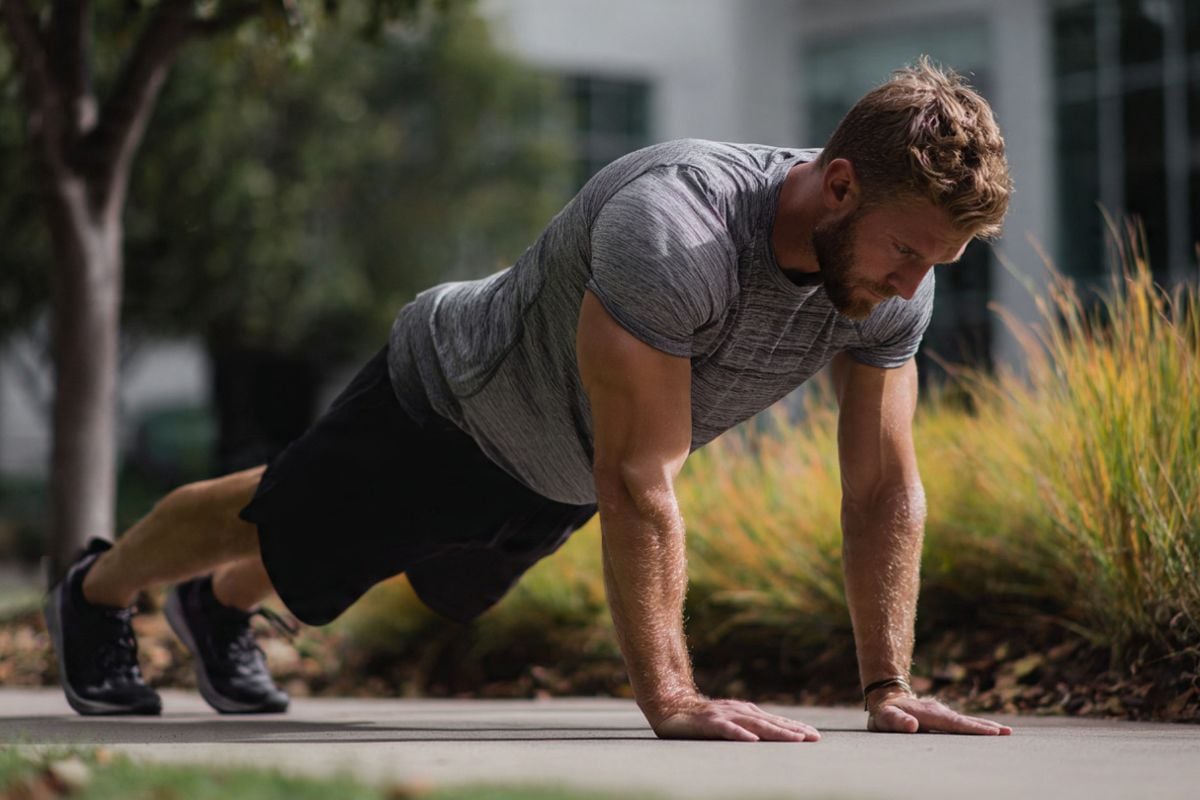
The narrow or close-grip pushup can be a great addition to your bodyweight arm exercises as it targets the triceps inner and long head and increases muscle size. It also trains the pectoral muscles and builds a solid upper body.3 Kim YS, Kim DY, Ha MS. Effect of the push-up exercise at different palmar width on muscle activities. J Phys Ther Sci. 2016 Jan;28(2):446-9. doi: 10.1589/jpts.28.446. Epub 2016 Feb 29. PMID: 27064571; PMCID: PMC4792988, 4Topalidou, Anastasia & Dafopoulou, Georgina & Klepkou, Eirini-erofili & Aggelidakis, John & Bekris, Evaggelos & Sotiropoulos, Aristomenis. (2012). Biomechanical Evaluation of the Push-Up Exercise of the Upper Extremities from Various Starting Points. Journal of Physical Education and Sport (JPES). 12. 71-80.
The only difference between the standard and the narrow grip pushup is the width of your hand position. Keeping it narrower helps target your triceps more than your chest.
Here’s the how-to instructions:
- Begin in a high plank with hands placed closer than shoulder-width apart, fingers pointing forward.
- Keep your body in a straight line, core engaged, and elbows tucked close to your sides.
- Inhale as you lower your chest slowly toward the floor.
- Descend until your chest nearly touches the ground, then exhale and push back to the start without locking your elbows.
5. L-Sit

The L-sit is an isometric tricep exercise that helps develop strength and mobility. It also reinforces abdominal muscles and improves core endurance.
It involves sitting on your arms by keeping your hands on the floor and holding your entire body off the ground for a set period of time.
The L-sit is great for calisthenics athletes who want to scale their fitness to the next level.
To perform this movement:
- Sit on the floor with your legs straight in front of you.
- Place your palms on the floor and lift your glutes off the floor. Make sure your arms are straight so you can feel the work in your triceps.
- Keep your core tight, your legs straight, and your back flat during the entire movement.
- Hold in this position for as long as possible and repeat for the desired number of times.
6. Fingertip Pushups
The fingertip push-up is an advanced bodyweight exercise to strengthen forearms, develop strong fingers, and bolster grip power.5Are push-ups on fingers even helpful for grip strength? – Reddit Martial Arts
It also makes your wrist more stable, helping you perform better where the grip strength is needed.
Steps involved in fingertip push-ups:
- Get into a high plank with hands shoulder-width apart.
- Rise onto your fingertips (palms off the floor).
- Keep your body straight from head to heels with your abs tight and glutes squeezed. That’s the start.
- Inhale and slowly lower until chest nears floor, elbows tucked.
- Exhale and push up through your fingertips until your arms are straight. That’s one rep.
7. Wall Supported Handstand Push-up
The wall-assisted handstand push-up is a safer version of the handstand push-up. It involves doing push-ups while upside down in a handstand, with your feet against a wall for balance and support.
This exercise primarily targets the shoulders, triceps, and abs to build strength and mobility.
It also improves wrist mobility and increases forearm strength, helping you develop muscular arms.
Steps for doing a wall-supported handstand push-up:
- Get into a handstand position by keeping your hands on the floor (shoulder-width apart), and your heels touching the wall.
- Keep your body straight like a plank upside down with your core and glutes tight.
- Bend elbows (ensure they are close to the head) and lower slowly until the head touches the floor (or close).
- Press hard through your hands until your arms are extended. Maintain a straight body with no sagging or arching. Breathe in on the way down, out on push-up. That’s one rep.
8. Forearm to High Plank
Forearm to High Plank is a great exercise for the arms, shoulders, and core. It also works on your balance and coordination, and can be a good addition to your bodyweight arm training.
How to do it:
- Get into a forearm plank position with your elbows on the floor and below the shoulders.
- Extend your arms alternatively to go into a high plank.
- Reverse the movement and repeat. Do it at your own pace.
9. Knuckle Push-up

The knuckle pushup (also known as fist push-ups) is a great exercise to strengthen the forearms and triceps.
It involves resting your weight on your clenched fists (knuckles) instead of flat palms. This position builds tough knuckles and wrist strength.
Give it a try; here are the steps to do:
- Close your fist (like a punch) and get into a regular up position of a pushup.
- Keeping your core as tight as possible, lower your chest toward the floor, and then, using your arm strength, press back to the start. Repeat it as many times as you like.
- It’s best to do this movement on the mat.
10. Pike Push-ups
The pike pushup is another push-up variation that involves doing push-ups into an inverted V position. It mostly trains the shoulders and triceps, strengthens the upper body, and increases pushing strength.
Follow the steps below to do it:
- Place your hands on the floor and get into an inverted V-shape by raising your hips up and lowering your head toward the floor.
- Brace your abdominal muscles and keep your back in a neutral position.
- Lower your head toward the floor and then extend your arms until you feel the work in your triceps. Perform as many reps and sets as you like.
Bodyweight Arm Exercises (Equipment-based)
1. Chin-up

Chin-up is a bodyweight compound exercise that works on the back and biceps and builds a stronger upper body. It also strengthens forearms and enhances grip strength.6 Doma K, Deakin GB, Ness KF. Kinematic and electromyographic comparisons between chin-ups and lat-pull-down exercises. Sports Biomech. 2013 Sep;12(3):302-13. doi: 10.1080/14763141.2012.760204. PMID: 24245055
The supinated grip allows a complete range of motion at the elbow, providing a decent stretch and contraction in the biceps.
If you want to build bigger and rounder biceps without weights, chin-ups should be a primary exercise.
Steps to perform chin-ups:
- Grab the pull-up bar with an underhand grip with your hands shoulder-width apart, and hang onto it with your arms straight.
- Keep your knees straight to maximize the biceps engagement.7 Azmi, Abdul & Syamil, Mohd & Fazila, Nor & Tan, Kevin & Krishnan Vasanthi, Rajkumar & Ab Malik, Zulezwan & Md, Ali. (2022). The effects of knee flexion on muscle activation and performance during chin-up exercise. Pedagogy of Physical Culture and Sports. 26. 158-164. 10.15561/26649837.2022.0303
- Brace your core and pull your body toward the bar until your chin reaches just above the bar.
- Hold for a couple of seconds at the top, make sure your bicep is fully contracted, and then lower your body in a controlled fashion. That’s one rep.
2. Back Dip

The back dip is a bodyweight exercise for strengthening and shaping the tricep muscles.8McKenzie, A.; Crowley-McHattan, Z.; Meir, R.; Whitting, J.; Volschenk, W. Bench, Bar, and Ring Dips: Do Kinematics and Muscle Activity Differ? Int. J. Environ. Res. Public Health 2022, 19, 13211. https://doi.org/10.3390/ijerph192013211
It involves placing your palms on a bench, lowering your glutes down, then pushing with your hands to return to the start.
This exercise requires no special equipment; you can do it at home on a bench, chair, bed, or even on the sofa.
How to perform it:
- Sit on a chair, keep your feet hip-width apart on the floor, and place your hands on the edge of a chair, palms down, and grip the edge of a bench with your fingers.
- Lift your butt off the chair, move your torso forward, and slightly bend your knees in front of you. That’s your starting position.
- Now, push through your arms (and contract your triceps), raise your torso upward until your arms are fully extended, pause for a moment, and then bend your elbows to lower your body to the start. That’s your one repetition.
- Keep doing it until you feel a good contraction in your triceps. Do three sets of 15 reps each.
Although dip is an excellent exercise, it also puts a heavy burden on the front shoulder flexors, increasing the risk of injuries.9 Follow-up Q and A: Dangerous Dips – American Council of Exercise (ACE)
So, don’t be hasty while doing the back dips. Do it slowly with the correct form.
3. Parallel Bar Dips
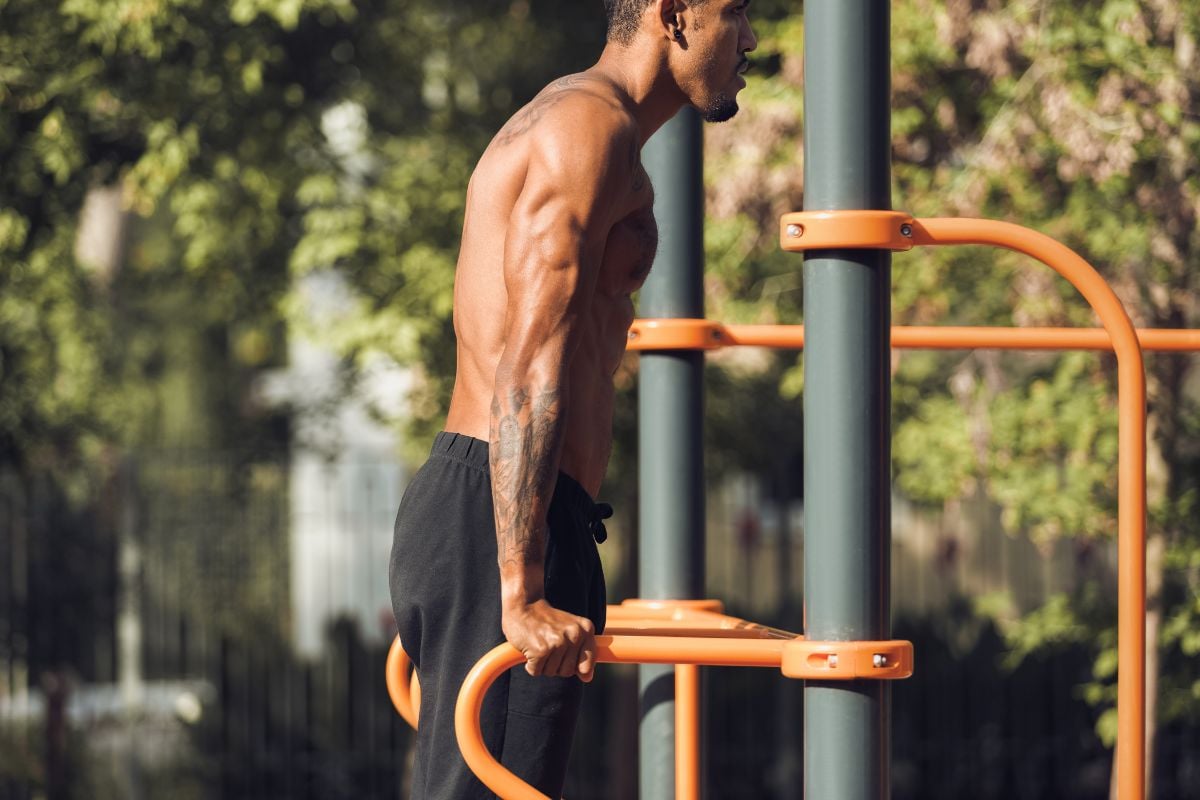
If you want to build strong and aesthetic arms, especially the triceps, consider doing the parallel bar dip.
The bar dip is a bodyweight compound workout that strengthens many muscles at once, particularly the triceps and the chest.10 McKenzie, A.; Crowley-McHattan, Z.; Meir, R.; Whitting, J.; Volschenk, W. Fatigue Increases Muscle Activations but Does Not Change Maximal Joint Angles during the Bar Dip. Int. J. Environ. Res. Public Health 2022, 19, 14390. https://doi.org/10.3390/ijerph192114390
It also strengthens the grip, engage anterior deltoids, contract abs, and helps build a muscular upper body.
How to do a bar dip:
- Grab the handles of the bar dip machine, press the handle to lift your body off the ground, and hold your arms straight.
- Slightly lean forward with your torso so you’ll be in a vertical position. And keep your knees and body straight for the highest triceps engagement.11 Bagchi, Amritashish. (2015). A COMPARATIVE ELECTROMYOGRAPHICAL INVESTIGATION OF TRICEPS BRACHII AND PECTORALIS MAJOR DURING FOUR DIFFERENT FREEHAND EXERCISES.
- Inhale and start lowering your body by bending your elbows until your chest is parallel to the ground.
- Contracting your tricep, press the bar until your elbows are fully extended, and now you’re in the starting position. That’s one rep.
4. Bodyweight Tricep Extension
The bodyweight triceps extension on the bar is an isolation exercise for building chiseled triceps at home.
It is a good alternative to the barbell skull crushers or the standing overhead triceps extension you do in the gym.
It also improves grip strength and helps make the wrist flexible.
The bodyweight triceps extension involves the following steps:
- Place the bar at an appropriate height and grip it firmly with your palms under the bar.
- Step back and get into an incline plank position with your feet together and back straight.
- Brace your core and bend your elbows to lower your head toward the bar.
- Then, contracting your triceps, extend your arms until they are straight.
- Pause for a couple of seconds and repeat the movement.
5. Inverted Row
The inverted row is a bodyweight pulling exercise that involves getting under the bar and lifting the chest toward it using the arms while keeping your body straight like a plank.
This exercise is also known as the Australian or Horizontal Pull-up.
It strengthens the back and biceps and helps enhance upper body strength and posture.12 Youdas JW, Keith JM, Nonn DE, Squires AC, Hollman JH. Activation of Spinal Stabilizers and Shoulder Complex Muscles During an Inverted Row Using a Portable Pull-up Device and Body Weight Resistance. J Strength Cond Res. 2016 Jul;30(7):1933-41. doi: 10.1519/JSC.0000000000001210. PMID: 26422610, 13Snarr, Ronald & Esco, Michael. (2013). Exercise Highlight: Inverted Row. Journal of Australian Strength and Conditioning. 21.
The Inverted Row involves the following steps:
- Get under the bar and grab it with an underneath grip, hands shoulder-width apart.
- Extend your arms and lean back.
- Maintain a neutral spine position and a tight core.
- Pull yourself until your elbows are bent, and your biceps are fully engaged.
- Return and repeat for the desired number of times.
6. Neutral Grip Chin-up
The neutral grip chin-up works the largest head of the biceps and helps build strong and toned arms.14 ACE Technique Series: Chin-ups by Pete McCallby, Health and Fitness Expert – American Council of Exercise (ACE Fitness)
It also targets the latissimus dorsi and trapezius, as well as strengthens forearms and develops crushing grip strength.
It is a good alternative to hammer curl, which is one of the best exercises for biceps development.
The Chin-up involves the following steps:
- Reach up and grab the bar with both hands, using a neutral grip.
- Pull yourself up until your chin is above the bar. Ensure your chest is up and your abs are tight.
- Contract your biceps, pause for a moment at the top, and return to the start. That’s one rep.
7. Pullups
The pull-up is a compound bodyweight exercise for developing a broader back and bigger biceps. Besides the back, it helps increase biceps’ strength and size and makes forearms bigger.
How to do it:
- Grab the bar firmly with an overhand grip, hands slightly wider than shoulder-width apart.
- Pull yourself up in a controlled manner until your chin is close to the bar.
- Hold for a second at the top and return to the start. Repeat the suggested reps and sets.
8. Towel Chin-up
If doing normal chin-ups makes you bored, try the towel chin-up. The towel chin-up is an excellent exercise to strengthen biceps, forearms, and sturdy arms. It also strengthens the lats, traps, and core and pumps up the upper body.15 Snarr RL, Hallmark AV, Casey JC, Esco MR. Electromyographical Comparison of a Traditional, Suspension Device, and Towel Pull-Up. J Hum Kinet. 2017 Aug 1;58:5-13. doi: 10.1515/hukin-2017-0068. PMID: 28828073; PMCID: PMC5548150.
Follow the steps to perform the towel chin-up:
- Place the bath towel over the bar and grab its ends firmly with a neutral grip.
- Brace your abdominal muscles and pull your body as high as you can.
- Pause for a brief moment and lower your body to the start.
- Perform desired reps and sets.
9. Isometric Chin-up Hold
The Chin-up hold is an isometric bicep workout that requires you to hold your body in a chin-up position for a set amount of time.
It keeps your biceps under constant tension and helps increase strength and size.
Lift yourself up and hold in an up for as long as you can.
10. Palms-Up Inverted Row
Palms-Up Inverted Row (also known as supinated grip inverted row, underhand inverted row, or bodyweight biceps curls) is another bodyweight exercise that builds the biceps.
Supinated grip makes the exercise less challenging than neutral or pronated grips, so you can do more reps, build volume, or use it as a progression toward chin-ups and pull-ups.
It also strengthens the traps and posterior deltoids and builds a strong functional upper body.
The steps for doing the underhand inverted row:
- Lie under the bar, facing up. Grab it with your hands shoulder-width or slightly narrower, with your palms facing up.
- Pull elbows back and down, drive chest toward the bar. Keep your body straight and pull until your chest nearly touches the bar.
- Lower slowly until your arms are extended. That’s one rep.
How Does a Bodyweight Arm Workout Routine Look?
You’ve got plenty of bodyweight exercises for training arms, and now it’s time to use them to make a routine. I’ve made some samples that you can try.
Plan A: 30-Minute Arm Workout (No Equipment)
| Exercise | Sets | Reps | Rest |
|---|---|---|---|
| Triangle Push-ups | 3 | 10-12 | 1-minute |
| Sphinx Push-Ups | 3 | 10-15 | 1-minute |
| Pseudo Planche Push-up | 3 | 8-10 | 2-minute |
| Forearm to High Plank | 3 | 20-25 | 1-minute |
| Fingertip Pushups | 3 | 8-10 | 2-minute |
Plan B: 45-Minute Superset Arm Workout (No Weight)
| Exercise | Sets | Reps |
|---|---|---|
| 1A Chin-up (Prone Grip) | 3 | 10-12 |
| 1B Vertical Bar Dips | 3 | 15-20 |
| 2A Triangle Push-ups | 3 | 10-12 |
| 2B Chin-Up (Neutral Grip) | 3 | 10-12 |
| 3A Back Dips | 3 | 10-12 |
| 3B Inverted Row (Supinated) | 3 | 10-12 |
Rest for 1-2 minutes after each superset.
The Bottom Line
Developing bigger biceps and triceps without weights is not easy. However, the bodyweight arm exercises I shared above can help build strong arms and increase their size.
Muscular arms improve your appearance and help you perform various day-to-day activities and lifting tasks easily.
References
- 1
- 2Comparison of Muscle Activation between Traditional, Diamond, and Knuckle Push Up Among Trained Men – Ali Md Nadzalan et al 2021 J. Phys.: Conf. Ser. 1874 012016, DOI 10.1088/1742-6596/1874/1/012016 ↩︎
- 3Kim YS, Kim DY, Ha MS. Effect of the push-up exercise at different palmar width on muscle activities. J Phys Ther Sci. 2016 Jan;28(2):446-9. doi: 10.1589/jpts.28.446. Epub 2016 Feb 29. PMID: 27064571; PMCID: PMC4792988 ↩︎
- 4Topalidou, Anastasia & Dafopoulou, Georgina & Klepkou, Eirini-erofili & Aggelidakis, John & Bekris, Evaggelos & Sotiropoulos, Aristomenis. (2012). Biomechanical Evaluation of the Push-Up Exercise of the Upper Extremities from Various Starting Points. Journal of Physical Education and Sport (JPES). 12. 71-80. ↩︎
- 5Are push-ups on fingers even helpful for grip strength? – Reddit Martial Arts ↩︎
- 6Doma K, Deakin GB, Ness KF. Kinematic and electromyographic comparisons between chin-ups and lat-pull-down exercises. Sports Biomech. 2013 Sep;12(3):302-13. doi: 10.1080/14763141.2012.760204. PMID: 24245055 ↩︎
- 7Azmi, Abdul & Syamil, Mohd & Fazila, Nor & Tan, Kevin & Krishnan Vasanthi, Rajkumar & Ab Malik, Zulezwan & Md, Ali. (2022). The effects of knee flexion on muscle activation and performance during chin-up exercise. Pedagogy of Physical Culture and Sports. 26. 158-164. 10.15561/26649837.2022.0303 ↩︎
- 8McKenzie, A.; Crowley-McHattan, Z.; Meir, R.; Whitting, J.; Volschenk, W. Bench, Bar, and Ring Dips: Do Kinematics and Muscle Activity Differ? Int. J. Environ. Res. Public Health 2022, 19, 13211. https://doi.org/10.3390/ijerph192013211 ↩︎
- 9Follow-up Q and A: Dangerous Dips – American Council of Exercise (ACE) ↩︎
- 10McKenzie, A.; Crowley-McHattan, Z.; Meir, R.; Whitting, J.; Volschenk, W. Fatigue Increases Muscle Activations but Does Not Change Maximal Joint Angles during the Bar Dip. Int. J. Environ. Res. Public Health 2022, 19, 14390. https://doi.org/10.3390/ijerph192114390 ↩︎
- 11
- 12Youdas JW, Keith JM, Nonn DE, Squires AC, Hollman JH. Activation of Spinal Stabilizers and Shoulder Complex Muscles During an Inverted Row Using a Portable Pull-up Device and Body Weight Resistance. J Strength Cond Res. 2016 Jul;30(7):1933-41. doi: 10.1519/JSC.0000000000001210. PMID: 26422610 ↩︎
- 13Snarr, Ronald & Esco, Michael. (2013). Exercise Highlight: Inverted Row. Journal of Australian Strength and Conditioning. 21. ↩︎
- 14ACE Technique Series: Chin-ups by Pete McCallby, Health and Fitness Expert – American Council of Exercise (ACE Fitness) ↩︎
- 15Snarr RL, Hallmark AV, Casey JC, Esco MR. Electromyographical Comparison of a Traditional, Suspension Device, and Towel Pull-Up. J Hum Kinet. 2017 Aug 1;58:5-13. doi: 10.1515/hukin-2017-0068. PMID: 28828073; PMCID: PMC5548150. ↩︎