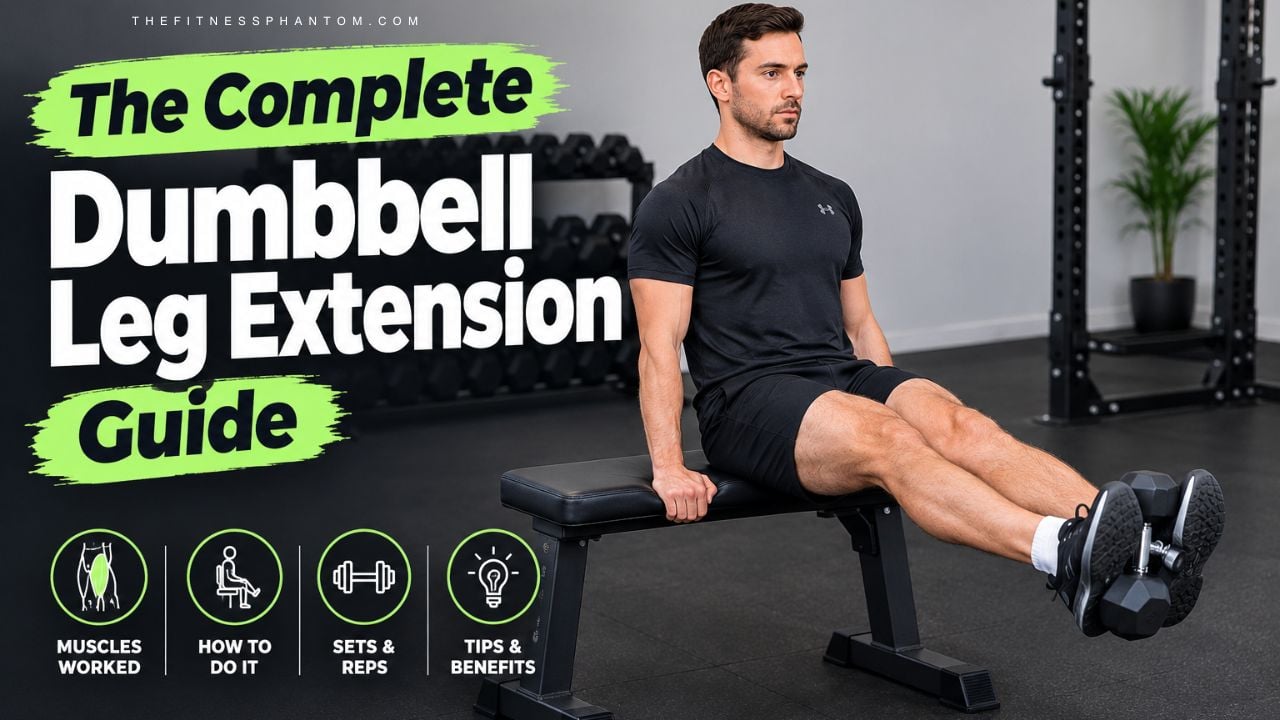
The dumbbell leg extension is an isolation exercise that primarily targets the quadriceps muscles (the front part of your thighs).
It is a useful home-workout alternative when you don’t have access to a leg extension machine.
You can also use it at the gym when the leg extension machine is occupied.
All you need is a dumbbell and a workout bench to perform this movement.
Unlike squats and lunges, the dumbbell leg extension focuses mainly on knee extension, allowing you to train your quadriceps without requiring much equipment.
In this article, you’ll learn how to do dumbbell leg extensions correctly, which muscles they work, the benefits, recommended sets and reps, common mistakes, safety tips, and the best alternatives.
Dumbbell Leg Extension: Exercise Summary
| Primary Target Muscle | Quadriceps |
| Secondary muscles | Minimal assistance from other muscles |
| Equipment | Dumbbell and sturdy bench |
| Exercise type | Isolation |
| Movement | Knee extension |
| Difficulty | Beginner to intermediate |
| Best for | Strengthening & sculpting Quads |
| Recommended reps | 10-15 |
| Recommended sets | 2-4 |
What Muscles Does Dumbbell Leg Extension Work?

DB leg extension primarily targets the quadriceps (simply called quads).
The quads are one of the largest muscle groups in the lower body.
They are a group of four muscles located on the front of your thighs (between the hips and knees).
The quadriceps consist of:
1. Vastus Lateralis
The vastus lateralis is located on the outer portion of your thigh. It contributes significantly to the overall size and width of your quadriceps.
2. Vastus Medialis
The vastus medialis is located on the inner portion of your thigh, close to the knee. It is often associated with the teardrop-shaped appearance of the lower inner quadriceps.
3. Rectus Femoris
The rectus femoris runs down the middle of the front of your thigh. Unlike the three vastus muscles, it crosses both the hip and knee joints.
4. Vastus Intermedius
The vastus intermedius sits underneath the rectus femoris and contributes to knee extension.
Together, these four muscles make up the quadriceps and are responsible for extending the knee.
Strong quads help improve performance where lower body strength is required, such as during running and jumping.
Seated Dumbbell Leg Extension at Home
To perform a leg extension with dumbbells, you need a workout bench or table where you can sit comfortably with your legs straight.
Here are the steps you can follow to perform seated dumbbell leg extensions:
Step 1: Sit on the Bench
Sit near the edge of a sturdy workout bench with your back straight and knees bent. Keep your torso slightly leaning forward to get more contraction in your quads.1 Larsen, Stian & Sandvik Kristiansen, Benjamin & Swinton, Paul & Wolf, Milo & Fredriksen, Andrea & Falch, Hallvard & Tillaar, Roland & Østerås Sandberg, Nordis. (2024). The effects of hip flexion angle on quadriceps femoris muscle hypertrophy in the leg extension exercise. 10.51224/SRXIV.407
Step 2: Secure the Dumbbell
Clamp a light dumbbell between your feet. Make sure the dumbbell is stable before beginning the exercise. If the dumbbell feels hard to control, pick a lighter dumbbell.
Step 3: Grip the Bench
Firmly grab the sides of the bench with your hands. It helps keep your upper body stable while you move your lower legs.
Step 4: Extend Your Legs
Slowly extend your knees and raise your lower legs. Continue until your legs are comfortably extended and you feel your quadriceps working.
But avoid overextension, as it can cause more harm than good.
Step 5: Pause Briefly
Pause for about one second near the top of the movement. Focus on contracting your quadriceps and feel the work in your quads.
Step 6: Lower the Weight Slowly
Slowly bend your knees and lower your feet back toward the starting position.
That completes one repetition.
How Many Sets and Reps Should You Do?
For general muscle building and strength development, start with: 2-4 sets × 10-15 repetitions with 60-90 seconds of rest between sets.
For example:
- Beginner: 2-3 sets of 12-15 reps
- Intermediate: 3-4 sets of 10-15 reps
- Advanced: 3-4 sets of 10-15 reps
You don’t need to use very heavy weights. Choose a manageable load that allows you to perform each rep with good control and technique.
How Much Weight Should You Use?
Start lighter than you think you need.
The dumbbell leg extension is an isolation exercise, so you generally don’t need a heavy dumbbell to challenge your quadriceps.
It’s best to start with 10 good reps; once you complete it. Use the same load and aim to increase to 15 reps.
If you can perform 15 clean reps for every set without much difficulty, increase the dumbbell weight slightly during your next workout.
Benefits of DB Leg Extension
1. Builds the Quadriceps
The main benefit of the dumbbell leg extension is its ability to directly train the quadriceps.2 Jakobsen MD, Sundstrup E, Andersen CH, Bandholm T, Thorborg K, Zebis MK, Andersen LL. Muscle activity during knee-extension strengthening exercise performed with elastic tubing and isotonic resistance. Int J Sports Phys Ther. 2012 Dec;7(6):606-16. PMID: 23316424; PMCID: PMC3537465
It involves knee extension, and knee extension exercises are effective for developing the rectus femoris and vastus lateralis.3 Kinoshita, M., Maeo, S., Kobayashi, Y., Eihara, Y., Nishizawa, N., Kusagawa, Y., Sugiyama, T., Wakahara, T., Kanehisa, H., & Isaka, T. (2026). Hypertrophic Effects of Single- versus Multi-Joint Exercise: A Direct Comparison between Knee Extension and Leg Press. Medicine and Science in Sports and Exercise, 58(7), 1566–1580. https://doi.org/10.1249/MSS.0000000000003957, 4Varović, D., Žganjer, K., Vuk, S., & Schoenfeld, B. J. (2021). Drop-Set Training Elicits Differential Increases in Non-Uniform Hypertrophy of the Quadriceps in Leg Extension Exercise. Sports (Basel, Switzerland), 9(9), 119. https://doi.org/10.3390/sports9090119
2. Good for Home Workouts
Dumbbell leg extensions are a feasible alternative to the leg extension machine for people who train at home. It only requires a dumbbell and a sturdy bench and can be done anywhere at home.
3. Can Complement Squats and Lunges
You don’t have to choose between compound and isolation exercises.
A lower-body workout could include a squat or split squat for overall leg development followed by dumbbell leg extensions for additional quad-focused work.
4. Beginner-Friendly
The DB leg extensions are easy to perform and less challenging than the various leg exercises. So, if you are new to resistance training, you can use this exercise to build strength for compound lifting.
Dumbbell Leg Extension vs. Machine Leg Extension
Both exercises train the quadriceps, but they have different advantages.
| Dumbbell Leg Extension | Machine Leg Extension |
|---|---|
| Good for home workouts | Better suited to gyms |
| Requires a dumbbell and bench | Requires a leg extension machine |
| More difficult to set up | Easier to set up |
| Weight selection can be limited | Easy to progressively load |
| Requires you to stabilize the dumbbell | Machine provides a more consistent setup |
| Useful when equipment is limited | Convenient for regular quad isolation |
If you train at home, the dumbbell version can be a practical substitute.
If you have access to a well-adjusted leg extension machine, the machine is generally easier to set up and progress because the resistance is designed specifically for the movement.
Is DB Leg Extension Safe for Your Knees?
The knee experiences substantial mechanical forces during resisted knee extension, particularly near terminal extension.5 Grood, E. S., Suntay, W. J., Noyes, F. R., & Butler, D. L. (1984). Biomechanics of the knee-extension exercise. Effect of cutting the anterior cruciate ligament. The Journal of bone and joint surgery. American volume, 66(5), 725–734.
However, like any resistance exercise, you should do this with an appropriate load and a range of motion that you can control comfortably.
If you have current knee pain, a recent injury, or symptoms that become worse during the exercise, don’t try to push through the pain.
Instead, reduce the weight and the range of motion if appropriate, stop if the movement remains painful, or consider another quad exercise.
For more clarity, I suggest speaking with a qualified healthcare professional if you have an ongoing knee problem.
Common Dumbbell Leg Extension Mistakes
1. Using Too Much Weight
This is one of the most common mistakes. A heavy dumbbell can make it difficult to control the movement and may cause you to swing your legs. So, start light and increase the weight gradually.
2. Moving Too Quickly
Leg extensions are not for endurance training. It’s an isolation exercise that requires deliberate ascent and descent (not too slow, not too fast). Perform each rep with control to get maximum activation.6 Enes, Alysson & Piñero, Alec & Hermann, Tom & Zamanzadeh, Arman & Hennessy, Tran & Montenegro, Daniel & Parnell, Chris & Jia, Albert & Weitzman, Tami & Wolf, Milo & Androulakis Korakakis, Patroklos & Swinton, Paul & Schoenfeld, Brad. (2025). How slow should you go? A systematic review with meta-analysis of the effect of resistance training repetition tempo on muscle hypertrophy.
3. Losing Control During the Lowering Phase
Controlling the descent is crucial for muscle engagement. So, don’t simply allow the dumbbell to drop toward the starting position. Lower the weight slowly while maintaining control.
4. Locking or Hyperextending the Knees
Keep your knees slightly soft at the top rather than forcefully locking them out. As the knee approaches full extension, it generates greater patellofemoral stress.7 Powers, C. M., Ho, K. Y., Chen, Y. J., Souza, R. B., & Farrokhi, S. (2014). Patellofemoral joint stress during weight-bearing and non-weight-bearing quadriceps exercises. The Journal of Orthopaedic and Sports Physical Therapy, 44(5), 320–327. https://doi.org/10.2519/jospt.2014.4936
5. Using an Unstable Bench
Never perform this exercise on a bench that rocks, slides, or is not designed to support your body weight. Use a sturdy, stable bench placed on a non-slip surface.
Dumbbell Leg Extension Progression
You don’t need to increase the weight every workout. Instead, use double progression.
For example, for 10-15 rep ranges,
Start with a weight that allows you to perform approximately 10 reps per set.
Then gradually increase your repetitions from 10 to 11, 12, 13, 14, until 15.
Once you can perform all three sets for 15 controlled repetitions, increase the dumbbell weight slightly and start again around 10-12 reps.
This provides a simple way to progressively overload the quadriceps without constantly testing your maximum strength.
Where to Place DB Leg Extension In Your Plan?
Dumbbell leg extensions work well toward the middle or end of a lower-body workout.
For example:
- Dumbbell Squat: 3 × 8-12
- Dumbbell Romanian Deadlift: 3 × 8-12
- Reverse Lunge: 3 × 10-12 each leg
- Dumbbell Leg Extension: 3 × 10-15
- Standing Calf Raise: 3 × 12-20
You can also perform leg extensions earlier in the workout if your primary goal is to prioritize your quadriceps.
Dumbbell Leg Extension Alternatives
If you don’t have a suitable dumbbell or find this exercise uncomfortable, try one of these alternatives.
1. Resistance Band Leg Extension
A resistance band leg extension is great if you want to isolate one leg (quads) at a time. It is especially useful when you don’t have access to heavier dumbbells.
2. Machine Leg Extension
The machine leg extension is one of the most straightforward ways to isolate the quadriceps in a gym. It requires no set-up, allows adjusting resistance and angle easily, and provides stability to the torso throughout the movement.
3. Reverse Nordic Curl
The reverse Nordic curl is a bodyweight quad-focused exercise that can be performed without weights. It can be challenging, so beginners should start with a range of motion they can control.
4. Heel-Elevated Squat
Elevating the heels slightly during a squat can make it easier to maintain a more upright torso. Plus, it also becomes more quad-dominant and reduces glute involvement.
Dumbbell Leg Extension FAQs
Is Dumbbell Leg Extension Effective?
Yes. Dumbbell leg extensions can effectively train the quadriceps when performed with appropriate resistance and controlled technique. They are particularly useful for home workouts where a leg extension machine isn’t available.
Can Beginners Do DB Leg Extensions?
Yes, but beginners should start with a very light dumbbell and learn how to position the weight securely. If you are completely new to resistance training, begin with controlled repetitions and avoid heavy weights.
Are Dumbbell Leg Extensions Better Than Squats?
Neither exercise is universally better. Squats train multiple lower-body muscles and allow you to use relatively high loads. Dumbbell leg extensions are more focused on the quadriceps. For balanced leg training, they can complement rather than replace each other.
How Often Should I Do Dumbbell Leg Extensions?
For most people, 1-3 times per week can work depending on the rest of their lower-body training. Allow enough recovery between sessions and consider your total weekly quadriceps volume.
Final Thoughts
The dumbbell leg extension is a practical quad-isolation exercise for people who train at home and don’t have access to a leg extension machine.
It doesn’t replace compound exercises such as squats, lunges, or split squats, but it can be a useful accessory exercise for adding more direct quadriceps work.
Start with a light weight, secure the dumbbell properly, use controlled repetitions, and gradually increase the resistance as your strength improves.
For most people, 2-4 sets of 10-15 controlled repetitions is a good starting point.
If the exercise causes pain or you have an existing knee injury, choose a more suitable movement and seek professional guidance when necessary.
References
- 1Larsen, Stian & Sandvik Kristiansen, Benjamin & Swinton, Paul & Wolf, Milo & Fredriksen, Andrea & Falch, Hallvard & Tillaar, Roland & Østerås Sandberg, Nordis. (2024). The effects of hip flexion angle on quadriceps femoris muscle hypertrophy in the leg extension exercise. 10.51224/SRXIV.407 ↩︎
- 2Jakobsen MD, Sundstrup E, Andersen CH, Bandholm T, Thorborg K, Zebis MK, Andersen LL. Muscle activity during knee-extension strengthening exercise performed with elastic tubing and isotonic resistance. Int J Sports Phys Ther. 2012 Dec;7(6):606-16. PMID: 23316424; PMCID: PMC3537465 ↩︎
- 3Kinoshita, M., Maeo, S., Kobayashi, Y., Eihara, Y., Nishizawa, N., Kusagawa, Y., Sugiyama, T., Wakahara, T., Kanehisa, H., & Isaka, T. (2026). Hypertrophic Effects of Single- versus Multi-Joint Exercise: A Direct Comparison between Knee Extension and Leg Press. Medicine and Science in Sports and Exercise, 58(7), 1566–1580. https://doi.org/10.1249/MSS.0000000000003957 ↩︎
- 4Varović, D., Žganjer, K., Vuk, S., & Schoenfeld, B. J. (2021). Drop-Set Training Elicits Differential Increases in Non-Uniform Hypertrophy of the Quadriceps in Leg Extension Exercise. Sports (Basel, Switzerland), 9(9), 119. https://doi.org/10.3390/sports9090119 ↩︎
- 5Grood, E. S., Suntay, W. J., Noyes, F. R., & Butler, D. L. (1984). Biomechanics of the knee-extension exercise. Effect of cutting the anterior cruciate ligament. The Journal of bone and joint surgery. American volume, 66(5), 725–734. ↩︎
- 6Enes, Alysson & Piñero, Alec & Hermann, Tom & Zamanzadeh, Arman & Hennessy, Tran & Montenegro, Daniel & Parnell, Chris & Jia, Albert & Weitzman, Tami & Wolf, Milo & Androulakis Korakakis, Patroklos & Swinton, Paul & Schoenfeld, Brad. (2025). How slow should you go? A systematic review with meta-analysis of the effect of resistance training repetition tempo on muscle hypertrophy. ↩︎
- 7Powers, C. M., Ho, K. Y., Chen, Y. J., Souza, R. B., & Farrokhi, S. (2014). Patellofemoral joint stress during weight-bearing and non-weight-bearing quadriceps exercises. The Journal of Orthopaedic and Sports Physical Therapy, 44(5), 320–327. https://doi.org/10.2519/jospt.2014.4936 ↩︎