If you want all glute exercises in one place, you’ve come to the right place.
In this article, I’ll show you 20 of the best glute exercises that target the gluteus maximus, medius, and minimus from different angles and help build a strong, curvy backside.
Whether you’re an athlete, powerlifter, bodybuilder, or a typical fitness enthusiast, having solid glutes is essential.
The glute is one of the superior muscles involved in various activities, from sitting on the couch and walking to lifting weights and jumping.
It is composed of three muscles: gluteus minimus, gluteus medius, and gluteus maximus.
Strong glutes provide stability to your torso, minimize the risk of lower back injuries, help you sit for a longer duration, and enhance your compound lifts, such as squats, deadlifts, and bench presses.
Let’s explore all exercises that strengthen your gluteal muscles with and without equipment.
20 Glute Exercises for Building a Stronger Backside
- Front Leaning Step-up
- Trap Bar Deadlift
- Hip Thrust
- Belt Squat
- Parallel Back Squat
- Single-leg Romanian Deadlift
- Stiff-Leg Deadlift
- Bulgarian Sprinter Squat
- Cable Pull Through
- Cable Standing Hip Extension
- Cable Glute Kickback
- Reverse Hyperextension
- Frog Pump
- Single-leg Glute Bridge
- Single-leg Hip Thrust
- Donkey Kick
- Long Leg March
- Clamshell
- Fire Hydrant
- Hip Airplanes
It includes all compound glute exercises, isolation glute exercises, and unilateral glute workouts.
Some of these are equipment-free glute exercises that you can use at home to strengthen your booty.
Let’s see how to perform these exercises step by step and how to include them in your workout plan.
Compound Glute Exercises
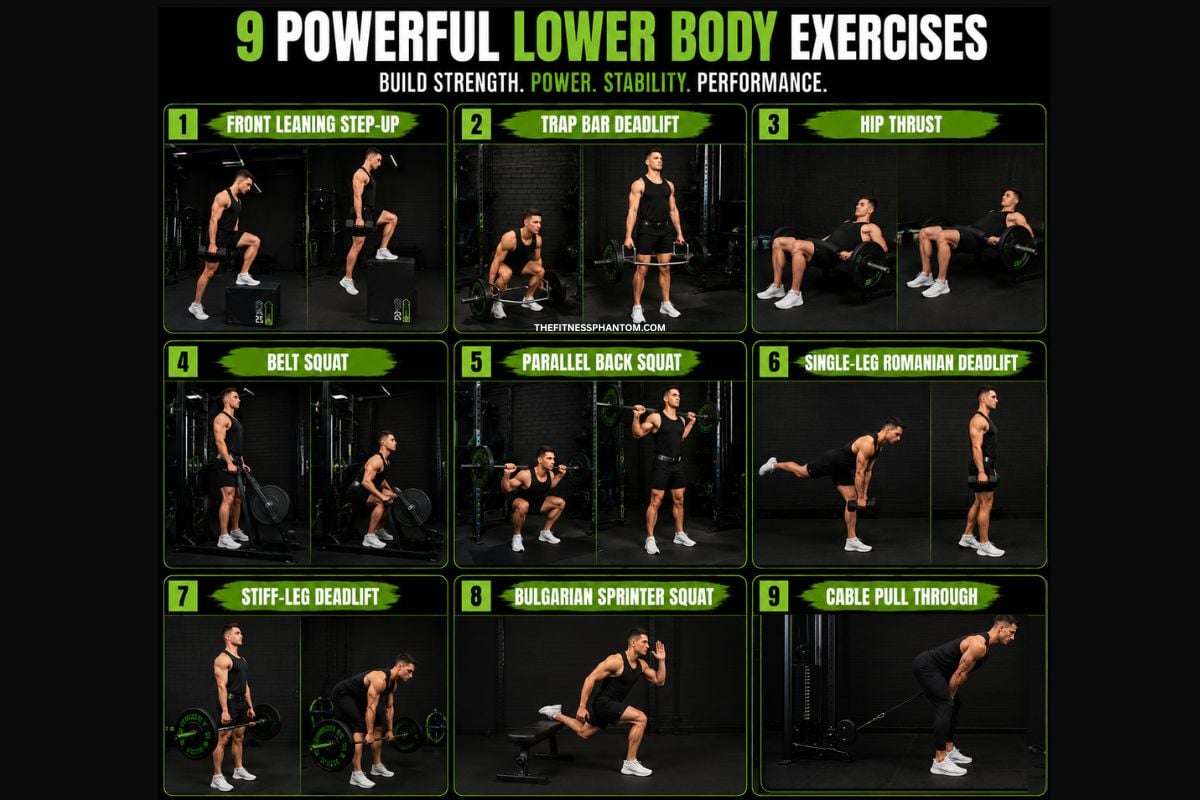
Compound exercises work on multiple muscles at the same time. For example, squats, deadlifts, step-ups, and pull-throughs. These exercises not only train glutes but also quads, hamstrings, and lower back, helping you build strength and promote hypertrophy.
1. Leaning Step-up
The step-up with slightly leaning forward is a great way to highly activate the gluteal muscles.1 Neto WK, Soares EG, Vieira TL, Aguiar R, Chola TA, Sampaio VL, Gama EF. Gluteus Maximus Activation during Common Strength and Hypertrophy Exercises: A Systematic Review. J Sports Sci Med. 2020 Feb 24;19(1):195-203. PMID: 32132843; PMCID: PMC7039033.
The gluteus maximus drives hip extension, while the gluteus medius and minimus stabilize the pelvis during the step-ups.
It also engages the quads and helps develop lower body strength.2 Krause Neto W, Krause TLV and Gama EF (2025) The impact of resistance training on gluteus maximus hypertrophy: a systematic review and meta-analysis. Front. Physiol. 16:1542334. doi: 10.3389/fphys.2025.1542334
You can do it with and without weight, but the weighted one produces higher muscle contraction and maximum results.
To perform weighted leaning step-up, you can use any equipment that you find comfortable holding, including dumbbells, kettlebells, and plates.
Barbell step-up is also a good option as it enhances mobility.
Step-up involves the following steps:
- Stand straight in a hip-width stance in front of the box, holding one dumbbell in each hand with your arms straight at your sides and palms facing your body. You can also keep the dumbbells on your shoulders by bending your elbows.
- Step your right foot on the box while keeping your left leg straight.
- Press your right foot into the box to straighten your right leg, and bring your left leg onto the box, so you’re staying in the standing position.
- Reverse the steps to complete one rep for your right leg. And repeat the same steps to perform the next rep with your left leg.
- Do the desired number of sets and repetitions with a 1-minute rest between each set.
- Always use your front foot to lift yourself onto the box.
Other step-up variations for training glutes:
- Diagonal Step-up (Stand at a 30-45° angle to the box and step diagonally forward onto the box)
- Lateral Step-up (Step sideways onto the box)
- Crossover Step-up (Stand beside the box and cross the outside leg over your body onto the box)
2. Hex Bar Deadlift

The hex-bar deadlift is a multi-joint compound exercise as it strengthens the legs, glutes, back, core, shoulders, and grip all at once.3 Chen S, Yang S, Zhang X, Ye J, Feng S, Huang W and Liang W (2026) Offset loading in hexagonal bar deadlift: a ‘stealth’ strategy for acutely modulating neuromuscular activation asymmetry and enhancing acute jump performance. Front. Physiol. 17:1768828. doi: 10.3389/fphys.2026.1768828
Your glutes work hard to extend your hips and help you stand up with the weight.
It activates the glutes more than the Sumo deadlift, split squat, and lunge.
It is also easier to perform than a conventional deadlift and puts less stress on the lumbar spine.4 Miller BA, Arroyo E, Tagesen EC, Jajtner AR. Relationships Between Hex Bar Deadlift One-Repetition Maximum and Maximal Isometric Pulls. Int J Exerc Sci. 2021 Dec 1;15(4):45-57. doi: 10.70252/BPGM4852. PMID: 36895846; PMCID: PMC9987429.
Including it in your compound workout routine is best to strengthen your glute muscles.
Steps for doing the hex bar deadlift:
- Stand upright in the hip-width stance in the middle of the hex bar.
- Push your hips back, bend your knees, and lower yourself to grab the handles of the trap bar.
- Keep your chest up and shoulder blades down so that you can lift the weight powerfully.
- Raise your hips and shoulders in the same range while maintaining a straight back.
- Take a long breath and lift the bar with full strength until your hips come forward.
- Hold for a couple of seconds, then slowly lower the weight onto the floor. That’s one rep.
- Keep your core tight during the whole lift.
3. Hip Thrust

The hip thrust is a popular glute-building strength exercise. It involves placing the weight on the hips, lowering it, then extending with full force.
It directly trains the gluteus maximus and gluteus medius, helping you build a stronger and curvier backside.5 Neto WK, Vieira TL, Gama EF. Barbell Hip Thrust, Muscular Activation and Performance: A Systematic Review. J Sports Sci Med. 2019;18(2):198-206. Published 2019 Jun 1. 6 Kassiano, Witalo & Kunevaliki, Gabriel & Costa, Daniella & Nunes, J.P. & de Castro e Souza, Pâmela & Tricoli, Ian & Ribeiro, Alex & Cyrino, Edilson. (2024). Addition of The Barbell Hip Thrust Elicits Greater Increases in Gluteus Maximus Muscle Thickness in Untrained Young Women. International Journal of Strength and Conditioning. 4. 10.47206/ijsc.v4i1.284.
It also strengthens the lower back, hamstrings, side quads, and abdominals.
You can do the hip thrust using different pieces of equipment, including a dumbbell, plate, and barbell.
The popular one is the barbell hip thrust because the barbell allows a full range of motion and helps you perform hip thrusts with heavier weight safely and effectively.
The hip thrust involves the following steps:
- Put the appropriate weight into the bar and attach a thick sponge to the center of the bar.
- Place your upper back on the bench with your feet flat on the floor (shoulder-width apart) in front of you, knees bent to 90 degrees, so your chest and knees are in line.
- Put a balance pad on your hip for extra safety, and place the bar on your hips.
- Keeping your core tight, thrust the bar upward as quickly as possible. Once you reach your top, hold for a couple of seconds and lower your hips to the start. That’s one rep.
- Focus on squeezing your Glutes throughout the movement.
Other hip thrust variations for activating gluteal muscles:
- Dumbbell Hip Thrust (good for beginners and ideal for home workouts)
- Smith Machine Hip Thrust (very stable, allowing you to focus on squeezing the glutes)
- Lever Hip Thrust Machine (safe and comfortable but not as effective as a barbell)
4. Belt Squat
The belt squat is a muscle-building compound exercise that works throughout the lower body, primarily the quads and glutes.
It is easier on the lower back, as it involves attaching the weight to your waist instead of placing the bar on your shoulders. So, if you don’t want to involve the upper body muscles (arms, shoulders, and abs), the belt squat is a good alternative option to the back squat.7 Joseph L, Reilly J, Sweezey K, Waugh R, Carlson LA, Lawrence MA. Activity of Trunk and Lower Extremity Musculature: Comparison Between Parallel Back Squats and Belt Squats. J Hum Kinet. 2020 Mar 31;72:223-228. doi: 10.2478/hukin-2019-0126. PMID: 32269663; PMCID: PMC7126258.
Follow the steps to perform a belt squat effectively:
- Wear the belt on your lower back and tightly tie it below your hips (below your stomach).
- Stand upright in front of the belt squat machine with your feet shoulder-width apart.
- Insert the weight according to your strength in the bar and attach the belt to the chain.
- Place your hands on the machine in front of you for help. That’s the start.
- Push your hips back, bend your knees, and squat down until your glutes are parallel to the ground.
- Hold for a couple of seconds, and then press into the floor with your feet to return to standing. That’s one complete repetition.
5. Back Squat
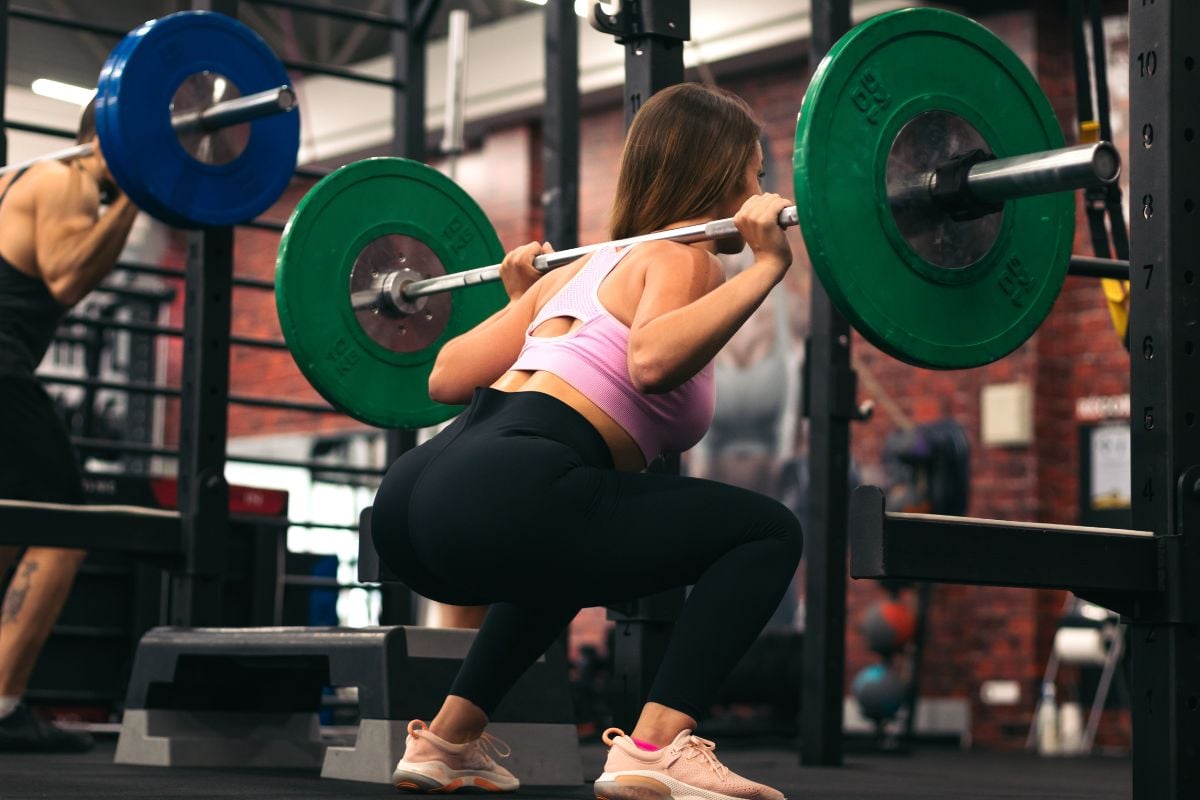
The back is a powerful exercise for developing lower-body strength and size.
It involves placing the loaded barbell on the back of the shoulders and squatting down.
It engages multiple muscles simultaneously, especially the quadriceps and glute maximus.8 Plotkin DL, Rodas MA, Vigotsky AD, McIntosh MC, Breeze E, Ubrik R, Robitzsch C, Agyin-Birikorang A, Mattingly ML, Michel JM, Kontos NJ, Lennon S, Frugé AD, Wilburn CM, Weimar WH, Bashir A, Beyers RJ, Henselmans M, Contreras BM, Roberts MD. Hip thrust and back squat training elicit similar gluteus muscle hypertrophy and transfer similarly to the deadlift. Front Physiol. 2023 Oct 9;14:1279170. doi: 10.3389/fphys.2023.1279170. PMID: 37877099; PMCID: PMC10593473.
The glutes are the primary hip extensor muscles during the back squat. Every time you lower into a squat and stand back up, your hips flex and then extend, contracting your glutes effectively.9 Myer GD, Kushner AM, Brent JL, Schoenfeld BJ, Hugentobler J, Lloyd RS, Vermeil A, Chu DA, Harbin J, McGill SM. The back squat: A proposed assessment of functional deficits and technical factors that limit performance. Strength Cond J. 2014 Dec 1;36(6):4-27. doi: 10.1519/SSC.0000000000000103. PMID: 25506270; PMCID: PMC4262933
The squats also stretch the gluteal muscles when you go into a deep squat, helping your glutes grow bigger.
Follow the steps to perform a back squat:
- Put the desired weight in the bar and get underneath it.
- Unrack the bar and place it on the back of your shoulders
- Keep your feet 1-1.5 times your shoulder-width with your toes pointing out.
- Lower into a squat until you feel the stretch in your glutes.
- Push through your heels and return to the standing position. That’s one rep.
Other Back Variations:
- Smith Machine Back Squats (better suited for those who want balance during exercise)
6. Single-Leg Romanian Deadlift
The single-leg Romanian deadlift is a strength and balance exercise.
It trains the lower back, hamstrings, and glutes and develops the posterior chain muscles.
It combines hip extension, a large stretch under load, and single-leg stability. The glutes not only move but also keep your pelvis and hip stable throughout the exercise, helping your gluteus maximus and medius grow stronger.10 Diamant W, Geisler S, Havers T, Knicker A. Comparison of EMG Activity between Single-Leg Deadlift and Conventional Bilateral Deadlift in Trained Amateur Athletes – An Empirical Analysis. Int J Exerc Sci. 2021 Apr 1;14(1):187-201. doi: 10.70252/MVFY4610. PMID: 34055137; PMCID: PMC8136577, 11Kim, Jioun & Jeon, Youngirl & Eom, Kilho. (2026). Biomechanical analysis of single-leg deadlift under the effect of instability. Scientific Reports. 10.1038/s41598-026-56871-1.
The single-leg RDL also improves overall balance and strengthens abdominal muscles.
You can perform this exercise using a barbell, dumbbell, or kettlebell, whichever equipment suits you the most.
The single-leg RDL involves the following steps:
- Insert the appropriate weight in the bar and grab it firmly with an overhand grip.
- Stand upright with your feet together, and keep your arms straight in front of your thighs.
- Lower the bar and lift your right leg off the floor simultaneously until your torso and leg are parallel to the ground.
- Pause for a moment and extend your trunk and legs in the upright position. That’s one rep. Perform three sets of eight to ten reps on each side.
7. Stiff-Leg Deadlift

The stiff-leg deadlift (SDL) is a solid exercise for stimulating the posterior chain muscles (lower back, hamstrings, and glutes).
The SDL provides decent stretch to the glutes and hamstrings muscles and heavily generates power from the glutes to extend the hip and get back to the standing position.12 GEHLSEN, G., DELONG, T., & WRIGHT, G. (1999). Electromyographic Activity of the Hamstrings During Performance of the Leg Curl, Stiff-Leg Deadlift, and Back Squat Movements. Journal of Strength & Conditioning Research, 13(2), 168–174.
It activates the gluteus more than the Romanian or conventional deadlift.13 Coratella G, Tornatore G, Longo S, Esposito F, Cè E. An Electromyographic Analysis of Romanian, Step-Romanian, and Stiff-Leg Deadlift: Implication for Resistance Training. Int J Environ Res Public Health. 2022 Feb 8;19(3):1903. doi: 10.3390/ijerph19031903. PMID: 35162922; PMCID: PMC8835508
If your goal is to add a compound movement to your glute training, consider including hex-bar or SDL in your glute hypertrophy program.
Follow these steps to perform a stiff-leg deadlift:
- Insert the desired weight into the barbell and place it close to your legs.
- Stand in a hip-to-shoulder-width stance with your feet above the barbell.
- Push your hips back and hinge forward to grab the barbell (don’t bend your knees).
- Keep your arms straight, shoulders back, and slowly extend your hips and use your lower body to get into the standing position to complete your first rep.
Other Stiff Leg Deadlift Variations:
- Dumbbell Stiff Leg Deadlift (you can go slightly deeper because the dumbbells travel beside your legs)
- Smith Machine Straight Leg Deadlift (the fixed bar path provides better stability)
8. Bulgarian Sprinter Squat
The Bulgarian sprinter squat is a unilateral exercise that hits the quads, glutes (GMax), and hamstrings simultaneously.14 Aygun-Polat E, Guzel NA, Guruhan S, Polat Y, Karatas N. Targeted muscle activation in Bulgarian split squat variations: effects of trunk position and suspension-based execution. BMC Sports Sci Med Rehabil. 2025 Aug 27;17(1):251. doi: 10.1186/s13102-025-01306-z. PMID: 40867012; PMCID: PMC12382192.
It’s another exercise where the gluteus works when you squat down and extend your hips, but it gives your glutes a better stretch than many other exercises.
It also helps improve balance and mobility and enhance lower-body athletic fitness.
The Bulgarian Sprinter Squat involves the following steps:
- Grab one dumbbell in each hand and stand upright with your arms straight at your sides.
- Place the top of your left foot on a bench behind you while keeping the other leg straight.
- Slightly lean forward, brace your core, and maintain a neutral spine position. That’s the start.
- Lower into a lunge until your rear knee is close to the floor. Make sure your front knee is directly above your ankle and doesn’t extend past your toes.
- Extend your knees to return to the starting position. That’s one rep.
9. Cable Pull Through
Cable pull-through is a popular machine exercise for glute hypertrophy training.
It involves setting the pulley at the lowest section and pulling the weight, like you’re doing a deadlift with a cable machine.
The cable provides resistance through nearly the entire movement, helping keep the glutes working continuously.
It is good for increasing glute size and strength and strengthening hamstrings.15 Dicus JR, Ellestad SH, Sheaffer JE, Weber CA, Novak NC, Holmstrup ME. A Comparison of Muscle Recruitment Across Three Straight-Legged, Hinge-Pattern Resistance Training Exercises. Int J Exerc Sci. 2023 Jan 1;16(4):12-22. doi: 10.70252/ZAOJ6139. PMID: 37113509; PMCID: PMC10124728.
You can also easily increase and decrease the weight on the machine to adjust according to your strength.
Here are step-by-step instructions for cable pull-through:
- Attach a rope handle to the low pulley.
- Stand facing away from the cable (2-3 steps away).
- Hold the rope between your legs.
- Stand with feet shoulder-width apart and soften your knees slightly.
- Push your hips backward while keeping your back neutral.
- Lower until you feel a stretch in your glutes and hamstrings.
- Drive your hips forward by squeezing your glutes.
- Stand tall without leaning backward. That’s one rep.
- Do as many as you like.
Isolation Glute Exercises
Isolation exercises primarily train one or two specific muscle groups at a time. They are good for shaping muscle and improving appearance.
10. Cable Standing Hip Extension
The cable standing hip extension involves lifting a weight backward (by extending your hip) using one leg at a time without bending the knees.
It is one of the best glute isolation exercises because it trains the glutes from an angle that doesn’t involve other lower body muscles, such as quads and hamstrings.
And the cable provides resistance throughout the entire movement, keeping your glutes working from start to finish and helping them achieve better shape.
Follow the steps to perform standing hip extension:
- Attach an ankle strap to one ankle and connect it to the low pulley of a cable machine.
- Stand facing the machine and hold the frame or handles for balance.
- Step back slightly until the cable gets straight. Keep your feet together or split.
- Brace your abdominal muscles and maintain a neutral spine with a slight bend in the standing knee.
- Extend your working leg backward by squeezing your glute (move only at the hip). Keep your leg mostly straight with a slight bend in the knee.
- Contract your glute as hard as possible at the top.
- Slowly return your leg to the starting position while resisting the pull of the cable.
- Complete the desired reps (10-15), then switch sides and repeat.
11. Cable Glute Kickback
The glute kickback is an isolation exercise. It involves kicking the weight back using one foot at a time in a leaned position, unlike upright.
The leaned-forward position allows a larger range of hip extension and typically more stress on the gluteus maximus.
You can alternate between glute kickback and standing hip extension on glute training day.
It also activates the abdominal muscles and lower back and is an excellent exercise for improving posture.
Step-by-step guide to perform cable glute kickback:
- Attach an ankle strap to one ankle and connect it to the low pulley of a cable machine.
- Face the machine and hold the frame or handles for support.
- Step back slightly, then lean your torso forward about 15-30°. Keep your back straight.
- Brace your core and keep a slight bend in your standing knee.
- Kick your working leg backward and slightly upward by driving from your hip and squeezing your glute. Keep your knee slightly bent throughout the movement.
- Pause for 1-2 seconds at the top and feel the contraction in your glutes.
- Slowly lower your leg back to the starting position.
- Perform 10-15 good controlled reps, then switch legs and repeat.
12. Reverse Hyperextension
The reverse hyperextension is a great exercise for strengthening the posterior chain muscles (hamstrings, glutes, and lower back).
It involves lifting your legs backward and upward by squeezing your glutes until your body forms a straight line on a reverse hyperextension machine.
It has a large range of hip motion that contracts your glutes decently and promotes muscle growth.
Step-by-step guide for reverse hyperextension:
- Lie face down on the machine with your hips positioned at the edge of the pad.
- Grip the handles firmly for stability or the sides of the bench for support.
- Let your legs hang straight down with your feet together and knees slightly bent.
- Brace your core and keep your spine in a neutral position.
- Lift your legs backward and upward by squeezing your glutes until your body forms a straight line (from head to heels).
- Feel the contraction in your glutes at the top for 1-2 seconds.
- Slowly lower your legs back to the starting position.
13. Frog Pump
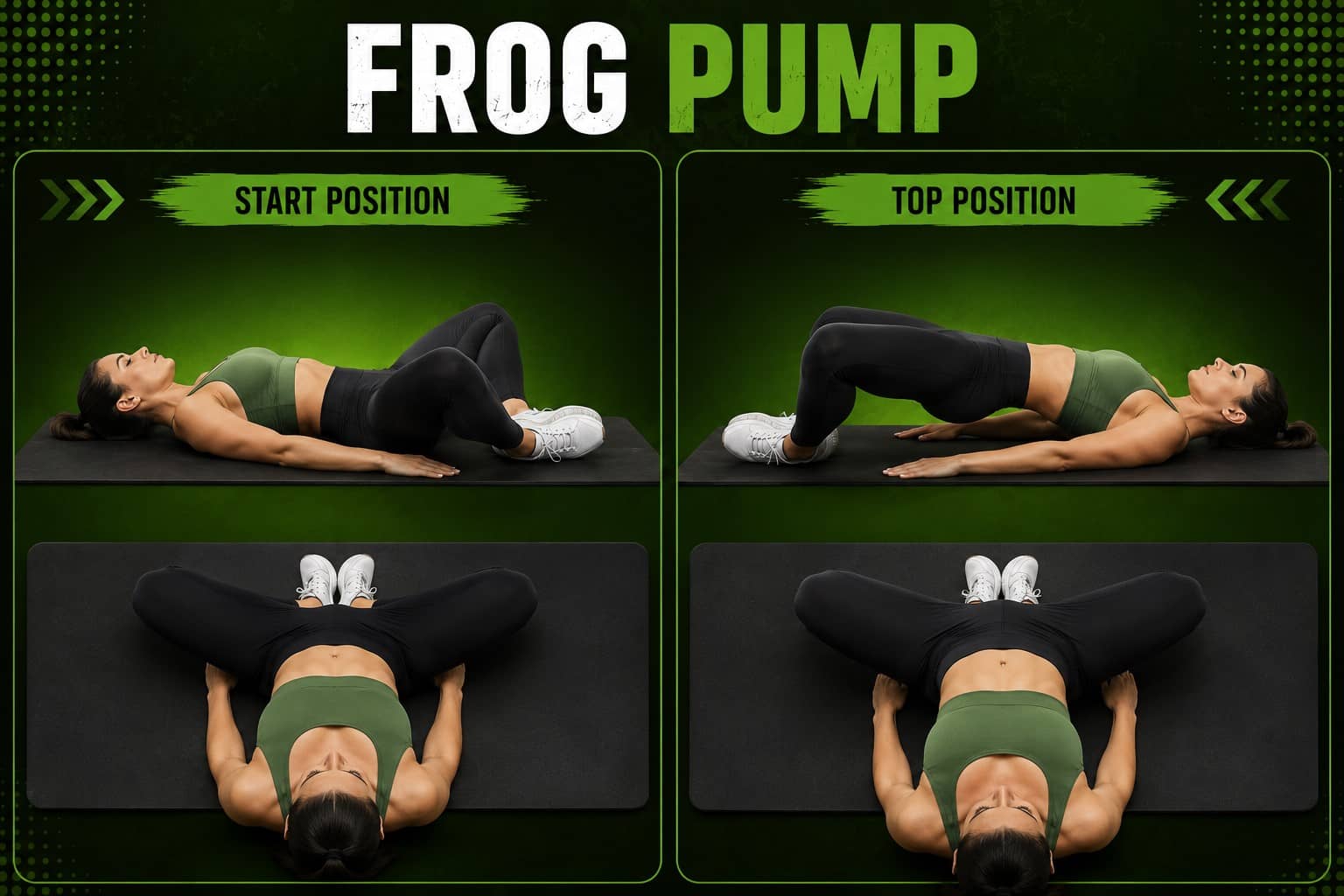
The frog pump is a bodyweight isolation exercise for strengthening gluteal muscles.
It involves keeping the soles of your feet together and your knees pointing out; this reduces hamstring involvement and helps you focus on squeezing the glutes throughout the movement.
It is easy to perform compared to other glute exercises, making it a good option for beginners and older people.
Steps to perform frog pump:
- Lie on your back with your knees bent.
- Bring the soles of your feet together and let your knees fall outward, creating a “frog” position.
- Keep your heels about 8-12 inches away from your hips (you can adjust slightly to find the strongest glute contraction for you).
- Rest your arms by your sides for support.
- Keep your core engaged and your neck relaxed. That’s the set-up.
- Drive through the outer edges of your feet while squeezing your glutes to lift your hips.
- Raise your hips until your body forms a straight line from your shoulders to your knees.
- You’ll feel the stress in your glutes at the top.
- Slowly lower your hips until they’re just above the floor to complete your first rep.
- Perform as many reps and sets as you like.
14. Single-leg Glute Bridge
The unilateral hip bridge involves performing a bridge while keeping one foot grounded and the other off the floor.16 Lehecka BJ, Edwards M, Haverkamp R, Martin L, Porter K, Thach K, Sack RJ, Hakansson NA. BUILDING A BETTER GLUTEAL BRIDGE: ELECTROMYOGRAPHIC ANALYSIS OF HIP MUSCLE ACTIVITY DURING MODIFIED SINGLE-LEG BRIDGES. Int J Sports Phys Ther. 2017 Aug;12(4):543-549. PMID: 28900560; PMCID: PMC5534144.
It activates all three gluteal muscles (gluteus maximus, gluteus medius, and gluteus minimus).17 Tobey, Kelcy & Mike, Jonathan. (2017). Single-Leg Glute Bridge. Strength and Conditioning Journal. 40. 1. 10.1519/SSC.0000000000000323.
It allows you to work on each side separately, helping you develop stronger and more balanced glutes.
It also engages the hamstrings and erector spinae and improves your posterior chain flexibility.
Follow the steps to perform a one-leg glute bridge:
- Lie on the floor with your face up, knees bent, and feet flat on the floor.
- Keep your arms straight at your sides, palms down.
- Brace your abdominal muscles, extend one leg, and lift it off the floor.
- Press your hands into the floor and raise your hips until your knees and chest are in a straight line.
- Feel the contraction for a few seconds before lowering your hip back to the floor. Your other leg will be extended off the floor throughout the movement.
- Perform the desired repetitions and repeat on the opposite side.
15. Single-leg Hip Thrust
The single-leg hip thrust is an isolation exercise that primarily strengthens and grow gluteal muscles.
It is performed in the same set-up as the bilateral hip thrust, but it involves lifting one leg off the floor during each rep.
Since only one leg is doing the work, the glutes work harder than in a regular hip thrust because the working glute generates almost all the force to lift your hips, making it a great glute-builder exercise.18 COMPARISON OF THE BILATERAL AND UNILATERAL BARBELL HIP THRUST – Cardiff School of Sport and Health Sciences, Cardiff Metropolitan University1 Centre for the Analysis of Motion, Entertainment Research and Applications, University of Bath UK2, Department for Health, University of Bath, Bath, UK3
It also allows training each glute individually, allowing you to improve strength imbalances and muscular symmetry.
Steps to perform a unilateral hip thrust:
- Grab a loaded barbell, put a thick sponge under it, and put it on your hips.
- Keep your upper back on the bench, your knees bent, and your feet flat on the floor.
- Lift your one leg off the floor, bend your knee, and brace your core. That’s the start.
- Thrust your hip upward until your glutes are fully engaged. Keep your core and glutes as tight as possible while thrusting your hips.
- Hold for a couple of seconds, then return to the start and repeat. Focus on squeezing your glutes throughout the movement.
16. Donkey Kick
The donkey kick is a glute-building exercise that requires little or no equipment.19 Ekechukwu, N., & Okoh, A. (2020). Effects of Six Weeks Donkey Kick and Squat Resistance Exercises on Gluteal Adiposity, Muscle Strength, and Muscle Bulk of Young Nigerian Female Adults: A Randomized Controlled Trial. International Journal of Medicine and Health Development, 25(1), 28–37. https://doi.org/10.4103/ijmh.IJMH_36_19
It involves getting on all fours and extending one leg backward while keeping the knee bent, which helps you train your glutes on each side separately.
It’s a good exercise option for people who train glutes at home with bodyweight or resistance bands.
Follow these steps to perform a donkey kick:
- Get on all fours with your hands under your shoulders and knees below your hips.
- Brace your core, keep your back flat, and get ready.
- Lift your knee and kick your leg upward and backward by squeezing your glute. Your knee remains bent.
- Pause for 1-2 seconds at the top and squeeze your glute.
- Slowly lower your knee back to the starting position without letting it slam to the floor.
- Perform the desired number of reps and repeat on the opposite side.
17. Long Leg March
The long leg march is a bodyweight compound exercise. It involves getting into a bridge position and alternately lifting one foot off the floor in a marching motion.
This exercise bolsters the glutes, hamstrings, lower back, and abdominal muscles and helps increase balance and flexibility.
Combining it with the other glute strengthening exercises will help you build a sturdy and defined buttock.
Steps to perform a long leg march:
- Lie on your back with your knees bent.
- Keep your feet about hip-width apart.
- Brace your core and press through your heels.
- Lift your hips until your body forms a straight line from your shoulders to your knees.
- Keeping your hips level, slowly lift one foot a few inches off the floor.
- Lower that foot back under control.
- Lift the opposite foot and repeat, alternating legs without letting your hips drop.
18. Clamshell
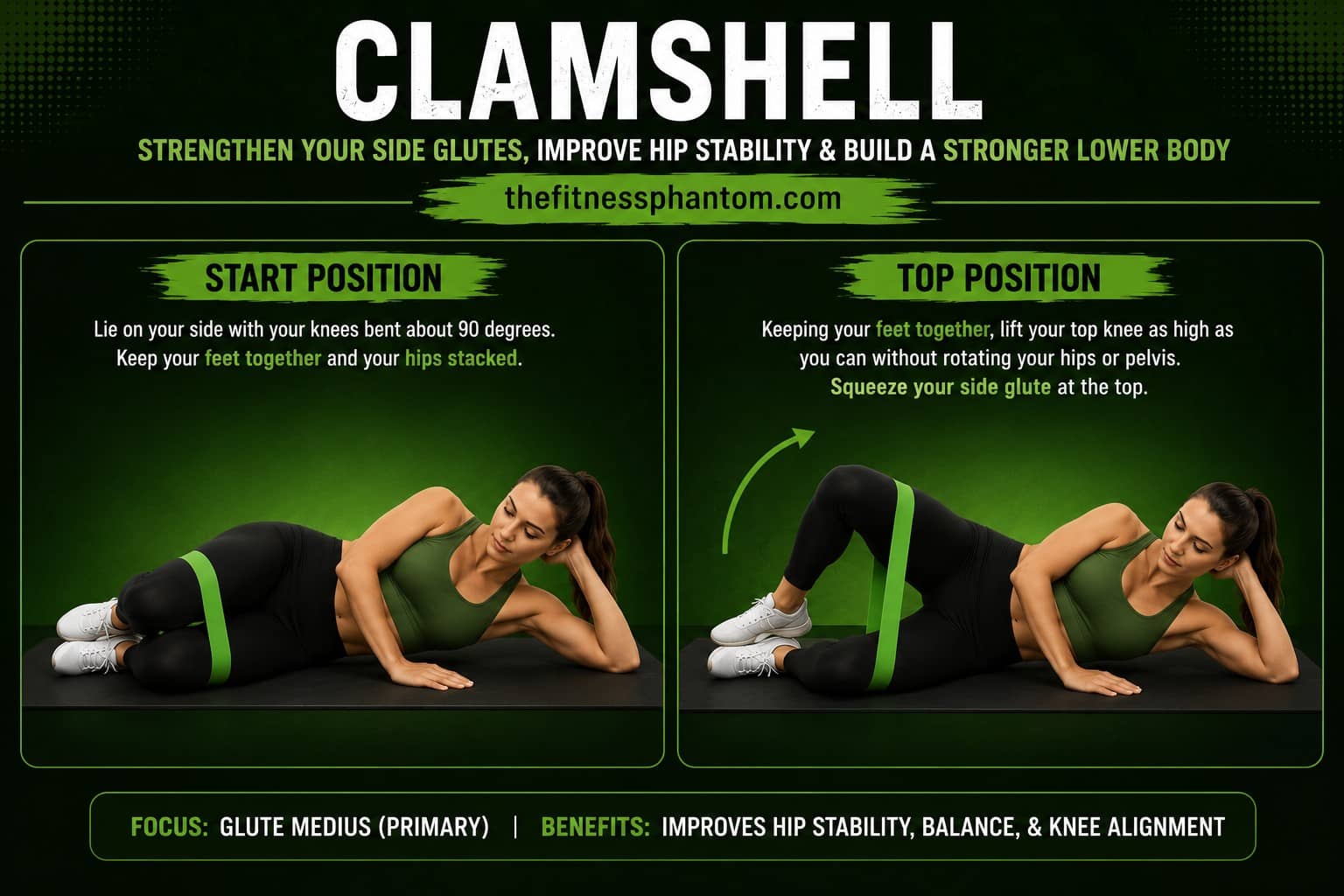
The Clamshell is a bodyweight or band-resisted hip exercise that targets the gluteus medius.20 Boren K, Conrey C, Le Coguic J, Paprocki L, Voight M, Robinson TK. Electromyographic analysis of gluteus medius and gluteus maximus during rehabilitation exercises. Int J Sports Phys Ther. 2011 Sep;6(3):206-23. PMID: 22034614; PMCID: PMC3201064, 21Jeong, Seom-Gyeul & Cynn, Heon-Seock & Lee, Jihyun & Choi, Sil-Ah & Kim, Daeun. (2019). Effect of Modified Clamshell Exercise on Gluteus Medius, Quadratus Lumborum, and Anterior Hip Flexor in Participants with Gluteus Medius Weakness. Journal of The Korean Society of Physical Medicine. 14. 9-19. 10.13066/kspm.2019.14.2.9
It involves opening the top knee while keeping your feet together, similar to a clam opening its shell.
Unlike hip thrusts or squats, the Clamshell is not designed to build large glutes. Instead, it’s one of the best exercises for improving hip stability, pelvic control, and side-glute strength.
Steps to perform Clamshell:
- Lie on your side with your legs stacked.
- Bend your knees to about 90 degrees.
- Keep your feet together throughout the exercise.
- Rest your head on your lower arm.
- Engage your core and keep your pelvis stable.
- Lift your top knee as high as you can without separating your feet or rolling your hips backward.
- Pause for one second at the top while squeezing your side glute.
- Slowly lower your knee back to the starting position.
- Perform the desired reps and repeat the same on the opposite side.
19. Fire Hydrant
The Fire Hydrant is a bodyweight or band-resisted glute isolation exercise that primarily targets the gluteus medius and gluteus minimus.
It involves lifting one bent leg out to the side while keeping your hands and knees on the floor.
The exercise gets its name because the movement resembles a dog lifting its leg next to a fire hydrant.
It won’t make the glutes big, but it improves glute health and hip stability.
Steps for Fire Hydrant:
- Get on all fours with your hands under your shoulders and knees beneath your hips.
- Keeping your knee bent, lift one leg out to the side as high as you comfortably can.
- Keep your hips facing the floor and avoid rotating your torso.
- Feel the squeeze in your side glute for a second, then lower your knee to the starting position.
- Perform the desired number of reps, then repeat on the other side.
20. Hip Airplanes
The hip airplane is a single-leg exercise to improve balance and hip stability.
It combines a single-leg hip hinge with controlled hip rotation, allowing you to work on the gluteus medius, gluteus maximus, and the deep hip stabilizers.22 Song JK, Yoo WG. Effects of modified hip airplane exercise on gluteal muscle activation in healthy individuals. J Back Musculoskelet Rehabil. 2025 Sep;38(5):1021-1030. doi: 10.1177/10538127251322857. Epub 2025 Mar 28. PMID: 40152281.
The steps involved in hip airplanes:
- Stand on one leg with a slight bend in your knee.
- Hinge at your hips and lean your torso forward until it’s nearly parallel to the floor. You can hold something for support.
- Extend your opposite leg straight behind you.
- Slowly rotate your pelvis open by lifting the hip of your raised leg toward the ceiling while maintaining balance.
- Slowly rotate your pelvis closed, bringing it back toward the floor in a steady fashion.
- Repeat the movement without losing balance, then switch legs.
The Bottom Line
The gluteal muscles are involved in various activities, from sitting on a chair and jogging to lifting weights and jumping.
Solid glutes provide stability to the upper body, reduce the risk of lower back and hamstring injuries, help you sit for a longer duration, and support you during heavy compound lifting.
So, whether you’re an athlete, powerlifter, bodybuilder, or a typical fitness enthusiast, you can include some of the best compound glute exercises to build sturdy buttocks.
The compound and isolation glute exercises activate and engage the gluteal muscles in an effective way and produce maximum results.
References
- 1Neto WK, Soares EG, Vieira TL, Aguiar R, Chola TA, Sampaio VL, Gama EF. Gluteus Maximus Activation during Common Strength and Hypertrophy Exercises: A Systematic Review. J Sports Sci Med. 2020 Feb 24;19(1):195-203. PMID: 32132843; PMCID: PMC7039033. ↩︎
- 2Krause Neto W, Krause TLV and Gama EF (2025) The impact of resistance training on gluteus maximus hypertrophy: a systematic review and meta-analysis. Front. Physiol. 16:1542334. doi: 10.3389/fphys.2025.1542334 ↩︎
- 3Chen S, Yang S, Zhang X, Ye J, Feng S, Huang W and Liang W (2026) Offset loading in hexagonal bar deadlift: a ‘stealth’ strategy for acutely modulating neuromuscular activation asymmetry and enhancing acute jump performance. Front. Physiol. 17:1768828. doi: 10.3389/fphys.2026.1768828 ↩︎
- 4Miller BA, Arroyo E, Tagesen EC, Jajtner AR. Relationships Between Hex Bar Deadlift One-Repetition Maximum and Maximal Isometric Pulls. Int J Exerc Sci. 2021 Dec 1;15(4):45-57. doi: 10.70252/BPGM4852. PMID: 36895846; PMCID: PMC9987429. ↩︎
- 5Neto WK, Vieira TL, Gama EF. Barbell Hip Thrust, Muscular Activation and Performance: A Systematic Review. J Sports Sci Med. 2019;18(2):198-206. Published 2019 Jun 1. ↩︎
- 6Kassiano, Witalo & Kunevaliki, Gabriel & Costa, Daniella & Nunes, J.P. & de Castro e Souza, Pâmela & Tricoli, Ian & Ribeiro, Alex & Cyrino, Edilson. (2024). Addition of The Barbell Hip Thrust Elicits Greater Increases in Gluteus Maximus Muscle Thickness in Untrained Young Women. International Journal of Strength and Conditioning. 4. 10.47206/ijsc.v4i1.284. ↩︎
- 7Joseph L, Reilly J, Sweezey K, Waugh R, Carlson LA, Lawrence MA. Activity of Trunk and Lower Extremity Musculature: Comparison Between Parallel Back Squats and Belt Squats. J Hum Kinet. 2020 Mar 31;72:223-228. doi: 10.2478/hukin-2019-0126. PMID: 32269663; PMCID: PMC7126258. ↩︎
- 8Plotkin DL, Rodas MA, Vigotsky AD, McIntosh MC, Breeze E, Ubrik R, Robitzsch C, Agyin-Birikorang A, Mattingly ML, Michel JM, Kontos NJ, Lennon S, Frugé AD, Wilburn CM, Weimar WH, Bashir A, Beyers RJ, Henselmans M, Contreras BM, Roberts MD. Hip thrust and back squat training elicit similar gluteus muscle hypertrophy and transfer similarly to the deadlift. Front Physiol. 2023 Oct 9;14:1279170. doi: 10.3389/fphys.2023.1279170. PMID: 37877099; PMCID: PMC10593473. ↩︎
- 9Myer GD, Kushner AM, Brent JL, Schoenfeld BJ, Hugentobler J, Lloyd RS, Vermeil A, Chu DA, Harbin J, McGill SM. The back squat: A proposed assessment of functional deficits and technical factors that limit performance. Strength Cond J. 2014 Dec 1;36(6):4-27. doi: 10.1519/SSC.0000000000000103. PMID: 25506270; PMCID: PMC4262933 ↩︎
- 10Diamant W, Geisler S, Havers T, Knicker A. Comparison of EMG Activity between Single-Leg Deadlift and Conventional Bilateral Deadlift in Trained Amateur Athletes – An Empirical Analysis. Int J Exerc Sci. 2021 Apr 1;14(1):187-201. doi: 10.70252/MVFY4610. PMID: 34055137; PMCID: PMC8136577 ↩︎
- 11Kim, Jioun & Jeon, Youngirl & Eom, Kilho. (2026). Biomechanical analysis of single-leg deadlift under the effect of instability. Scientific Reports. 10.1038/s41598-026-56871-1. ↩︎
- 12GEHLSEN, G., DELONG, T., & WRIGHT, G. (1999). Electromyographic Activity of the Hamstrings During Performance of the Leg Curl, Stiff-Leg Deadlift, and Back Squat Movements. Journal of Strength & Conditioning Research, 13(2), 168–174. ↩︎
- 13Coratella G, Tornatore G, Longo S, Esposito F, Cè E. An Electromyographic Analysis of Romanian, Step-Romanian, and Stiff-Leg Deadlift: Implication for Resistance Training. Int J Environ Res Public Health. 2022 Feb 8;19(3):1903. doi: 10.3390/ijerph19031903. PMID: 35162922; PMCID: PMC8835508 ↩︎
- 14Aygun-Polat E, Guzel NA, Guruhan S, Polat Y, Karatas N. Targeted muscle activation in Bulgarian split squat variations: effects of trunk position and suspension-based execution. BMC Sports Sci Med Rehabil. 2025 Aug 27;17(1):251. doi: 10.1186/s13102-025-01306-z. PMID: 40867012; PMCID: PMC12382192. ↩︎
- 15Dicus JR, Ellestad SH, Sheaffer JE, Weber CA, Novak NC, Holmstrup ME. A Comparison of Muscle Recruitment Across Three Straight-Legged, Hinge-Pattern Resistance Training Exercises. Int J Exerc Sci. 2023 Jan 1;16(4):12-22. doi: 10.70252/ZAOJ6139. PMID: 37113509; PMCID: PMC10124728. ↩︎
- 16Lehecka BJ, Edwards M, Haverkamp R, Martin L, Porter K, Thach K, Sack RJ, Hakansson NA. BUILDING A BETTER GLUTEAL BRIDGE: ELECTROMYOGRAPHIC ANALYSIS OF HIP MUSCLE ACTIVITY DURING MODIFIED SINGLE-LEG BRIDGES. Int J Sports Phys Ther. 2017 Aug;12(4):543-549. PMID: 28900560; PMCID: PMC5534144. ↩︎
- 17Tobey, Kelcy & Mike, Jonathan. (2017). Single-Leg Glute Bridge. Strength and Conditioning Journal. 40. 1. 10.1519/SSC.0000000000000323. ↩︎
- 18COMPARISON OF THE BILATERAL AND UNILATERAL BARBELL HIP THRUST – Cardiff School of Sport and Health Sciences, Cardiff Metropolitan University1 Centre for the Analysis of Motion, Entertainment Research and Applications, University of Bath UK2, Department for Health, University of Bath, Bath, UK3 ↩︎
- 19Ekechukwu, N., & Okoh, A. (2020). Effects of Six Weeks Donkey Kick and Squat Resistance Exercises on Gluteal Adiposity, Muscle Strength, and Muscle Bulk of Young Nigerian Female Adults: A Randomized Controlled Trial. International Journal of Medicine and Health Development, 25(1), 28–37. https://doi.org/10.4103/ijmh.IJMH_36_19 ↩︎
- 20Boren K, Conrey C, Le Coguic J, Paprocki L, Voight M, Robinson TK. Electromyographic analysis of gluteus medius and gluteus maximus during rehabilitation exercises. Int J Sports Phys Ther. 2011 Sep;6(3):206-23. PMID: 22034614; PMCID: PMC3201064 ↩︎
- 21Jeong, Seom-Gyeul & Cynn, Heon-Seock & Lee, Jihyun & Choi, Sil-Ah & Kim, Daeun. (2019). Effect of Modified Clamshell Exercise on Gluteus Medius, Quadratus Lumborum, and Anterior Hip Flexor in Participants with Gluteus Medius Weakness. Journal of The Korean Society of Physical Medicine. 14. 9-19. 10.13066/kspm.2019.14.2.9 ↩︎
- 22Song JK, Yoo WG. Effects of modified hip airplane exercise on gluteal muscle activation in healthy individuals. J Back Musculoskelet Rehabil. 2025 Sep;38(5):1021-1030. doi: 10.1177/10538127251322857. Epub 2025 Mar 28. PMID: 40152281. ↩︎