If you’re looking for barbell push exercises to incorporate into your push, pull, and legs (PPL) workout program, you can check out this article.
I’ll share all the popular barbell push workouts that you can do on your push day.
It includes compound, isolation, unilateral, and power exercises. These exercises are great for everyone, from beginners to experienced lifters and from gym-goers to athletes.
You’ll see detailed information about each exercise, such as stepwise instructions, benefits, rep-set suggestions, and correction tips.
Before I share all exercises, let’s see what the overall muscles push workouts train and what the pros and cons of performing push exercises with barbells.
Overall Muscles Worked During the Barbell Push Workout
Barbell pushing exercises strengthen and tone upper body muscles, particularly the chest, shoulders, and triceps. They also engage abdominal muscles and help develop a sturdy core.
- Chest: The pectoralis muscles, also known as pecs, are one of the largest muscles of the upper body that engage during bench press variations, such as flat, incline, and decline bench presses. Having sturdy and sizeable pecs helps improve the appearance of your upper body physique.
- Shoulder: The shoulder is made of three muscles: the anterior delts, the lateral delts, and the posterior delts. However, the front deltoid is the primary muscle worked during barbell push exercises.
- Triceps: The triceps is the largest arm muscle located on the back of your upper arm. It has two heads, long and short, and almost all the muscles are activated during barbell push workouts, such as narrow grip bench press and French press.
Pros & Cons of Doing Push Exercises with Barbells
Barbells, dumbbells, machines, and kettlebells are all excellent pieces of equipment and allow you to do myriad exercises. However, when it comes to doing push exercises, the barbell has a few advantages and disadvantages.
PROS
Barbells help lift more weight than dumbbells: If you want to lift more weight, you can exercise with barbells. A barbell helps lift 17 percent more weight than dumbbells during the bench press, as shown in a study published by the Journal of Sports Science. 1A comparison of muscle activity and 1-RM strength of three chest-press exercises with different stability requirements – Journal of Sports Science
Barbells provide a better range of motion than machines: A barbell is a free weight and allows a greater range of motion than machines. A better range of motion helps you perform exercises efficiently as well as improve your balance.
CONS
A barbell is a useful tool, but it also has one downside. For example, you can not perform many unilateral exercises using one arm at a time, and you won’t be able to correct muscle and strength imbalance if you want. That’s why incorporating dumbbell push exercises along with barbells will help you achieve maximum results.
The Best Barbell Push Exercises to Build Muscle
- Barbell Bench Press (Incline, Flat, and Decline)
- Overhead Press (Seated, Military, and Behind The Neck)
- Dual Arm Landmine Press (Dual arm & Single-arm)
- Barbell Push Press
- Close-Grip Bench Press
- Barbell French Press or Skull Crusher
1-3. Barbell Bench Press
| Exercise Level | Intermediate |
| Primary Target Muscle | Chest |
| Exercise Goal | Build Strength and Mass |
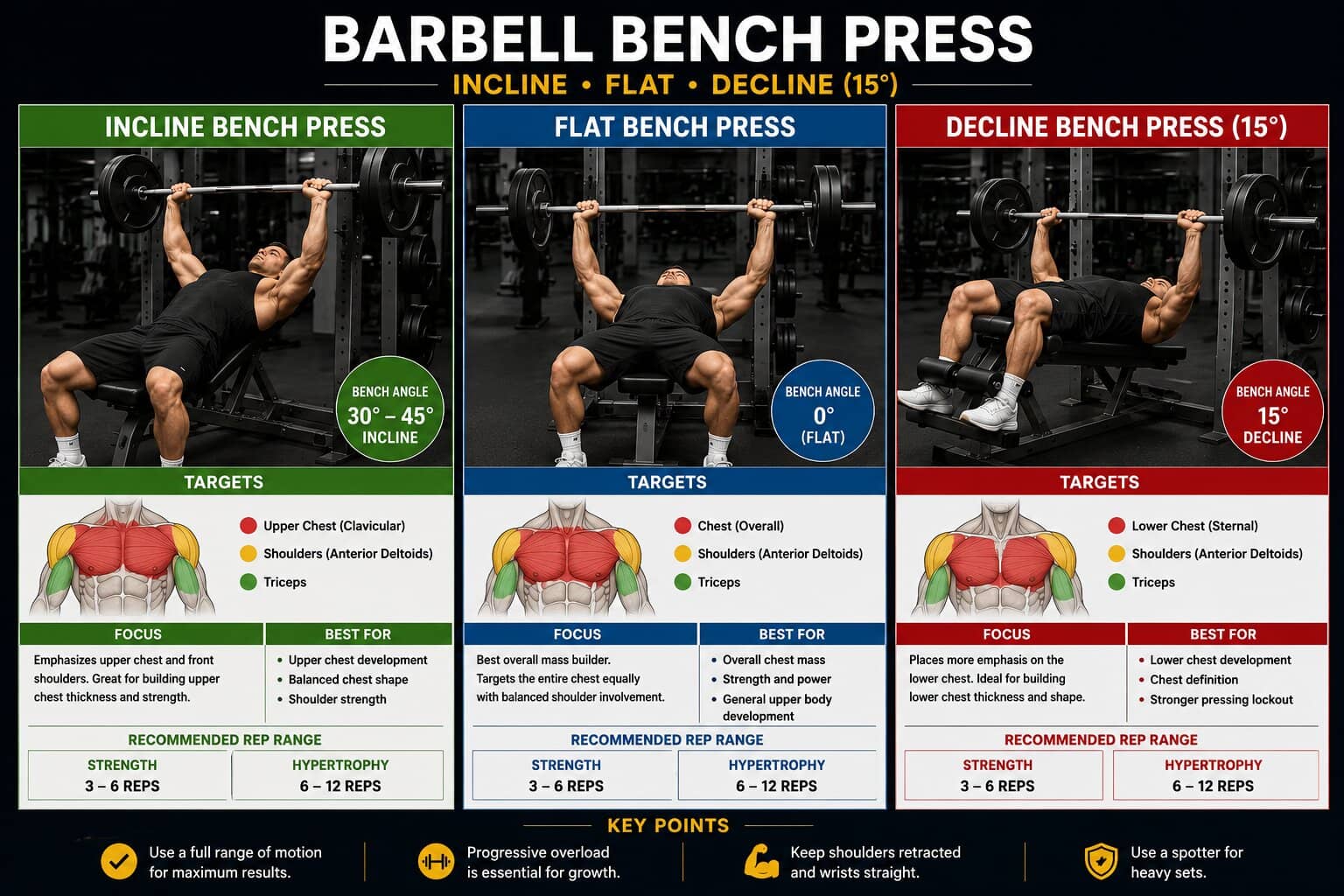
The barbell bench press is the most popular upper body exercise that helps build stronger and sizeable pecs. It also works out your triceps, shoulders, and core.2 Schick EE, Coburn JW, Brown LE, Judelson DA, Khamoui AV, Tran TT, Uribe BP. A comparison of muscle activation between a Smith machine and free weight bench press. J Strength Cond Res. 2010 Mar;24(3):779-84. doi: 10.1519/JSC.0b013e3181cc2237. Erratum in: J Strength Cond Res. 2011 Jan;25(1):286. PMID: 20093960
Research has shown that the bench press highly activates the pectoralis major compared to nine chest exercises, including pushups, dips, and chest flyes. 3ACE Fitness Research:Top 3 Most Effective Chest Exercises
The bench also helps improve balance and grip because it involves holding the weight without assistance.
It is one of the foundational movements used in bodybuilding, powerlifting, athletic training, and general fitness.
Steps Involve:
- Put the appropriate weight into the bar. Begin with a light weight, approximately 30-40% of your 1RM.
- Lie on the bench with your face underneath the barbell.
- Grab the bar with an underhand grip with your hands slightly wider than shoulder-width.
- Brace your abdominal muscles, unrack the bar, and hold it above your chest. Make sure your chest is above your hips, and your elbows are not flaring outwards.
- Lower the bar close to your chest, inhale, and press it directly over your chest until your arms are straight.
- Exhale, pause for one second, and lower the barbell close to your chest again. That’s one rep.
Correction & Performance Tips:
- Perform each rep in a controlled fashion, and make sure you lower the bar on the same spot during each rep.
- Try not to hold the bar at the bottom for more than one or two seconds.
- Before pressing heavily, perform warm-up exercises for shoulder mobility and rotator cuff activation.
- Start with light weight and go heavy as you progress for the next sets.
The Reasons for Popularity
- Builds overall upper-body size
- Increases pushing strength
- Improves athletic performance
- Helps progressive overload easily (increase the weight on the bar or reps with the same load for gaining strength over time).
- Develops chest thickness and density
- Trains multiple muscles together
It is also one of the three lifts in Powerlifting competitions.
Bench Press Variations
The bench press is also performed at different angles to hit the different areas of the chest. For example, the incline bench press (30-45 degree inclined) targets the chest upper portions, and the decline bench press (15-20 degree) focuses on the lower chest.
The combination of all three bench press variations improves the size, definition, and appearance of the chest muscles.
Reps, Sets, and Frequency Recommendations
Reps: Keep the rep ranges 2 to 5 for strength and 5 to 12 for hypertrophy. Slow descent and press normally is the way to gain size and strength, so do not rush.
Sets: 2-4 sets are good for beginners, and 4-6 sets are ideal for advanced lifters.
Frequency: 1 time a week is enough for beginners and those who want to maintain fitness, while twice a week is good for those who want to gain size and strength.
Who Can Do Bench Press and Who Should Avoid?
Free weight or manual bench press isn’t for everyone, especially beginners. It requires control, balance, and strength to do it correctly. But those lifting for a while can do the bench press easily.
It is not limited to bodybuilders and powerlifters; even if you are an athlete (any sport), doing bench press will help you enhance your performance.
But avoid if you have a shoulder injury, wrist pain, or poor shoulder mobility. You can try the bench press with light dumbbells to prepare for the manual bench press.
4-6. Overhead Press
| Exercise Level | Beginner to Intermediate |
| Target Muscle | Shoulder |
| Exercise Goal | Increase Strength and Mass |
| Exercises | Seated, Military, & Behind-the-Neck |
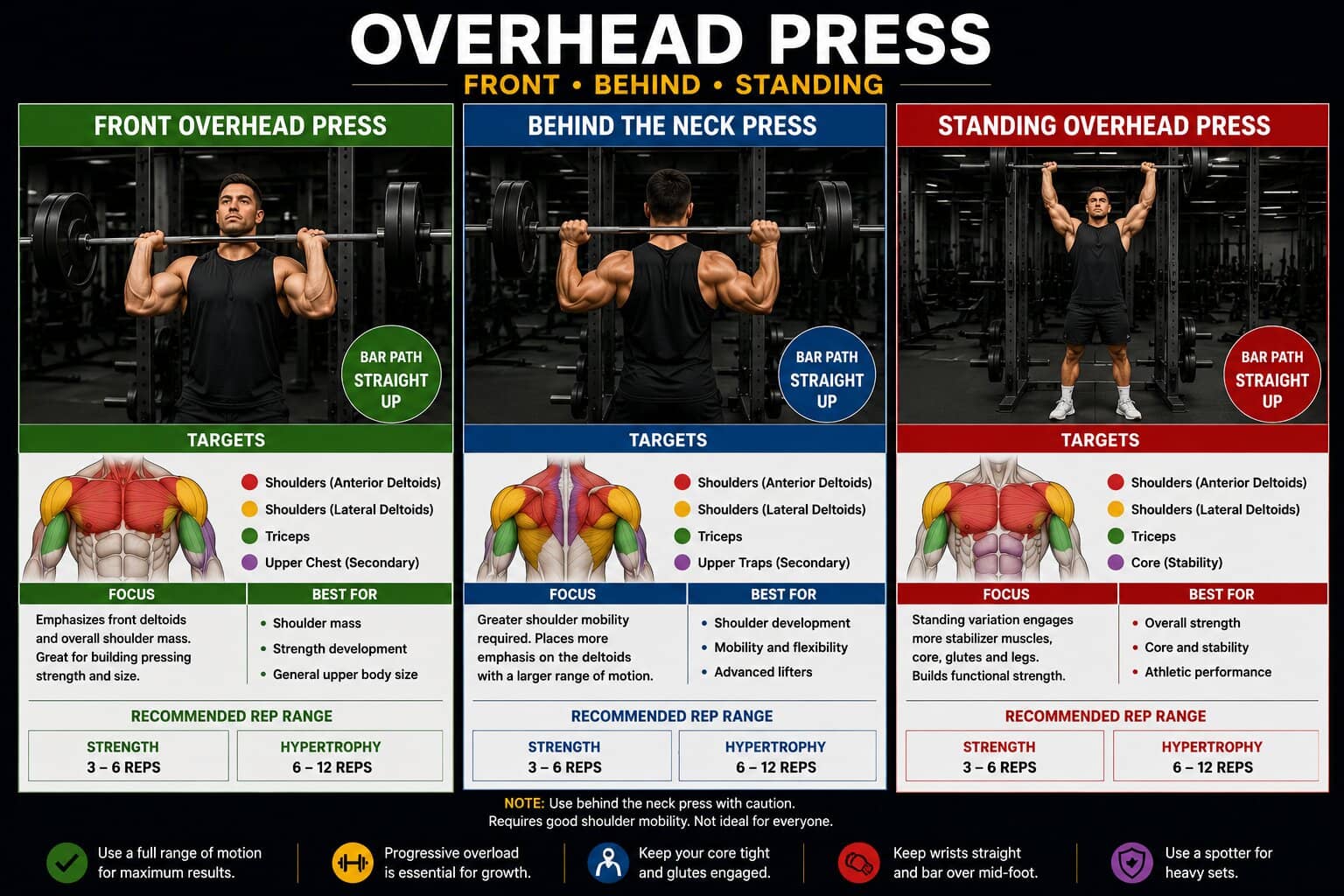
The overhead barbell press is a great exercise for building stronger, sculpted, and bigger shoulders.4Campos YAC, Vianna JM, Guimarães MP, Oliveira JLD, Hernández-Mosqueira C, da Silva SF, Marchetti PH. Different Shoulder Exercises Affect the Activation of Deltoid Portions in Resistance-Trained Individuals. J Hum Kinet. 2020 Oct 31;75:5-14. doi: 10.2478/hukin-2020-0033. PMID: 33312291; PMCID: PMC7706677
It has three variations: seated overhead press, standing or military press, and behind-the-neck press. All three variations target the shoulders from all angles and build strength and grow muscle size.
Unlike the bench press, the overhead press develops strength in a vertical plane, making it highly effective for athletes and overall functional fitness.
Steps Involve:
- Put the suitable weight into the bar.
- Grip the bar firmly with an underhand grip, hands shoulder-width apart.
- Bend your elbows and hold the barbell at your shoulder height. Make sure your elbows are not pointing completely outward.
- Brace your abdominal muscles and press the bar overhead until your arms are straight.
Place the barbell behind your head for the behind-the-neck press.
Correction & Performance Tips:
- You can use a gym belt during standing overhead presses, as it provides stability to your lower back and reduces the risk of low back pain.
- Keep the barbell at your shoulder level and repeat the desired number of times.
- Move your head slightly back while pressing the bar.
- Avoid flaring your elbows out as much as possible.
- Perform the overhead press early in your workout.
The Reasons for Popularity
- The best exercise for building broader shoulders.
- Improve pressing strength, power, and athleticism.5 Kroell, Jordan & Mike, Jonathan. (2017). Exploring the Standing Barbell Overhead Press. Strength and Conditioning Journal. 39. 1. 10.1519/SSC.0000000000000324.
- The fast overhead press (push press) builds explosiveness.
Overhead Press Variations
You can do overhead presses in multiple ways with barbells, including seated, standing, behind-the-neck, and push press (you’ll see more about it below).
The seated overhead press is good for people who want to push heavy weights.
The standing overhead press involves core muscles (abs and lower back) and improves balance.
The behind-the-neck press trains the medial, posterior, and partly anterior deltoid.6 Coratella G, Tornatore G, Longo S, Esposito F, Cè E. Front vs Back and Barbell vs Machine Overhead Press: An Electromyographic Analysis and Implications For Resistance Training. Front Physiol. 2022 Jul 22;13:825880. doi: 10.3389/fphys.2022.825880. PMID: 35936912; PMCID: PMC9354811.
The push press is great for people who want to enhance their explosive strength. It can be done both seated and standing.
Reps, Sets, and Frequency Recommendations
Reps: Keep the rep ranges 3 to 6 for strength, 6 to 12 for hypertrophy, 12-20 push presses for power and endurance.
Sets: 2-4 sets are good for beginners, and 4-6 sets are ideal for advanced lifters.
Frequency: Once a week is enough for beginners, while twice a week is good for those who want to gain size and strength.
Who Can Do Overhead Press and Who Should Avoid?
The overhead press is suitable for all fitness enthusiats, from beginners to elite lifters. However, people with poor shoulder mobility or injuries should avoid or perform under a professional.
7-8. Landmine Press
| Exercise Level | Beginner to Intermediate |
| Target Muscle | Chest and Shoulder |
| Exercise Goal | Build Muscle and Strength |
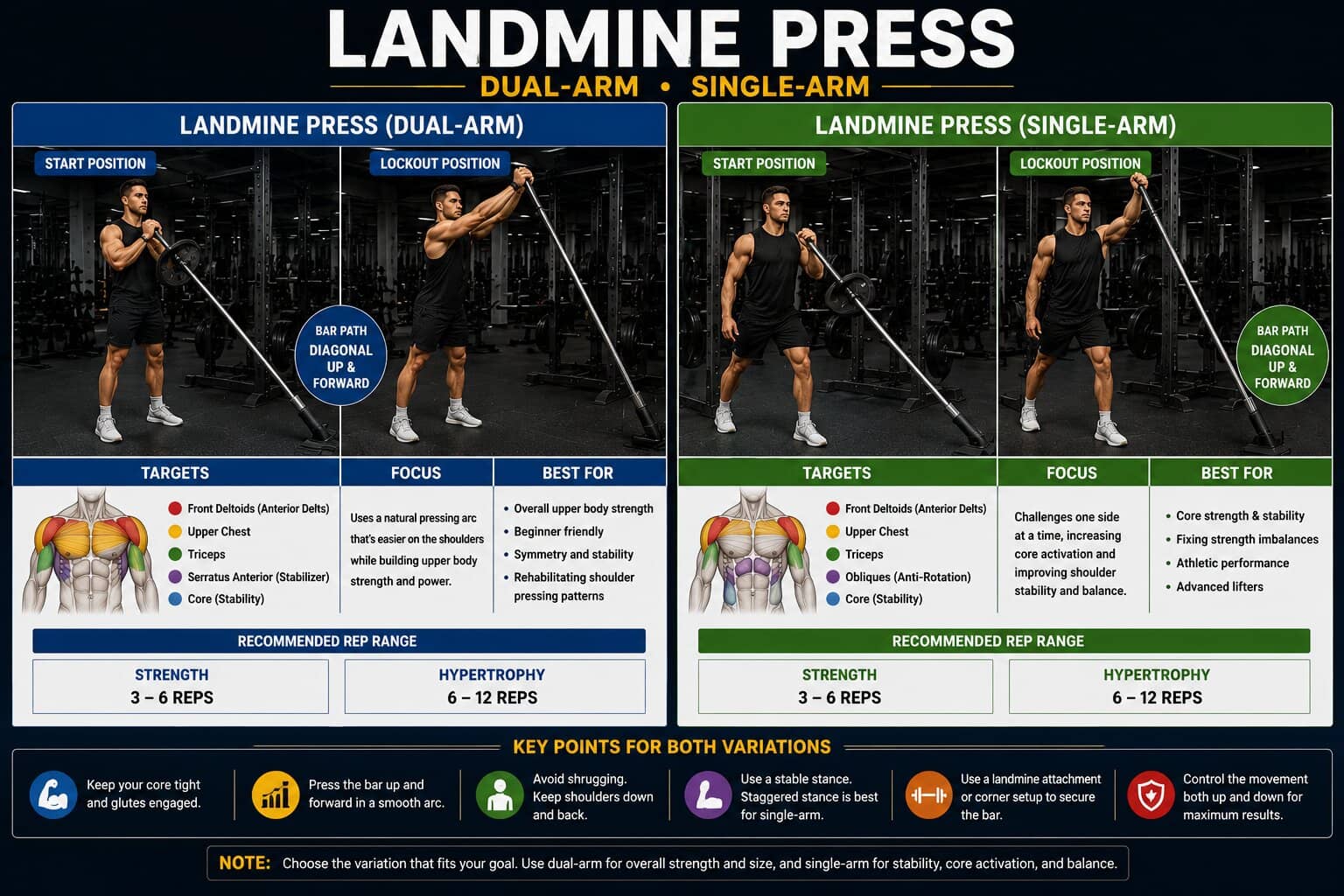
The landmine press involves placing one end of a barbell on the floor (corner of the wall) or a landmine attachment while you press the other end upward and forward.
It can be done in two ways: using both hands and one arm at a time (both in a seated or standing position). These are functional compound movements.
They strengthen the chest and shoulders simultaneously (especially the anterior deltoids and the upper chest) and help build an athletic upper body.
Unlike traditional overhead presses, it uses a natural arcing movement that is often easier on the shoulders while still building strength and muscle.
You don’t need a bench or any additional equipment to perform this exercise; all you need is a barbell and weight plates.
Steps Involve:
- Place one end of the bar in the corner of the wall and insert the weight plates into the other.
- Sit on your knees, grab the bar with your hands, and hold it at your chest level. For the one-arm press, sit on one knee while keeping the other foot flat on the ground and holding the bar with one hand.
- Slightly lean forward, keep your back straight, and brace your core. That’s the start.
- Press the barbell toward the ceiling until your arms are straight.
- Pause for one second, then return to the start.
Correction & Performance Tips
- You can place a foam pad under your knees for comfort.
- Start with a lightweight and increase the weight in your subsequent sets.
- Keep your shoulders down and stable, and perform each rep with better control.
- Keep your abdominals tight and chest up throughout the movement.
The Reasons for Popularity
- A good alternative for overhead press.
- Easier on the shoulder joints.
- A functional exercise to engage multiple upper-body muscles simultaneously.7 Park BJ, Jang MY, Seon SY. The effects of a 16-week periodized linear strength training program incorporating landmine exercises on physical performance in professional female volleyball players. Phys Act Nutr. 2025 Dec;29(4):75-82. doi: 10.20463/pan.2025.0037. Epub 2025 Dec 30. PMID: 41508644; PMCID: PMC12784033.
Landmine Press Variations
The landmine press usually has two variations: the two-arm and single-arm. Both can be done in a seated or standing position.
The one-arm landmine press focuses more on your weaker side and corrects strength and muscle imbalance. It’s a great exercise if you want to work on one side of your delt individually.
The seated ones are good if you want to press heavy weights with better control.
Reps, Sets, and Frequency Recommendations
Reps: 6 to 12 for hypertrophy and 12-20 for power and endurance.
Sets: 2-4 sets are good for beginners, and 4-6 sets for experienced lifters.
Frequency: Once a week is suitable. The other day, you could do overhead press.
Who Can Do Landmine Press and Who Should Avoid?
The landmine press is good for everyone, often more comfortable than traditional overhead presses.
But if you have elbow pain, shoulder discomfort, and a stiff wrist, you’ll find it challenging to do it.
9. Barbell Push Press
| Exercise Level | Intermediate |
| Target Muscle | Shoulder and Core |
| Exercise Goal | Build Strength, Speed, and Muscle |
The push press is one of the high-intensity exercises that burns significant calories and builds muscles at the same time. It is an excellent way to work on strength, power, and explosiveness.8 Bishop, Chris & Chavda, Shyam & Turner, Anthony. (2017). Exercise Technique: The Push Press. Strength and Conditioning Journal. 40. 1. 10.1519/SSC.0000000000000321.
It strengthens many upper-body muscles at once, particularly the shoulders and quads.
If you’re an athlete, you can also incorporate this exercise into your plyometric workout routine to boost your upper and lower body strength and power. 9Power and Impulse Applied During Push Press Exercise – National Strength and Conditioning Association
Steps Involve:
- Grab a loaded barbell and hold it in front of your shoulder with your elbows pointing forward and palms facing up.
- Stand upright with your feet shoulder-width apart and back straight.
- Keeping your core tight, lower into a partial squat, and then thrust your hips to push the barbell explosively overhead until your arms are straight.
- Lower the bar on your shoulder again and repeat for the suggested reps.
Correction & Performance Tips
- Keep your chest high and torso vertical for better press.
- Fully extend your arms at the top.
- Uses leg drive to explosively press the weight.
The Reasons for Popularity
- An explosive exercise for building power and strength.
- Used by athletes, Olympic weightlifters, CrossFit athletes, and strength trainees.
- A full-body movement that transfers power from the legs through the torso into the bar.
Push Press Variations
There are no variations, but you can try with dumbbells and kettlebells as alternate options.
Reps, Sets, and Frequency Recommendations
Reps: 12-20 reps. It’s not about building only strength. So, focus on higher rep ranges with shorter rest time between sets.
Sets: 2-4 sets are good for beginners, and 4-6 sets for experienced lifters.
Frequency: 1-2 times weekly is enough for this exercise.
Who Can Do Push Press and Who Should Avoid?
Push press is not for newbies. It is for those who have been training for a while and want to develop power and strength at the same time.
10. Close-Grip Bench Press
| Exercise Level | Beginner to Intermediate |
| Target Muscle | Triceps and Chest |
| Exercise Goal | Build Strength and Muscle Mass |
If you want to build your tricep muscles and build bigger arms, you can incorporate a close-grip bench press into your workout routine.10 Lockie RG, Callaghan SJ, Moreno MR, Risso FG, Liu TM, Stage AA, Birmingham-Babauta SA, Stokes JJ, Giuliano DV, Lazar A, Davis DL, Orjalo AJ. An Investigation of the Mechanics and Sticking Region of a One-Repetition Maximum Close-Grip Bench Press versus the Traditional Bench Press. Sports (Basel). 2017 Jun 24;5(3):46. doi: 10.3390/sports5030046. PMID: 29910406; PMCID: PMC5968970.
It involves keeping your hands close together. This close gap between your hands forces your triceps to work while pressing the weight. It also engages the pectoral muscles and strengthens the upper body.11 Lockie, Robert & Moreno, Matthew. (2017). The Close-Grip Bench Press. Strength and Conditioning Journal. 39. 1. 10.1519/SSC.0000000000000307, 12 Larsen S, Gomo O, and van den Tillaar R (2021) A Biomechanical Analysis of Wide, Medium, and Narrow Grip Width Effects on Kinematics, Horizontal Kinetics, and Muscle Activity on the Sticking Region in Recreationally Trained Males During 1-RM Bench Pressing. Front. Sports Act. Living 2:637066. doi: 10.3389/fspor.2020.637066
The close-grip bench press is one of the mass-gainer tricep exercises. It is the primary triceps exercise for many professional lifters, including Kevin Levrone, Jay Cutler, and Lee Priest.
Steps Involve:
- Insert the suitable weight into the bar and set it to an appropriate position.
- Lie on the bench with your face underneath the barbell.
- Grab the bar firmly with your hands, shorter than shoulder-width apart, and palms facing up.
- Unrack the bar, and hold it above your chest with your elbows close to your sides and pointing forward.
- Press the bar directly over your chest until your arms are straight.
- Pause for one second and return to the starting position.
Correction & Performance Tips
- Keep elbows tucked around 30–45 degrees throughout the movement.
- Use a grip just inside shoulder width to avoid excessive strain on the wrists.
- Complete each rep with full extension at the top. Half reps are no reps.
The Reasons for Popularity
- Muscle-building triceps exercise.
- Work as a supportive lift for the bench press.
- Increases pushing strength.
Reps, Sets, and Frequency Recommendations
Reps: Perform 4 to 6 reps for strength and 6 to 12 for hypertrophy.
Sets: 3-4 sets are good enough to hit the triceps effectively.
Frequency: Since you already perform bench presses, doing the close-grip once a week will be sufficient.
Who Can Do the Close-Grip Press and Who Should Avoid It?
Those who want bigger triceps should definitely include the close-grip bench press in their workout plan, irrespective of fitness level.
But, avoid it if you feel pain in your wrist or elbows while doing this exercise.
11. Barbell French Press
| Exercise Level | Beginner to Intermediate |
| Target Muscle | Triceps |
| Exercise Goal | Build Strength and Muscle Mass |
The barbell French press, also known as a skull crusher, involves lying on the bench (face up), holding a zig-zag or EZ bar, and extending the elbows until the arms are straight.
It is an excellent exercise for strengthening all three heads and toning the triceps.13 Farias, D. A., Willardson, J. M., Paz, G. A., Bezerra, E. S., & Miranda, H. (2017). Maximal Strength Performance and Muscle Activation for the Bench Press and Triceps Extension Exercises Adopting Dumbbell, Barbell, and Machine Modalities Over Multiple Sets. Journal of strength and conditioning research, 31(7), 1879–1887. https://doi.org/10.1519/JSC.0000000000001651
It also strengthens grip and wrist mobility and builds bigger arms.
Steps Involve:
- Grab a loaded barbell, lie on a flat bench, and keep your feet flat on the floor.
- Hold the barbell over your head with your elbows bent and facing forward.
- Keeping your elbows fixed, extend your lower arms over your head. You’ll feel the contraction in your long head of triceps at the top.
- Slowly lower the bar and repeat.
Correction & Performance Tips
- Ensure only the lower arms move (elbow to hand) while keeping the upper arm stable.
- Keep your elbows relatively narrow and don’t let them point outward. The greater the distance between the elbows, the lower the contraction in the triceps.
- Perform each rep with full arm extension so each triceps head feels the work.
The Reasons for Popularity
- Best free-weight isolation exercise for increasing triceps size.
- Easy to perform, suitable for all fitness levels.
French Fress Variations
You can do a French press in many ways by adjusting the bench to a 30-45 degrees inclined or 10-15 degrees declined. All these have a slight difference. You can do the one that feels more in your triceps.
Reps, Sets, and Frequency Recommendations
Reps: 10 to 15 for hypertrophy and muscle definition.
Sets: 3-4 sets.
Frequency: 2 times a week will be good for developing sizable triceps.
Who Can Do French Press and Who Should Avoid?
Anyone who wants to build bigger and sculpted triceps can include the French press in their training plan. But it can also be challenging for beginners as it requires flexible wrists and strong elbows.
Barbell Push Day Workout Samples
For Strength
- Flat Barbell Bench Press: 4-6 sets of 3-5 reps
- Strict Overhead Press: 4-6 sets of 3-5 reps
- Close-Grip Bench Press: 3-4 sets of 4-6 reps
- Rest for 2-4 minutes between sets.
For Hypertrophy
- Incline Barbell Bench Press: 3-4 sets of 8-12 reps
- Decline Bench Press: 3-4 sets of 8-12 reps
- Seated Barbell Overhead Press: 3-4 sets of 8-12 reps
- 1-arm Landmine Press: 2-3 sets of 10-12 reps per side
- Close-Grip Bench Press: 3-4 sets of 8-12 reps
- Babrell Skull Crusher: 3-4 sets of 8-12 reps
- Rest for 1.5 to 2.5 minutes between sets.
For Endurance
- Barbell Push Press: 3-4 sets of 12-15 reps
- 1-arm Landmine Press: 3-4 sets of 10-12 reps per side
- Flat Bench Press: 3-4 sets of 12-15 reps
- Rest for 60-90 seconds between sets.
Final Words
A barbell is a great piece of equipment that provides a greater range of motion, helps you lift more weight, and allows you to perform various exercises.
Doing push exercises with barbells is a great way to strengthen and develop upper body muscles, especially the chest, shoulders, and triceps.
You can incorporate them into your push, pull, and legs (PPL) workout program, along with other exercises, to achieve the best results.
You can also perform barbell push exercises, such as push press and 1-arm landmine press, to improve stamina and functional fitness.
References
- 1
- 2Schick EE, Coburn JW, Brown LE, Judelson DA, Khamoui AV, Tran TT, Uribe BP. A comparison of muscle activation between a Smith machine and free weight bench press. J Strength Cond Res. 2010 Mar;24(3):779-84. doi: 10.1519/JSC.0b013e3181cc2237. Erratum in: J Strength Cond Res. 2011 Jan;25(1):286. PMID: 20093960 ↩︎
- 3ACE Fitness Research:Top 3 Most Effective Chest Exercises ↩︎
- 4Campos YAC, Vianna JM, Guimarães MP, Oliveira JLD, Hernández-Mosqueira C, da Silva SF, Marchetti PH. Different Shoulder Exercises Affect the Activation of Deltoid Portions in Resistance-Trained Individuals. J Hum Kinet. 2020 Oct 31;75:5-14. doi: 10.2478/hukin-2020-0033. PMID: 33312291; PMCID: PMC7706677 ↩︎
- 5Kroell, Jordan & Mike, Jonathan. (2017). Exploring the Standing Barbell Overhead Press. Strength and Conditioning Journal. 39. 1. 10.1519/SSC.0000000000000324. ↩︎
- 6Coratella G, Tornatore G, Longo S, Esposito F, Cè E. Front vs Back and Barbell vs Machine Overhead Press: An Electromyographic Analysis and Implications For Resistance Training. Front Physiol. 2022 Jul 22;13:825880. doi: 10.3389/fphys.2022.825880. PMID: 35936912; PMCID: PMC9354811. ↩︎
- 7Park BJ, Jang MY, Seon SY. The effects of a 16-week periodized linear strength training program incorporating landmine exercises on physical performance in professional female volleyball players. Phys Act Nutr. 2025 Dec;29(4):75-82. doi: 10.20463/pan.2025.0037. Epub 2025 Dec 30. PMID: 41508644; PMCID: PMC12784033. ↩︎
- 8Bishop, Chris & Chavda, Shyam & Turner, Anthony. (2017). Exercise Technique: The Push Press. Strength and Conditioning Journal. 40. 1. 10.1519/SSC.0000000000000321. ↩︎
- 9Power and Impulse Applied During Push Press Exercise – National Strength and Conditioning Association ↩︎
- 10Lockie RG, Callaghan SJ, Moreno MR, Risso FG, Liu TM, Stage AA, Birmingham-Babauta SA, Stokes JJ, Giuliano DV, Lazar A, Davis DL, Orjalo AJ. An Investigation of the Mechanics and Sticking Region of a One-Repetition Maximum Close-Grip Bench Press versus the Traditional Bench Press. Sports (Basel). 2017 Jun 24;5(3):46. doi: 10.3390/sports5030046. PMID: 29910406; PMCID: PMC5968970. ↩︎
- 11Lockie, Robert & Moreno, Matthew. (2017). The Close-Grip Bench Press. Strength and Conditioning Journal. 39. 1. 10.1519/SSC.0000000000000307 ↩︎
- 12Larsen S, Gomo O, and van den Tillaar R (2021) A Biomechanical Analysis of Wide, Medium, and Narrow Grip Width Effects on Kinematics, Horizontal Kinetics, and Muscle Activity on the Sticking Region in Recreationally Trained Males During 1-RM Bench Pressing. Front. Sports Act. Living 2:637066. doi: 10.3389/fspor.2020.637066 ↩︎
- 13Farias, D. A., Willardson, J. M., Paz, G. A., Bezerra, E. S., & Miranda, H. (2017). Maximal Strength Performance and Muscle Activation for the Bench Press and Triceps Extension Exercises Adopting Dumbbell, Barbell, and Machine Modalities Over Multiple Sets. Journal of strength and conditioning research, 31(7), 1879–1887. https://doi.org/10.1519/JSC.0000000000001651 ↩︎