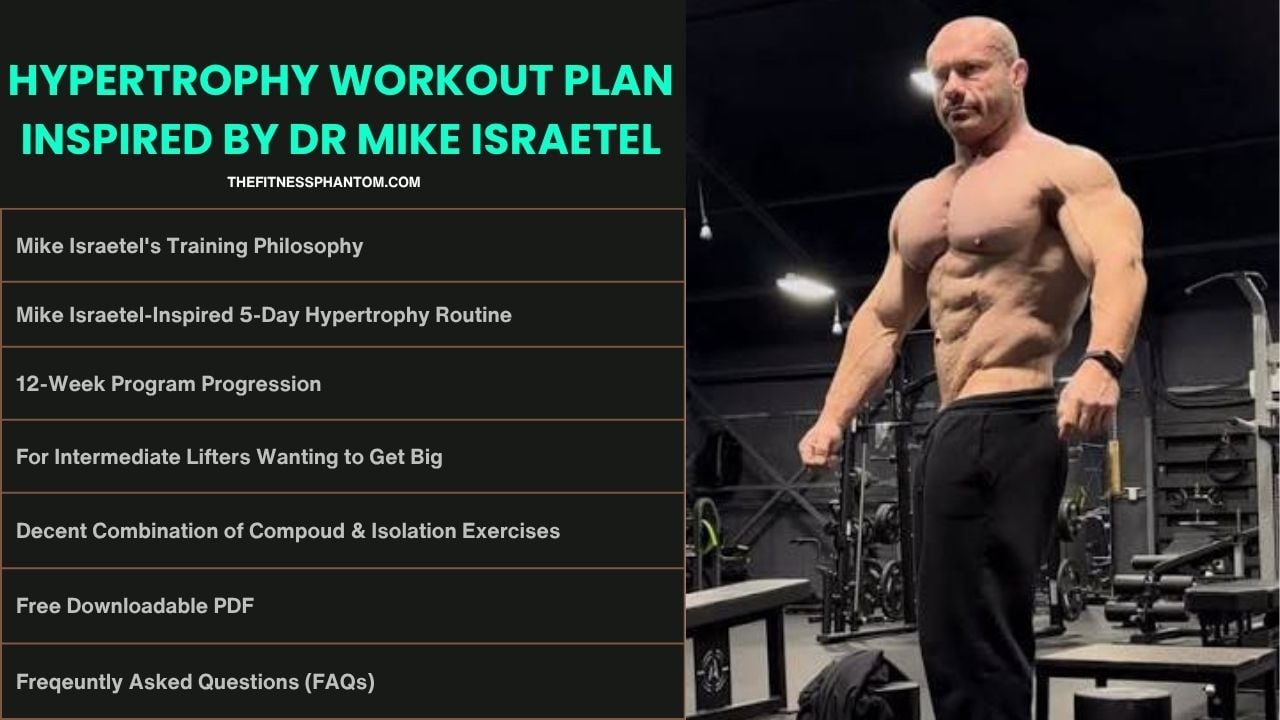
Dr. Mike Israetel is an exercise scientist (Ph.D. in Sport Physiology), fitness coach, and bodybuilder.
He is one of the most recognizable names in evidence-based bodybuilding and hypertrophy training.
Dr. Mike is well known for sharing educational fitness content on YouTube (Renaissance Periodization Channel).
In this article, I’ll share a detailed workout routine inspired by his training methods.
It will be a 5-day split program with one optional day (6th day) for weaker muscle groups.
Dr. Mike Israetel’s training philosophy focuses on understanding how training volume, effort, exercise selection, progression, and recovery interact to build muscle.
He doesn’t believe in training as much as possible. Instead, he advocates for productive training that you can recover from, progress with, and sustain over time.
This is where concepts such as MEV (Minimum Effective Volume), MAV (Maximum Adaptive Volume), MRV (Maximum Recoverable Volume), RIR (Reps in Reserve), progressive overload, and mesocycles become useful.
In this guide, you’ll learn:
- What Mike Israetel’s hypertrophy training philosophy is
- Whether this is Dr. Israetel’s actual workout routine
- How MEV, MAV, and MRV work
- How many sets to perform for each muscle group
- How close to failure you should train
- How to select exercises for hypertrophy
- A complete 5-day workout routine with an optional sixth day
- How to progressively increase training stress
- How to know when to add or reduce volume
- How to structure a 12-week training block
- When and how to deload
- Common mistakes to avoid
- How to track your workouts
What Makes a Mike Israetel-Inspired Program Different?
This Dr. Mike Israetel-inspired bodybuilding workout plan is not only about listing exercises, sets, and reps.
It’s also about guiding you on when and how to increase training volume, how to use RIR to regulate training effort, how to implement progressive overload to gain strength, and how to train effectively without feeling burned out.
This program tells you to start with manageable volume, train hard enough to stimulate adaptation, track performance and recovery, add volume only when useful, reduce training stress when fatigue becomes excessive, and repeat.
That is why you should treat this workout routine as an autoregulated framework, rather than a fixed prescription that every lifter must follow exactly.
Mike Israetel Workout Plan Summary
| Primary goal | Muscle growth (Hypertrophy) |
| Secondary goal | Increase strength |
| Experience | Intermediate lifters |
| Sessions per week | 5 days + optional 6th session |
| Training style | Hypertrophy-focused resistance training |
| Rep ranges | Approximately 6-20 depending on exercise |
| Rest periods | 1-4 minutes depending on exercise |
| Starting volume | Moderate and adjustable |
| Program length | 12 weeks |
| Progression | Reps, load, intensity, and volume |
| Deload | Based on fatigue and performance |
| Available |
Is This Mike Israetel’s Actual Workout Routine?
No, this is a Mike Israetel-inspired hypertrophy program.
I’ve selected exercises based on his recommendation and what he publicly discussed.
You can also adjust training volume and swap exercises as per your convenience.
The main thing is to follow Dr. Mike’s training philosophies.
Mike Israetel’s Training Philosophy
1. Training Volume
Training volume is one of the most important variables in hypertrophy training.
But more volume does not automatically mean more muscle growth, especially for experienced lifters.1 Hammert, William & Moreno, Enrique & Buckner, Samuel. (2023). The Importance of Previous Resistance Training Volume on Muscle Growth in Trained Individuals. Strength & Conditioning Journal. 46. 251-255. 10.1519/SSC.0000000000000798.
A lifter performing five productive sets and progressing may be getting more benefit from those sets than another lifter performing 25 sets while constantly fatigued.
The goal is therefore not to maximize the number of sets.
The goal is to maximize productive training.
2. Training Close to Failure Using RIR Approach
Hypertrophy training generally requires sufficiently challenging sets.
That doesn’t mean every set has to end in absolute muscular failure.
Instead, you should use RIR (Reps in Reserve) to regulate intensity for compound strength and hypertrophy training.2 Helms, E. R., Cronin, J., Storey, A., & Zourdos, M. C. (2016). Application of the Repetitions in Reserve-Based Rating of Perceived Exertion Scale for Resistance Training. Strength and Conditioning Journal, 38(4), 42–49. https://doi.org/10.1519/SSC.0000000000000218
RIR Meaning
| RIR | Meaning |
|---|---|
| 4 RIR | You could probably perform 4 more reps |
| 3 RIR | Moderate effort |
| 2 RIR | Hard set |
| 1 RIR | Very hard set |
| 0 RIR | Muscular failure (No further repetitions could be performed) |
A practical hypertrophy program can use different RIR targets throughout a training block.
You might begin a training cycle with more repetitions in reserve and gradually increase effort as the block progresses.
This allows you to train hard without turning every workout into a maximal-effort session.
3. Progressive Overload
Building muscle requires a reason for your body to adapt.
That doesn’t necessarily mean adding weight every workout.
Progress can come from:3 Chaves TS, Scarpelli MC, Bergamasco JGA, Silva DGD, Medalha Junior RA, Dias NF, Bittencourt D, Carello Filho PC, Angleri V, Nóbrega SR, Roberts MD, Ugrinowitsch C, Libardi CA. Effects of Resistance Training Overload Progression Protocols on Strength and Muscle Mass. Int J Sports Med. 2024 Jun;45(7):504-510. doi: 10.1055/a-2256-5857. Epub 2024 Jan 29. PMID: 38286426, 4Horn, Jay. (2025). Progressive Load: The Forgotten Principle Behind Muscle Hypertrophy for Natural Bodybuilders. Journal of Exercise Physiology Online. 28. 14–31.
- More repetitions with the same weight
- More weight for the same repetitions
- Increasing the number of working sets
- Doing more challenging exercises
For example, suppose you perform 30kg dumbbell bench presses for 8 repetitions, then you progress gradually by increasing the number of reps to 9, 10, 11 and 12.
Once you can perform 10-12 good reps with full range of motion, then you’ll be able to increase the weight and begin with a 6-8 rep range.
4. Fatigue Management
One of the most important ideas in this style of programming is that training stimulus and fatigue are not the same thing.5 Folland, J. P., Irish, C. S., Roberts, J. C., Tarr, J. E., & Jones, D. A. (2002). Fatigue is not a necessary stimulus for strength gains during resistance training. British journal of sports medicine, 36(5), 370–374. https://doi.org/10.1136/bjsm.36.5.370
A workout can be extremely exhausting without necessarily producing a proportionally greater muscle-building stimulus.
Every exercise has a cost.
Two exercises may train a similar muscle but create different amounts of systemic fatigue or joint stress.
So, exercise selection should consider the relationship between: Stimulus → Fatigue → Recoverability → Progression
The best exercise isn’t necessarily the most impressive-looking exercise.
It is often the exercise that allows you to train the target muscle hard, safely, consistently, and progressively.
5. Exercise Selection
A good hypertrophy exercise should ideally:
- Train the target muscle effectively
- Allow consistent technique
- Provide a useful range of motion
- Be reasonably stable
- Allow progressive overload
- Be comfortable for your joints
- Produce manageable fatigue
- Fit well with the rest of your program
You don’t need dozens of exercises.
A small number of well-chosen movements can provide plenty of stimulus.
For example, a chest program could combine:
- An incline or horizontal press
- Another stable pressing movement
- A fly or other isolation movement
You can use the following exercises throughout the 12 weeks, depending on your likes.
| Muscle | Primary Options | Secondary Options | Isolation |
|---|---|---|---|
| Chest | Bench Press, Incline Press | Machine Press, Smith Press | Cable Fly, Pec Deck |
| Back | Pulldown, Pull-Up, Row | T-Bar Row, Machine Row | Straight-Arm Pulldown |
| Quads | Squat, Hack Squat | Leg Press, Belt Squat | Leg Extension |
| Hamstrings | RDL, SLDL | Good Morning | Leg Curl |
| Delts | Shoulder Press | Machine Press | Lateral/Rear-Delt Raise |
| Biceps | EZ Curl, DB Curl | Preacher Curl | Cable Curl |
| Triceps | Pressdown, Skull Crusher | Machine Extension | Overhead Extension |
6. Individualize Training Volume
There is no single number of weekly sets that will maximize muscle growth for every person.
Your productive volume can depend on:
- Training experience
- Muscle group
- Exercise selection
- Exercise technique
- Training intensity
- Nutrition
- Sleep
- Stress
- Recovery capacity
- Genetics
- Current fitness level
A beginner may progress with relatively little training.
An advanced lifter may require more work.
Even within the same person, one muscle may tolerate substantially more volume than another.
For example, you may recover easily from moderate chest volume but struggle to recover from high-volume leg training.
So, make your own training log instead of following somebody else’s set count.
7. Think in Training Blocks
Instead of repeating the same workout indefinitely, organize training into mesocycles.6 Minor, Brian & Helms, Eric & Schepis, Jacob. (2020). RE: Mesocycle Progression in Hypertrophy: Volume Versus Intensity. Strength & Conditioning Journal. 42. 121-124. 10.1519/SSC.0000000000000581
A mesocycle is a planned period of training in which you manipulate training stress and monitor your response.
A simple hypertrophy block might look like:
| Week | Approx. Effort | Main Goal |
|---|---|---|
| 1 | 3 RIR | Establish baseline |
| 2 | 2-3 RIR | Build performance |
| 3 | 2 RIR | Continue progression |
| 4 | 1-2 RIR | Increase effort |
| 5 | 1 RIR | Push progression |
| 6 | 1 RIR | Hard training |
| 7 | 3-4+ RIR / reduced work | Deload |
| 8-12 | Repeat with adjusted starting point | New progression block |
This is only a framework. Start around 3 RIR and gradually increase effort as performance and recovery allow. Don’t force the RIR progression if performance, technique, or recovery deteriorates.
8. MEV, MAV and MRV
Three of the most recognizable concepts associated with Dr. Israetel’s approach are:
- MEV: Minimum Effective Volume
- MAV: Maximum Adaptive Volume
- MRV: Maximum Recoverable Volume
They are best understood as decision-making concepts, not magical numbers.
What Is MEV?
MEV stands for Minimum Effective Volume.
It represents the approximate amount of training required to produce measurable progress in a muscle within the context of your overall training.
Imagine that six challenging chest sets per week are producing consistent progress.
There may be no reason to immediately jump to 15 or 20 sets.
If six sets are working, six sets may be enough for you at that stage.
Your MEV can change over time.
What Is MAV?
MAV stands for Maximum Adaptive Volume.
MAV is better thought of as a productive range rather than one exact number.
It represents a range in which training volume is high enough to provide a strong stimulus while remaining sufficiently recoverable to support continued adaptation.
This is why two people may respond differently to the same amount of training.
What Is MRV?
MRV stands for Maximum Recoverable Volume.
It represents the upper end of training volume that you can recover from while still maintaining productive training and performance.
Going beyond this point doesn’t necessarily mean faster muscle growth.
It can instead result in:
- Persistent fatigue
- Declining strength
- Poor workout performance
- Reduced motivation
- Poor recovery
- Increased soreness
- Declining training quality
One important point:
Soreness alone does not prove that you have exceeded your MRV.
Performance, recovery, motivation, sleep, and overall training quality should be considered together.
How to Use These Methods in Your Training
Rather than starting with an extremely high number of sets, begin with a manageable amount of productive training.
Track:
- Sets
- Repetitions
- Weight
- RIR
- Exercise performance
- Recovery
If you’re progressing and recovering well, keep your volume where it is.
If progress stalls and recovery is good, consider adding a small amount of volume.
If performance and recovery deteriorate, adding more sets may be counterproductive. In that situation, reducing training stress or taking a deload may be more appropriate.
This makes MEV, MAV, and MRV useful as decision-making concepts, rather than rigid numbers that everyone must follow.
Mike Israetel-Inspired 5-Day Hypertrophy Workout
Here’s a simple yet effective 5-day split for hypertrophy.
- Monday: Chest & Triceps (Push-focused exercises)
- Tuesday: Back & Biceps (Pull-focused exercises)
- Wednesday: Rest (Active recovery day)
- Thursday: Quads & Hamstrings (Leg exercises)
- Friday: Shoulder & Arms
- Saturday: Optional Lower Body or Weak Muscle Groups
- Sunday: Rest
If you’re recovering well and have a muscle that needs additional work, then train on Saturday. If you’re already fatigued, skip it.
How to Warm Up
A warm-up should prepare you for training without creating unnecessary fatigue.
You can begin with approximately 5-10 minutes of light activity such as walking on the treadmill, cycling, or doing bodyweight cardio exercises.
You can also perform dynamic stretching exercises to reduce muscle stiffness and prepare your muscles for lifting.
Specific Warm-Up Sets
Before your first heavy exercise, perform lighter sets to practice the movement and gradually prepare for the working weight.
For example, if your working weight is 80 kg, perform two warm-up sets: one with 40 kg and the other with 60 kg, then start your working sets.
As you approach your working weight, you generally don’t need many repetitions.
Remember the goal is to wake your muscles up, not to exhaust them with higher rep warm-up sets.
Day 1: Chest + Triceps
Why this combination works: It starts with heavy press, follows with a stable pressing movement, and finishes chest work with an isolation exercise. After the chest, you’ll train your triceps without additional heavy compound pressing.
| Exercise | Sets | Reps | RIR | Rest |
|---|---|---|---|---|
| Incline Dumbbell Press | 3 | 6-10 | 2-3 | 2-3 min |
| Machine Chest Press | 3 | 8-12 | 2 | 2-3 min |
| Cable Fly | 2 | 10-15 | 1-2 | 1-2 min |
| Cable Triceps Extension | 3 | 10-15 | 2 | 1-2 min |
| Overhead Triceps Extension | 2 | 10-15 | 1-2 | 1-2 min |
Use controlled repetitions and prioritize consistent technique.
Day 2: Back + Biceps
Why this combination works: The session combines vertical pulling, supported horizontal rowing, and additional cable work before direct biceps training. The chest-supported row also limits unnecessary lower-back fatigue.
| Exercise | Sets | Reps | RIR | Rest |
|---|---|---|---|---|
| Lat Pulldown | 3 | 8-12 | 2 | 2-3 min |
| Chest-Supported Row | 3 | 8-12 | 2 | 2-3 min |
| Seated Cable Row | 2 | 10-15 | 1-2 | 1.5-2 min |
| Rear-Delt Fly | 3 | 12-20 | 1-2 | 1-2 min |
| Incline Dumbbell Curl | 3 | 8-12 | 2 | 1.5-2 min |
| Hammer Curl | 2 | 10-15 | 1-2 | 1-2 min |
Day 3: Rest
Use this day for:
- Complete rest
- Walking
- Light mobility
- Normal daily activity
You don’t need to perform additional exercise simply because it is a rest day.
Day 4: Quads + Hamstrings
Why this combination works: A squat pattern and leg press provide substantial quad work, while the RDL and leg curl train the hamstrings through complementary movement patterns. Because these exercises can be highly fatiguing, the program deliberately avoids prescribing failure on every set.
| Exercise | Sets | Reps | RIR | Rest |
|---|---|---|---|---|
| Hack Squat | 3 | 6-10 | 2-3 | 2-4 min |
| Leg Press | 3 | 10-15 | 2 | 2-3 min |
| Romanian Deadlift | 3 | 6-10 | 2-3 | 2-4 min |
| Leg Extension | 2 | 10-15 | 1-2 | 1-2 min |
| Leg Curl | 3 | 10-15 | 1-2 | 1-2 min |
| Calf Raise | 3 | 8-15 | 1-2 | 1-2 min |
Because lower-body compound movements can create substantial fatigue, avoid turning every set into an all-out effort.
Day 5: Shoulders + Arms
Why this combination works: Pressing provides anterior-delt work, lateral raises emphasize the side delts, and rear-delt work adds direct posterior-delt volume. Direct biceps and triceps work then allows additional arm stimulus without relying only on compound lifts.
| Exercise | Sets | Reps | RIR | Rest |
|---|---|---|---|---|
| Machine Shoulder Press | 3 | 6-10 | 2 | 2-3 min |
| Cable Lateral Raise | 3 | 10-20 | 1-2 | 1-2 min |
| Rear-Delt Fly | 2 | 12-20 | 1-2 | 1-2 min |
| EZ-Bar Curl | 3 | 8-12 | 2 | 1.5–2 min |
| Cable Curl | 2 | 10-15 | 1-2 | 1-2 min |
| Triceps Pressdown | 3 | 10-15 | 1-2 | 1-2 min |
| Overhead Cable Extension | 2 | 10-15 | 1-2 | 1-2 min |
Day 6: Optional Lower Body / Weak Point
Use this day to strengthen your lagging muscle groups. For example, I usually train my core (because I don’t get enough time other days) on Saturday, and sometimes I train traps and lower back.
The goal is to achieve a proportional physique by training all muscle groups effectively.
So, you can also pick the muscles you want to focus on more. If you need help regarding this session, let me know in the comments or contact me through any social media channel.
How to Progress the 12-Week Program
A simple way to use this program is to divide it into two training blocks.
Weeks 1–6: Accumulation
Week 1
Start conservatively.
Aim for approximately 3 RIR on most working sets.
Your goal is to establish:
- Working weights
- Rep performance
- Exercise technique
- Recovery baseline
Week 2
Aim for approximately 2-3 RIR.
Try to add repetitions while maintaining good technique.
Week 3
Work around 2 RIR.
Continue progressing reps or load.
Week 4
Move toward approximately 1-2 RIR on most working sets.
Week 5
Continue progressing. Most working sets can approach 1 RIR, particularly on stable exercises.
Week 6
Train hard if recovery and performance remain good.
You don’t need to take every set to failure.
Week 7: Deload
A deload reduces training stress so accumulated fatigue can dissipate.
You can accomplish this by:
- Reducing the number of sets
- Keeping more repetitions in reserve
- Using lighter loads
- Or combining these strategies
The exact approach doesn’t need to be identical for everyone.
The purpose is simple: Recover so you can train productively again.
Weeks 8–12: New Training Block
After the deload, begin another progression block.
Don’t automatically return to the same workload.
Instead, use what you learned during Weeks 1–6.
For example:
If chest progressed easily with eight sets:
Start again around eight sets.
If chest stalled at eight sets but recovered well after increasing to ten:
Start the next block around ten sets.
If ten sets caused excessive fatigue:
Start lower.
Your previous training block becomes information that helps you design the next one.
Common Mistakes When Following Mike Israetel’s Approach
- Treating MEV, MAV, and MRV as fixed numbers: These are guidelines, not rules. Your ideal training volume depends on your body, experience, recovery, and progress.
- Adding volume too quickly: More sets also mean more fatigue. Start with manageable volume and add work gradually when you actually need it.
- Taking every set to failure: Training hard doesn’t mean every set must be a failure set. Use RIR to control how hard you train and save failure for situations where it makes sense.
- Confusing soreness with progress: Being sore doesn’t necessarily mean a muscle is growing. Instead, look at strength, reps, technique, recovery, and long-term muscle growth.
- Changing exercises constantly: If you change exercises every week, it’s difficult to tell whether you’re actually getting stronger or making progress.
- Copying another person’s volume: Another person’s ideal volume may not work for you. Your own training log, performance, and recovery should guide your volume decisions.
- Ignoring indirect volume: Many exercises train more than one muscle. For example, presses also train the triceps and front delts, while rows and pulldowns also train the biceps. So, don’t look only at isolation exercises; count the total workload across your entire program.
Frequently Asked Questions (FAQs)
1. Is this Dr. Mike Israetel’s actual workout routine?
No. I’ve also said earlier that this is a Mike Israetel-inspired hypertrophy program based on training principles he has publicly discussed. If you want his personal hypertrophy routine, you have to contact him.
2. What’s the goal of Mike Israetel’s workout plan?
This workout is designed to promote hypertrophy (muscle growth).
It includes medium-to-high training volume, challenging sets performed relatively close to failure, progressive overload, etc., to help you achieve bigger muscles in an organized and efficient way.
You can also use it to gain strength, but building strength on specific lifts is not the primary objective.
3. Is this program good for beginners?
This program is best suited to intermediate lifters.
If you are a beginner, you can try the following programs, which will help you learn technique and build consistency:
At the start, learn the right technique of each exercise and perform basic compound and isolation movements.
The more training experience you have, the safer and more effectively you can use the principles mentioned in this blog.
4. How to adjust your training volume?
This table will help you when you should adjust your training volume:
| Your situation | What to do |
|---|---|
| Performance improving + recovery good | Keep volume the same |
| Performance stalled + recovery good | Add 1–2 weekly sets for the target muscle |
| Performance declining + fatigue increasing | Reduce training stress |
| One muscle progressing, another stalling | Adjust volume by muscle |
| Recovery consistently poor | Don’t add volume; investigate recovery/deload |
5. How long should I follow this workout program?
You can follow this weekly workout for multiple weeks rather than changing exercises every workout.
The main thing is to use it as a training block, track your performance, and adjust volume or load based on how your body responds.
You don’t need to change the entire program simply because you’ve been following it for several weeks.
6. When should I take a deload?
You can deload after several weeks of hard training, especially when you feel burned out, or your performance begins to decline.
Some lifters may benefit from a planned deload every 6-8 weeks, while others may be able to train productively for longer before needing one.7 Bell, L., Strafford, B. W., Coleman, M., Androulakis Korakakis, P., & Nolan, D. (2023). Integrating Deloading into Strength and Physique Sports Training Programmes: An International Delphi Consensus Approach. Sports medicine – open, 9(1), 87. https://doi.org/10.1186/s40798-023-00633-0
During the deload week, reduce your training volume by cutting sets or reps by 30% to 50% and keep weights a few repetitions shy of failure.
7. Can I substitute exercises in this program?
Yes. It entirely depends on you. The main thing is to follow the strategies, not the exact routine.
For example, you can replace:
- Barbell Bench Press with Dumbbell Press, Smith Machine Press, or Machine Chest Press.
- Barbell Squat with Hack Squat, Leg Press, or Smith Machine Squat.
- Barbell Row with Chest-Supported Row, T-Bar Row, or Machine Row.
- Romanian Deadlift with Dumbbell RDL or Smith Machine RDL.
Choose a substitute that trains the same general muscle groups and allows you to perform and progress the movement effectively.
8. Can I use this program for fat loss?
Yes, you can use it to strengthen muscles and gain muscle mass, but you need to focus on your diet.
Your nutrition and calorie intake will determine whether you actually lose body fat.
You may also need to adjust training volume according to your needs.
9. Can women follow this training plan?
Yes. This program is not restricted to any gender.
Resistance training works for all.
If you want to gain muscle, Dr. Mike Israetel’s principles mentioned in this blog will help you, irrespective of your gender.
But I suggest female lifters change some exercises to better target the muscles you want to grow.
For example, if you want to focus more on your glutes, include hip thrusts, back extension, and glute kickback.
You can also try the following programs, which I’ve designed primarily for women:
- Best 4-Day Split Workout Routine for Women
- 16-Week Push Pull Legs Split for Women
- 4-Week Pamela Reif Workout Plan
10. Can I follow this workout at home?
This training plan will produce better results when you perform gym-based resistance training.
But if that’s not possible, you can use it at home with appropriate exercise substitutions.
For example, you can use dumbbells and resistance bands instead of barbells and machine exercises to train your muscles.
The exact equipment isn’t as important as maintaining an effective training stimulus and a progression strategy.
11. How should I progress on this program?
Follow the mentioned rep range and RIR target.
For example, if an exercise says: 3 sets of 8-12 reps @ 2 RIR. Start with a weight that allows you to perform approximately eight repetitions while leaving around two good repetitions in reserve.
Over subsequent workouts, try to gradually increase your repetitions.
Once you’re consistently near the top of the range with the appropriate RIR and good technique, increase the load and build your repetitions again.
This creates a simple form of double progression.
12. Can I add cardio to this program?
Yes. Performing low-intensity cardio alongside resistance training will build endurance and cardiovascular health.
Keep cardio at a level that doesn’t significantly reduce your resistance-training performance or recovery.
13. How should I track the program?
For every working set, record:
| Date | Exercise | Weight | Reps | RIR | Notes |
|---|---|---|---|---|---|
Also track weekly:
- Body weight
- Key lifts
- Repetitions
- Total sets
- Recovery
- Sleep
- Motivation
- Muscle measurements, if desired
The goal isn’t to collect data for its own sake.
The goal is to answer three questions:
- Am I progressing?
- Am I recovering?
- Should I change anything?
If the answers are: Yes + Yes + No. Keep training.
The Bottom Line
The biggest lesson from Mike Israetel’s approach isn’t a particular exercise, split, or number of weekly sets.
It’s the idea that effective hypertrophy training requires balancing stimulus, volume, effort, fatigue, recovery, and progression.
You don’t need to perform the maximum amount of training you can tolerate.
You need enough productive training to stimulate growth, enough recovery to adapt, and enough progression to keep improving.
I’ve designed several workout plans. And Dr. Mike Israetel’s approach provides one of the more practical frameworks for organizing hypertrophy training around volume, effort, fatigue, recovery, and progression.
So, if you like the program and you want to follow it, download the PDF.
Editorial & Evidence Note: The research cited in this article supports general resistance-training concepts, such as training close to failure, progressive overload, fatigue management, and deloading. They do not mean that this routine is Dr. Mike Israetel’s personal program. I designed this program based on training principles he has discussed publicly.
References
- 1Hammert, William & Moreno, Enrique & Buckner, Samuel. (2023). The Importance of Previous Resistance Training Volume on Muscle Growth in Trained Individuals. Strength & Conditioning Journal. 46. 251-255. 10.1519/SSC.0000000000000798. ↩︎
- 2Helms, E. R., Cronin, J., Storey, A., & Zourdos, M. C. (2016). Application of the Repetitions in Reserve-Based Rating of Perceived Exertion Scale for Resistance Training. Strength and Conditioning Journal, 38(4), 42–49. https://doi.org/10.1519/SSC.0000000000000218 ↩︎
- 3Chaves TS, Scarpelli MC, Bergamasco JGA, Silva DGD, Medalha Junior RA, Dias NF, Bittencourt D, Carello Filho PC, Angleri V, Nóbrega SR, Roberts MD, Ugrinowitsch C, Libardi CA. Effects of Resistance Training Overload Progression Protocols on Strength and Muscle Mass. Int J Sports Med. 2024 Jun;45(7):504-510. doi: 10.1055/a-2256-5857. Epub 2024 Jan 29. PMID: 38286426 ↩︎
- 4Horn, Jay. (2025). Progressive Load: The Forgotten Principle Behind Muscle Hypertrophy for Natural Bodybuilders. Journal of Exercise Physiology Online. 28. 14–31. ↩︎
- 5Folland, J. P., Irish, C. S., Roberts, J. C., Tarr, J. E., & Jones, D. A. (2002). Fatigue is not a necessary stimulus for strength gains during resistance training. British journal of sports medicine, 36(5), 370–374. https://doi.org/10.1136/bjsm.36.5.370 ↩︎
- 6Minor, Brian & Helms, Eric & Schepis, Jacob. (2020). RE: Mesocycle Progression in Hypertrophy: Volume Versus Intensity. Strength & Conditioning Journal. 42. 121-124. 10.1519/SSC.0000000000000581 ↩︎
- 7Bell, L., Strafford, B. W., Coleman, M., Androulakis Korakakis, P., & Nolan, D. (2023). Integrating Deloading into Strength and Physique Sports Training Programmes: An International Delphi Consensus Approach. Sports medicine – open, 9(1), 87. https://doi.org/10.1186/s40798-023-00633-0 ↩︎